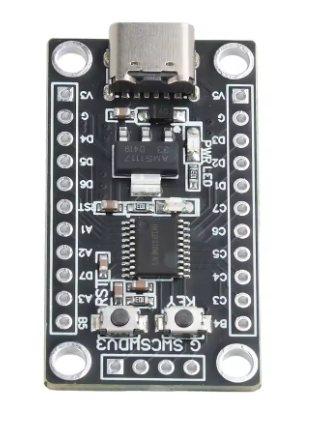
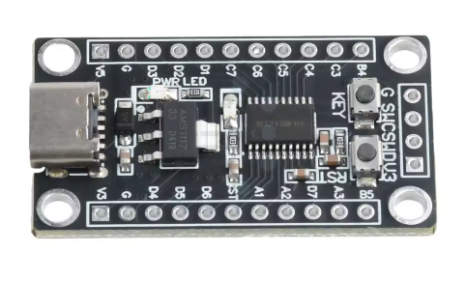
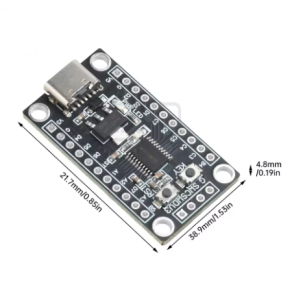
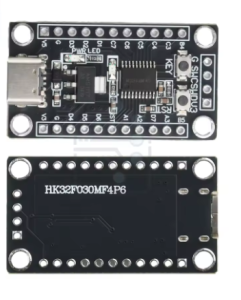
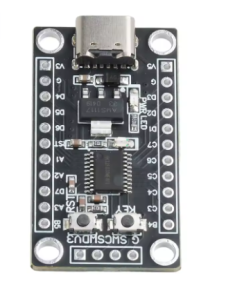
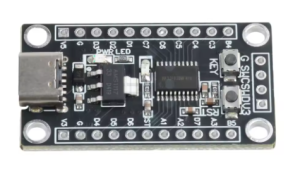
HK32F030MF4P6 Minimal System Core Board 32MHz – STM8S003 Replacement | Development & Evaluation Board for Learning

SKU: FA1071
Microcontroller

HK32F030MF4P6 (ARM Cortex-M0)

Maximum Clock Speed

32 MHz

Flash Memory

16 KB

SRAM / EEPROM

2 KB SRAM / 448 B EEPROM

GPIO Count

16 pins (all except power/ground)

Operating Voltage

1.8V – 3.6V

Communication Interfaces

1× USART, 1× SPI/I2S, 1× I2C

Package / Debug

TSSOP-20 / SWD (SWDIO, SWCLK)

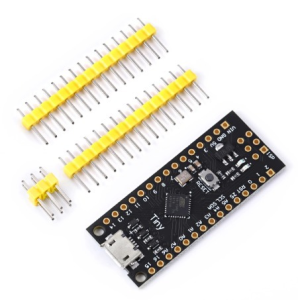
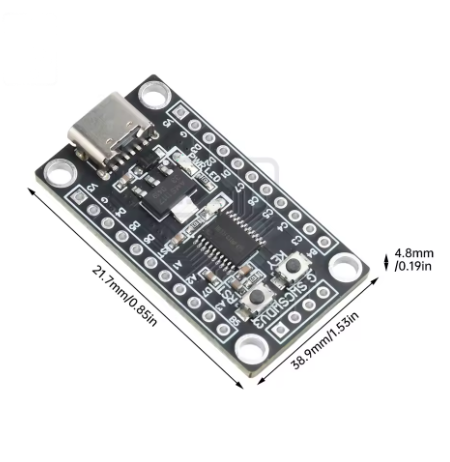
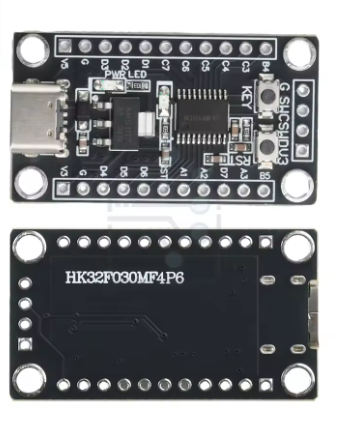
The HK32F030MF4P6 Minimal System Core Board is a compact, low-cost development and evaluation platform built around the HK32F030MF4P6 microcontroller from Hangshun Chip (HK). Designed as a direct hardware replacement for the STM8S003 and other 8-bit MCU platforms, this board brings 32-bit ARM Cortex-M0 processing power to projects where cost and simplicity are critical — without sacrificing development tool compatibility or performance.

At its core, the HK32F030MF4P6 is powered by an ARM Cortex-M0 core running at up to 32MHz, offering a significant performance leap over traditional 8-bit microcontrollers. It integrates 16KB Flash and 2KB SRAM for program storage and runtime data, along with 448 bytes of EEPROM for non-volatile parameter storage. Despite its compact TSSOP-20 package, the chip exposes 16 GPIO pins, all of which can serve as peripheral I/O or external interrupt inputs.

The board’s standout feature is its pin compatibility with the STM8S003. This means existing STM8S003 hardware designs, PCBs, and peripheral circuits can be reused directly — you simply swap the 8-bit MCU for this 32-bit upgrade. For developers maintaining legacy 8-bit projects, this provides a straightforward migration path to a modern ARM Cortex-M0 platform.

Communication and control peripherals are well-equipped for general-purpose embedded tasks. The chip includes one USART (up to 4 Mbit/s, supporting LIN and IrDA protocols), one SPI/I2S interface (up to 16 Mbit/s), and one I2C interface (up to 1 MHz). A 12-bit ADC with up to 1 MSPS sampling rate handles analog sensor inputs. For motor control and PWM applications, the chip provides one 16-bit advanced PWM timer with 4 output channels (3 with complementary output and dead-time insertion), plus one 16-bit general-purpose timer and one basic timer.

Power efficiency is another strength. The HK32F030MF4P6 operates from 1.8V to 3.6V and supports multiple low-power modes: Run, Sleep, DeepSleep, and Stop. In Stop mode, current consumption drops to approximately 30µA, with wake-up possible via external pin or internal timer. This makes the board suitable for battery-powered and energy-conscious applications.

Whether you are a student learning ARM embedded development, a maker building cost-sensitive control projects, or an engineer evaluating a replacement for STM8S003 designs, this core board provides a practical, affordable foundation. Its minimal system design keeps the focus on the MCU itself, while the exposed GPIO headers and SWD debug interface make development and testing straightforward.


Features

  • ARM Cortex-M0 @ 32MHz — 32-bit processing performance in a low-cost package, compatible with standard ARM development tools.

  • STM8S003 pin-compatible — Direct hardware replacement for STM8S003 designs, enabling reuse of existing PCBs and peripheral circuits.

  • 16KB Flash + 2KB SRAM + 448B EEPROM — Balanced memory configuration for control logic, protocol stacks, and parameter storage.

  • 16 GPIO pins — All pins (except power/ground) can function as GPIO, peripheral I/O, or external interrupt inputs.

  • Multiple communication interfaces — USART (up to 4 Mbit/s), SPI/I2S (up to 16 Mbit/s), and I2C (up to 1 MHz) for connecting sensors, displays, and modules.

  • 12-bit ADC — Up to 1 MSPS sampling rate for analog sensor and signal measurement applications.

  • Advanced PWM timer — 16-bit timer with 4 PWM outputs, 3 supporting complementary output with dead-time insertion for motor control.

  • Low-power modes — Run, Sleep, DeepSleep, and Stop modes with wake-up support; Stop mode current as low as ~30µA.


Technical Specifications 

# Parameter Specification
1 Microcontroller HK32F030MF4P6 (ARM Cortex-M0)
2 Maximum Clock Speed 32 MHz
3 Flash Memory 16 KB
4 SRAM / EEPROM 2 KB SRAM / 448 B EEPROM
5 GPIO Count 16 pins (all except power/ground)
6 Operating Voltage 1.8V – 3.6V
7 Communication Interfaces 1× USART, 1× SPI/I2S, 1× I2C
8 Package / Debug TSSOP-20 / SWD (SWDIO, SWCLK)

Usage

Getting Started

  1. Power the board — Supply 3.3V via the header pins or the on-board regulator (if provided). The MCU operates from 1.8V to 3.6V.

  2. Connect a debugger — Use a J-Link, DAP-Link, or ST-Link programmer connected to the SWDIO and SWCLK pins for programming and debugging.

  3. Set up the development environment — Install Keil MDK, IAR Embedded Workbench, or a GCC ARM toolchain. Device support packs for the HK32F030M series are available.

  4. Write and compile your code — Use the provided peripheral library (similar in structure to STM32F0 standard peripheral library) or CMSIS headers to access peripherals.

  5. Flash the firmware — Program the device via SWD using your preferred toolchain or a standalone programmer.

  6. Test and iterate — Use the exposed GPIO headers to connect sensors, LEDs, and other peripherals for your application.

Typical Applications

  • Learning ARM embedded development — A low-cost entry point to Cortex-M0 programming and the ARM ecosystem.

  • STM8S003 replacement — Direct pin-compatible upgrade for legacy 8-bit designs seeking higher performance.

  • Simple control systems — Timers, PWM, and ADC make it suitable for fan control, LED drivers, and basic motor control.

  • Sensor nodes and data acquisition — USART, I2C, and SPI enable connection to a wide range of sensor modules.

  • Battery-powered devices — Low-power modes support portable and energy-conscious designs.

  • Evaluation and prototyping — Assess the HK32F030M series for suitability in a target application before committing to a custom PCB.

  • Educational kits and training — Cost-effective platform for classroom and workshop use.

  • OEM and product development — Compact form factor and low BOM cost support integration into commercial products.

Notes for Business Buyers

  • Cost-efficient migration path — Provides 32-bit ARM performance at a price point competitive with 8-bit MCUs.

  • Pin compatibility simplifies redesign — Reuse existing STM8S003 hardware and peripheral circuits, reducing engineering effort for product refreshes.

  • Standard ARM toolchain support — Keil, IAR, and GCC ARM toolchains are all supported, with device packs and peripheral libraries available.

  • Suitable for bulk deployment — Low per-unit cost and compact package make it practical for volume production and educational purchasing.

Q: Is this board a direct replacement for STM8S003?

Yes, in terms of pinout. The HK32F030MF4P6 is pin-compatible with the STM8S003, meaning it can be dropped into existing STM8S003 hardware designs. However, it is a different architecture (ARM Cortex-M0 vs. STM8 core), so firmware must be recompiled for the new platform.

Q: What development tools are supported?

The chip supports Keil MDK, IAR Embedded Workbench, and GCC ARM toolchains (including Linux-based environments). Device support packs and peripheral libraries are available from the manufacturer and community resources.

Q: How do I program and debug the board?

Programming and debugging are done via the SWD interface (SWDIO and SWCLK pins). Compatible programmers include J-Link, DAP-Link, and ST-Link. J-Link version 7.70 and above includes built-in support for the HK32F030M series.

Q: Does the HK32F030MF4P6 work with the Arduino IDE?

Not natively. It is an ARM Cortex-M0 MCU that requires a standard embedded toolchain (Keil, IAR, or GCC). Some community projects have explored Arduino compatibility, but official support is not available.

Q: What is the difference between HK32F030MF4P6 and HK32F030F4P6?

The MF4P6 version is pin-compatible with the STM8S003, while the F4P6 version is pin-compatible with the STM32F030F4P6. They are different chips intended for different replacement scenarios.

Q: How much does the HK32F030MF4P6 chip cost?

The chip is known for its extremely low price point, typically under 1 RMB per unit in single quantities, with lower pricing for bulk orders. This makes it one of the most affordable Cortex-M0 options available.

Q: Does the chip support 5V-tolerant I/O?

Yes. According to some documentation, the GPIO pins on the HK32F030MF4P6 support 5V-tolerant input, allowing direct interface with 5V logic devices without level shifting. Verify this in the official datasheet for your specific application.

Q: What is the maximum ADC sampling rate?

The 12-bit ADC supports sampling rates up to 1 MSPS (1 million samples per second), though effective resolution may vary depending on configuration and operating conditions

Q: Does the chip have a DMA controller?

No. The HK32F030MF4P6 does not include a DMA controller. Data transfers between peripherals and memory must be handled by the CPU. For applications requiring high-speed data movement, this is a limitation to consider.

Q: Can I purchase in bulk for a school or company?

Yes. This core board and the HK32F030MF4P6 chip are suitable for both individual users and business purchasing, including classroom kits, evaluation labs, and volume production. The low unit cost makes it particularly attractive for educational and cost-sensitive applications.