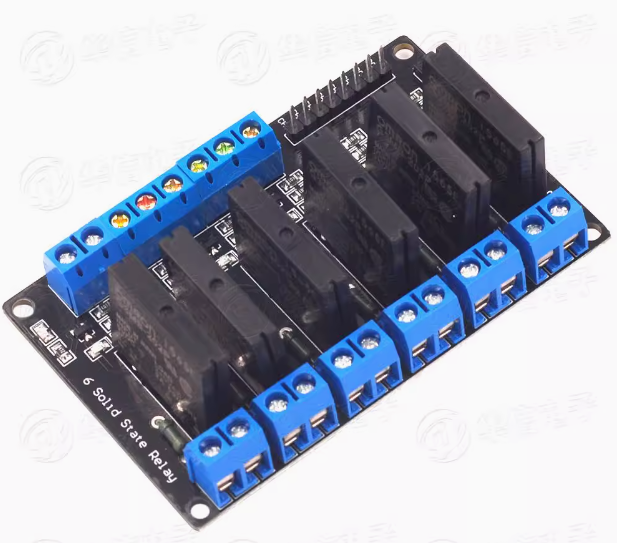
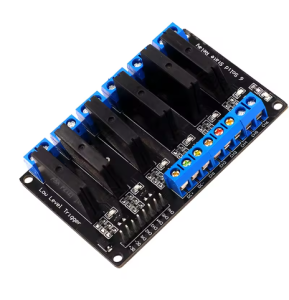
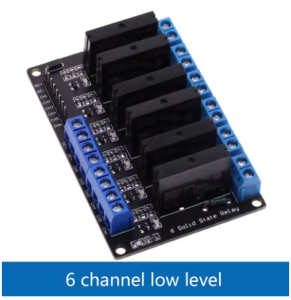
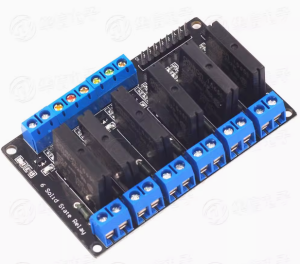
6-Channel Solid State Relay Module (DC to AC Control) – 5V/12V/24V Trigger, High/Low Level Selectable

SKU: FA2084-4
Number of Channels

6 Independent Channels

Control Voltage Range

5V / 12V / 24V DC (Jumper Selectable)

Trigger Mode

High-Level or Low-Level (Jumper Selectable per channel)

Load Voltage Rating

24 ~ 240V AC, 50/60Hz

Maximum Load Current

2A per channel

Isolation Voltage

2500V RMS (Input to Output)

Switching Type

Zero-Crossing, Solid State

On-state Resistance

< 30mΩ

Dimensions

Approx. 140mm x 90mm x 28mm (L x W x H)
Product Description

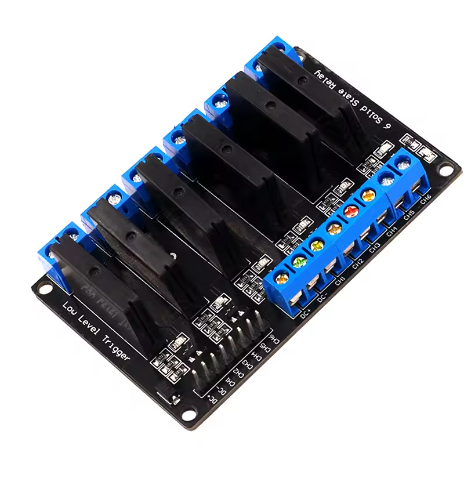
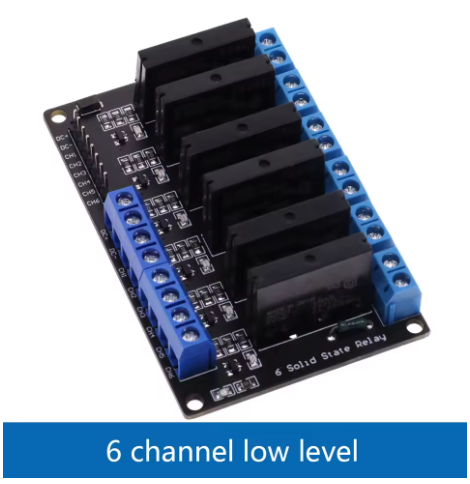
The 6-Channel Solid State Relay (SSR) Module is a professional-grade, high-density switching platform designed for sophisticated automation systems that require silent, reliable, and isolated control of multiple AC loads. This advanced module provides six completely independent, optically isolated channels, allowing you to control various AC-powered devices—such as lights, heaters, fans, and motors—from low-voltage DC signals with exceptional precision and zero audible noise. Engineered for maximum flexibility, it supports 5V, 12V, or 24V DC control logic and features jumper-selectable high/low-level triggering, ensuring seamless integration with any microcontroller, PLC, or industrial controller on the market.
Built with industry-grade components, each channel incorporates 2500V optical isolation and zero-crossing detection technology. This design completely separates your sensitive control electronics from the high-voltage AC side, while the zero-crossing function switches loads at the optimal point in the AC cycle to minimize electromagnetic interference (EMI) and inrush current, thereby dramatically extending the lifespan of both the SSR and connected equipment. The module’s compact, six-in-one design is ideal for central home automation hubs, commercial control panels, and industrial machinery where silent operation, high reliability, and multi-circuit management are paramount.

Key Features

  • High-Density 6-Channel Design:​ Maximize control capability in a compact footprint, allowing management of six independent AC circuits from a single, unified module.
  • Universal Control Voltage Compatibility:​ Jumper-selectable 5V, 12V, or 24V DC input makes it universally compatible with Arduino, Raspberry Pi (with adapter), PLCs, and 12V/24V industrial control systems.
  • Selectable Trigger Logic:​ Each channel can be individually configured for High-Level or Low-Level trigger operation via onboard jumpers, providing perfect compatibility with both sourcing and sinking control logic.
  • Advanced Optical Isolation:​ Each channel features 2500Vrms optocoupler isolation, providing complete electrical separation and protection for your low-voltage control circuitry from AC mains noise and transients.
  • Zero-Crossing Switching:​ Integrated zero-crossing circuitry ensures the AC load is switched precisely as the voltage crosses zero volts, eliminating electrical noise, reducing stress on components, and preventing contact arcing.
  • Silent, Maintenance-Free Operation:​ Solid-state design with no moving parts ensures absolutely silent switching, no contact wear, and a vastly longer operational lifespan compared to mechanical relays.
  • Clear Channel Status Indicators:​ Six bright LEDs provide immediate visual confirmation of the switching state for each channel, essential for system monitoring and diagnostics.
  • Robust & Secure Connections:​ High-current screw terminals for all AC load connections ensure safe, reliable, and vibration-resistant wiring, suitable for professional installations.

Main Parameters

  • Number of Channels:​ 6 Independent Channels
  • Control Voltage Range:​ 5V / 12V / 24V DC (Jumper Selectable)
  • Trigger Mode:​ High-Level or Low-Level (Jumper Selectable per channel)
  • Load Voltage Rating:​ 24 ~ 240V AC, 50/60Hz
  • Maximum Load Current:​ 2A per channel
  • Isolation Voltage:​ 2500V RMS (Input to Output)
  • Switching Type:​ Zero-Crossing, Solid State
  • On-state Resistance:​ < 30mΩ
  • Dimensions:​ Approx. 140mm x 90mm x 28mm (L x W x H)
Typical Applications / Usage

  1. Advanced Smart Home Controllers:​ Act as the central silent switching hub for a whole-home automation system, controlling multiple lighting zones, appliances, and HVAC equipment via a single microcontroller or home server.
  2. Industrial Multi-Process Control:​ Interface with a PLC to independently control multiple solenoids, contactor coils, small motors, or heaters in automated machinery, packaging lines, or process control systems.
  3. Commercial Lighting & Display Control:​ Manage complex lighting setups in retail displays, museums, or stage environments where silent operation and precise timing are critical.
  4. Laboratory & Test Equipment Automation:​ Build custom test racks or environmental chambers where multiple AC devices (heaters, lamps, stirrers) need to be controlled silently and reliably from a data acquisition system.
  5. Agricultural & Environmental Control:​ Automate multi-zone systems in greenhouses or grow rooms, controlling lights, ventilation fans, and irrigation pumps on separate schedules.
  6. Telecom/Server Rack Management:​ Control cooling fans, peripheral devices, or backup systems within equipment racks where EMI must be minimized and reliability is key.
Implementation Guide:
  1. Configuration:​ Set the master VCC Jumper​ to match your system’s DC voltage (5V, 12V, or 24V). Configure each channel’s trigger jumper to “H” (activates on HIGH signal) or “L” (activates on LOW signal) to match your controller’s output logic.
  2. Control & Power Wiring:​ Connect the module’s VCC​ and GND​ to your chosen DC power supply. Connect the six signal pins (IN1-IN6) to the digital outputs of your controller (e.g., Arduino, PLC).
  3. AC Load Wiring:​ For each channel, connect the AC “Live/Hot” wire to the relay’s COM​ terminal. Connect the device you wish to control between the relay’s NO​ (Normally Open) terminal and the AC “Neutral” wire. CRITICAL SAFETY NOTE: Always disconnect AC mains power and verify with a multimeter before making any connections. Install in a proper enclosure and adhere to all local electrical codes.
Q: What is the primary benefit of using a 6-channel SSR module over individual relays?

It offers a consolidated, space-saving, and more reliable solution. You get six optically isolated, zero-crossing SSRs in one compact unit with unified power and signal connectors, simplifying wiring, reducing points of failure, and making system design and installation significantly cleaner compared to using six separate modules.

Q: Can I use this module to control DC loads, like 12V DC motors or LED strips?

No, you cannot.​ This is a DC-to-AC Solid State Relay​ module. Its output is designed exclusively for switching Alternating Current (AC). The internal thyristor/TRIAC requires the AC waveform to turn off. For DC loads, you need a DC-output SSR.

Q: How do I choose between High-Level and Low-Level trigger mode?

It depends on your controller’s default “active” state. Most microcontrollers (Arduino, Raspberry Pi) are “active-HIGH” (pin goes HIGH/3.3V/5V to turn something ON). Use High-Level trigger. Many industrial PLCs use “sinking” logic (pin goes LOW/0V to activate). Use Low-Level trigger. The jumper lets you match the module to your controller’s output type.

Q: My controller is 3.3V logic (like ESP32). Can I use the 5V setting?

In most cases, yes, for High-Level trigger mode. A 3.3V HIGH signal is usually sufficient to trigger the optocoupler’s internal LED when the module VCC is set to 5V. For guaranteed compatibility, especially in noisy environments, a simple logic level shifter or an opto-isolated input module for your controller is recommended.

Q: Do all six channels need to switch the same AC voltage?

No.​ Each channel is completely independent and optically isolated. You can have one channel switching 120V AC, another 240V AC, and another 24V AC, as long as each stays within the 24-240V AC range and the current rating. The AC sides are not connected internally.

Q: I need to control a 1500W heater. Can this module handle it?

Absolutely not. Exceeding the current rating will destroy the SSR.​ This module is rated for 2A per channel. At 240V AC, 2A is only 480W. For a 1500W heater at 240V (~6.25A), you must use this SSR module to control the coil of a suitably rated contactor​ (a heavy-duty relay), which then switches the high-power heater.

Q: Does this module require a heatsink?

For loads below 1A per channel, a heatsink is generally not required. For continuous operation near the 2A maximum on multiple channels, mounting the module to a properly sized aluminum heatsink​ is strongly recommended​ to ensure long-term reliability by dissipating the generated heat.

Q: Is this product suitable for OEM and commercial system integration?

Yes, it is an excellent choice.​ Its industrial specifications (optical isolation, wide voltage input, zero-crossing), high channel density, and robust build make it ideal for integration into commercial products, professional control panels, and OEM equipment. We offer volume pricing, custom firmware/configuration services, and technical support for business and industrial clients. Please contact our sales team for specific requirements.