TF Card Data Logger with DS1307 RTC & NANO 3.0 – Shielded Data Logging Module

SKU: FA1070-5
Compatibility

Arduino Nano 3.0 and compatible 328P boards

Storage Interface

TF (MicroSD) card, FAT16 / FAT32 format

RTC Chip

DS1307 (I2C interface)

RTC Accuracy

±2 minutes per month at 25°C

Logic Level

3.3V for TF card (5V tolerant inputs)

Power Input

5V from Arduino Nano (USB or VIN)

RTC Backup

Coin cell battery (CR1220 type, not included)

Board Format

Nano-compatible shield footprint

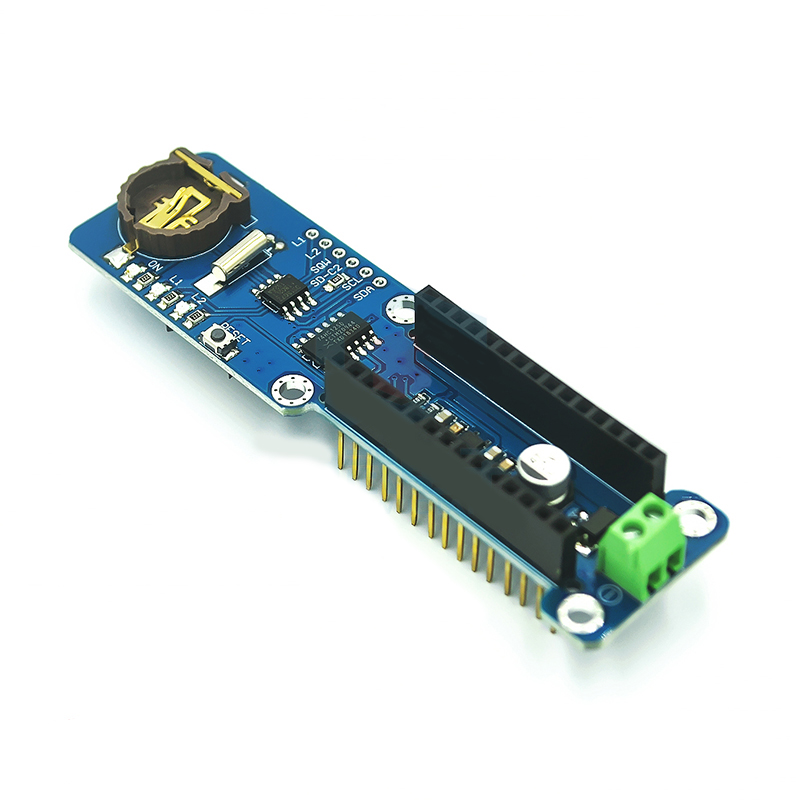
The TF Card Data Logger with DS1307 RTC & NANO 3.0 is a dedicated shield that turns your Arduino Nano into a complete, standalone data logging system. It combines a TF (MicroSD) card interface with a DS1307 real-time clock, allowing you to save sensor readings with precise timestamps to a removable memory card — without needing a computer, internet connection, or any external wiring. Simply plug your Nano into the shield, insert a TF card, and your data logging project is ready to go.

This shield is built for reliability in real-world applications. The DS1307 real-time clock keeps accurate time even when the Arduino is powered off, thanks to its backup battery support. It counts seconds, minutes, hours, day, date, month, and year, with automatic leap year compensation valid up to 2100 . This means every data entry is stamped with the exact time it was recorded, so you can precisely reconstruct what happened and when.

The TF card interface supports FAT16 and FAT32 formatted cards, allowing you to save data in standard text or CSV format that can be opened by any spreadsheet or analysis program . A built-in 3.3V level shifter and voltage regulator protect your TF card from the Arduino’s 5V logic levels, ensuring safe and reliable read/write operations . The onboard 3.3V regulator also provides a stable reference voltage and reliably powers SD cards that require higher current during write operations.

The shield is designed in the compact Nano form factor, preserving the small footprint that makes the Nano ideal for embedded projects. It includes a prototyping area for soldering additional connectors or sensors, and two configurable indicator LEDs for status feedback. Everything is pre-assembled and ready to use — no soldering or complex wiring required.

Whether you are building a weather station, an environmental monitoring system, a machine performance tracker, or a long-term sensor data collection project, this TF Card Data Logger shield gives your Nano the storage and timekeeping capabilities it needs. It is suitable for individual makers, students, and businesses purchasing in bulk for education, research, or product development.

Features

  • TF (MicroSD) card interface – Save data to FAT16 or FAT32 formatted cards, readable by any spreadsheet or analysis software .

  • DS1307 real-time clock – Accurate timekeeping with seconds, minutes, hours, day, date, month, and year, plus automatic leap year compensation valid to 2100 .

  • Battery backup support – RTC maintains time even when the Arduino is unplugged; coin cell backup lasts for years .

  • 3.3V level shifter and regulator – Protects your TF card from 5V logic while providing stable power for reliable write operations .

  • Nano-compatible form factor – Plugs directly onto Arduino Nano and compatible 328P boards; no external wiring required .

  • Prototyping area included – Dedicated space for soldering additional connectors, circuits, or sensors .

  • Configurable indicator LEDs – Two programmable LEDs for status and activity feedback .

  • Fully assembled – Ready to use out of the box; simply plug in Nano, insert TF card, and start logging.

Technical Specifications 

# Parameter Specification
1 Compatibility Arduino Nano 3.0 and compatible 328P boards
2 Storage Interface TF (MicroSD) card, FAT16 / FAT32 format
3 RTC Chip DS1307 (I2C interface)
4 RTC Accuracy ±2 minutes per month at 25°C
5 Logic Level 3.3V for TF card (5V tolerant inputs)
6 Power Input 5V from Arduino Nano (USB or VIN)
7 RTC Backup Coin cell battery (CR1220 type, not included)
8 Board Format Nano-compatible shield footprint

Usage

Getting Started

  1. Install the RTC battery – Insert a CR1220 coin cell into the backup battery holder to maintain timekeeping when power is off.

  2. Insert the TF card – Use a FAT16 or FAT32 formatted TF card (up to 32GB recommended).

  3. Mount the Nano – Align the Arduino Nano’s pins with the shield’s headers and press firmly to seat. The Nano’s USB port should face outward.

  4. Connect power – Power the Nano via USB or through the VIN pin. The shield draws power from the Nano.

  5. Install libraries – In the Arduino IDE, install the RTClib and SD libraries.

  6. Upload your sketch – Write or open a data logging sketch, select the correct board and port, and upload.

Key Libraries

  • RTClib – For reading and setting the DS1307 real-time clock .

  • SD – For reading and writing files on the TF card.

  • Wire – For I2C communication with the DS1307.

Typical Applications

  • Environmental monitoring – Log temperature, humidity, pressure, and light levels with timestamps for long-term analysis.

  • Weather stations – Record meteorological data continuously, even when offline.

  • Machine and equipment monitoring – Track operating hours, vibration, or performance metrics for maintenance planning.

  • Agricultural sensors – Monitor soil moisture, temperature, and other field conditions over days or weeks.

  • Laboratory experiments – Capture precise time-series data from multiple sensors.

  • Classroom and STEM projects – Teach data collection, storage, and analysis concepts.

  • Remote field deployments – Battery-powered logging in locations without network access.

  • OEM and product development – Integrate standalone data logging into custom equipment.

Notes for Business Buyers

  • The shield eliminates the need for external SD and RTC modules, reducing assembly time and wiring complexity for production builds.

  • Standard FAT16/FAT32 file format ensures data compatibility with any PC-based analysis software.

  • Battery-backed RTC provides reliable timekeeping for deployments where power may be interrupted.

  • Suitable for bulk purchasing for educational institutions, research labs, and industrial monitoring applications.

Q: Is this shield compatible with Arduino Nano 3.0?

Yes. It is designed for Arduino Nano and compatible 328P-based boards. The shield plugs directly onto the Nano’s headers .

Q: Does the shield come with a Nano or TF card?

No. The shield includes only the data logger board. You need to provide your own Arduino Nano, TF card, and CR1220 backup battery .

Q: What TF card size and format should I use?

Use a TF card formatted as FAT16 or FAT32. Cards up to 32GB are typically supported, but FAT32 format is required for cards larger than 2GB .

Q: How does the DS1307 keep time when the Arduino is off?

The DS1307 has a battery backup input. With a CR1220 coin cell installed, the RTC maintains accurate timekeeping even when the main power is disconnected .

Q: What is the time accuracy of the DS1307?

The DS1307 is accurate to approximately ±2 minutes per month at 25°C . For most data logging applications, this is sufficient. If higher precision is required, consider an alternative RTC such as the DS3231.

Q: Do I need to install any libraries to use this shield?

Yes. You will need the RTClib library for the DS1307 RTC and the standard SD library for TF card operations. Both are available through the Arduino IDE Library Manager .

Q: Can I use this shield with other Arduino boards?

This shield is specifically designed for the Arduino Nano form factor. It works with Nano 3.0 and compatible 328P-based boards. It is not directly compatible with UNO or Mega without an adapter.

Q: How do I format the TF card for use with this shield?

Format the TF card as FAT16 or FAT32 using your computer’s disk formatting tool. For cards larger than 32GB, you may need to use a third-party tool to force FAT32 format .

Q: Can I power the shield separately from the Nano?

No. The shield draws power from the Arduino Nano through the header connections. The Nano can be powered via USB or through the VIN pin from an external supply.

Q: Can I purchase in bulk for a school or company?

Yes. This data logger shield is suitable for both individual users and business purchasing, including classroom sets, laboratory equipment, and industrial monitoring deployments.