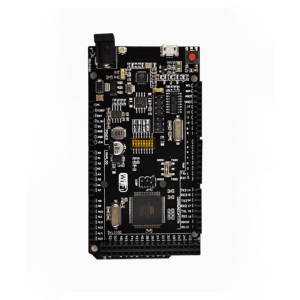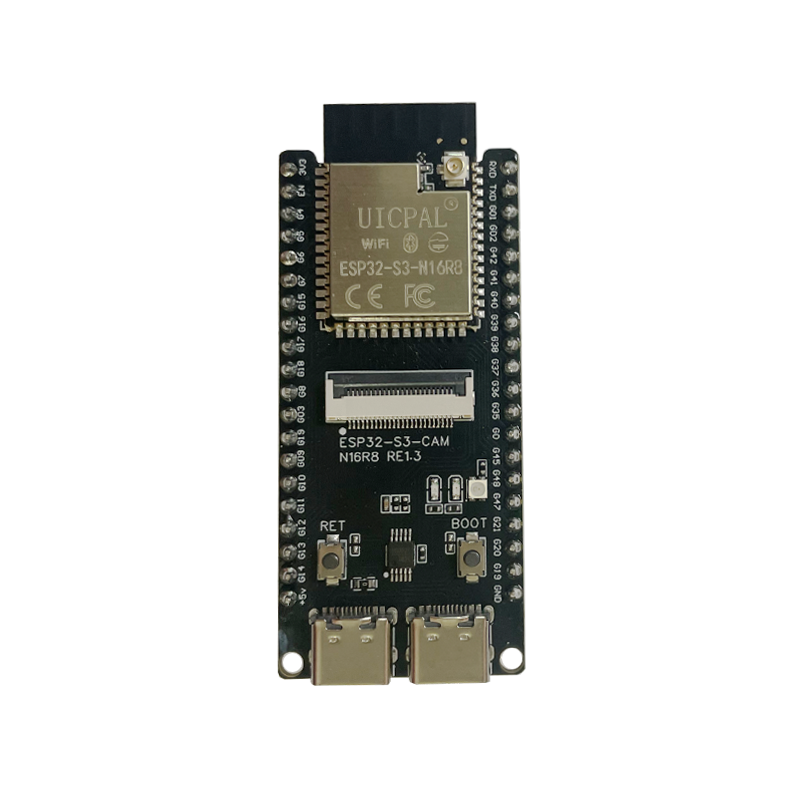
ESP32-S3-CAM using ESP32-S3-N16R8 development board 40pins with IPEX antenna mount CH340C Chip 2×Type-C interface

SKU: FA1053-0-1-12-2
Module

ESP32-S3-WROOM-1 N16R8

Processor

Dual-core Xtensa LX7, up to 240 MHz

Memory

16 MB Flash + 8 MB PSRAM

Wireless

WiFi 802.11 b/g/n + Bluetooth 5 (LE/Mesh)

USB Interfaces

2× Type-C (CH340C UART + native USB OTG)

Camera Interface

24-pin DVP (OV2640/OV5640 compatible)

Antenna

Onboard PCB + IPEX/U.FL external mount

Pin Count

40 pins (2×20 headers)

The ESP32-S3-CAM Development Board is a high-performance, camera-ready IoT platform built around the ESP32-S3-WROOM-1 N16R8 module. Designed for embedded vision, AIoT applications, and wireless monitoring projects, this board combines the processing power of the ESP32-S3 with a dedicated camera interface, dual USB-C connectivity, and flexible antenna options in a compact, breadboard-friendly form factor.

At its core is the ESP32-S3-WROOM-1 N16R8 module, featuring a dual-core Xtensa LX7 32-bit processor running at up to 240 MHz, with 16 MB Flash and 8 MB PSRAM. This generous memory configuration is essential for camera applications, allowing you to buffer high-resolution images, run complex AI models, or stream video without memory constraints. The module supports 2.4GHz WiFi (802.11 b/g/n) and Bluetooth 5 (LE + Mesh), providing versatile wireless options for connected devices.

The board features dual Type-C interfaces for maximum development flexibility. One port is dedicated to UART programming and debugging via the onboard CH340C USB-to-serial chip, which requires a one-time driver installation on most systems. The second Type-C port connects directly to the ESP32-S3’s native USB (GPIO19/20), supporting USB OTG functionality — you can use it to emulate HID devices, access external storage, or debug via the ESP32-S3’s built-in USB Serial/JTAG interface. This separated design means you can program via UART while using native USB for other purposes, without cable swapping.

The 40-pin layout exposes a comprehensive set of GPIOs on standard 0.1-inch headers along both sides of the board, making it ideal for connecting sensors, displays, and peripherals. For wireless connectivity, the board includes both an onboard PCB antenna and an IPEX/U.FL antenna mount, allowing you to connect an external antenna for extended range in challenging RF environments. A dedicated 24-pin DVP camera interface supports popular camera modules including the OV2640 (2MP) and OV5640 (5MP), covering everything from basic image capture to high-resolution photography.

The ESP32-S3’s AI acceleration capabilities, including vector instructions, make this board well-suited for edge AI applications such as image recognition, voice wake-word detection, and object classification. Development is fully supported through Arduino IDE, ESP-IDF, and MicroPython, with extensive community libraries including the esp32-camera library for rapid camera project development.

Whether you are building a smart doorbell, a remote surveillance system, an AI vision prototype, or an IoT camera device, the ESP32-S3-CAM Development Board provides a powerful, well-supported platform that balances processing performance, memory capacity, and camera readiness.


Features

  • ESP32-S3-WROOM-1 N16R8 module — dual-core Xtensa LX7 @ 240 MHz with 16 MB Flash + 8 MB PSRAM.

  • Dual Type-C interfaces — one for UART programming (CH340C), one for native USB OTG.

  • CH340C USB-to-serial chip — stable, widely supported UART programming and serial communication.

  • 40-pin GPIO breakout — comprehensive pin access on standard 0.1″ headers.

  • IPEX antenna mount — supports external antenna for extended wireless range.

  • 24-pin DVP camera interface — compatible with OV2640, OV5640, and other DVP cameras.

  • AI acceleration — vector instructions for neural network inference and edge AI applications.

  • Wireless connectivity — WiFi 802.11 b/g/n + Bluetooth 5 (LE/Mesh).

  • PSRAM for camera buffering — 8 MB PSRAM essential for high-resolution image processing.

  • Wide development support — Arduino IDE, ESP-IDF, and MicroPython compatible.


Technical Specifications 

# Parameter Specification
1 Module ESP32-S3-WROOM-1 N16R8
2 Processor Dual-core Xtensa LX7, up to 240 MHz
3 Memory 16 MB Flash + 8 MB PSRAM
4 Wireless WiFi 802.11 b/g/n + Bluetooth 5 (LE/Mesh)
5 USB Interfaces 2× Type-C (CH340C UART + native USB OTG)
6 Camera Interface 24-pin DVP (OV2640/OV5640 compatible)
7 Antenna Onboard PCB + IPEX/U.FL external mount
8 Pin Count 40 pins (2×20 headers)

Usage

Getting Started

  1. Install the CH340C driver — required on most systems for first-time UART use.

  2. Connect via UART Type-C port — use the port labeled UART or COM for programming and serial monitoring.

  3. Select the development environment — Arduino IDE, ESP-IDF, or PlatformIO.

  4. Configure board parameters — select “ESP32S3 Dev Module”, set PSRAM to “OPI PSRAM”, and Flash Size to “16MB”.

  5. Connect the camera — attach a compatible DVP camera (OV2640/OV5640) to the 24-pin FPC connector.

  6. Upload and test — use the CameraWebServer example from the esp32-camera library to test the camera and WiFi streaming.

Camera Configuration Notes

  • PSRAM is essential — the 8 MB PSRAM is required for high-resolution camera operation and JPEG buffering.

  • Camera model selection — use CAMERA_MODEL_ESP32S3_EYE or the appropriate model definition for your camera.

  • Pin mapping — camera pin assignments vary by board revision. Verify against your specific board’s documentation.

Typical Applications

  • AI vision prototyping — image recognition and object detection with TensorFlow Lite.

  • IoT surveillance cameras — WiFi streaming and remote monitoring.

  • Smart doorbells and access control — face detection and image capture.

  • Edge AI projects — voice wake-word detection and image classification.

  • Robotics vision — camera feedback for navigation and object tracking.

  • OEM product development — camera-enabled IoT devices for commercial applications.

Notes for Business Buyers

  • Dual Type-C flexibility — reduces cable swapping during development and debugging.

  • IPEX antenna mount — enables extended range for deployments in challenging RF environments.

  • N16R8 configuration — 16 MB Flash + 8 MB PSRAM provides ample memory for AI and camera applications.

  • Suitable for bulk purchasing — ideal for product development teams, IoT integrators, and educational institutions.

Q: What is the difference between this board and the standard ESP32-S3-N16R8 development board?

The ESP32-S3-CAM adds a 24-pin DVP camera interface, an IPEX antenna mount, and a 40-pin layout optimized for camera projects. The standard N16R8 board lacks the camera connector.

Q: Which camera modules are compatible?

The board supports OV2640 (2MP), OV5640 (5MP), and other DVP-interface cameras. The 24-pin FPC connector accepts standard camera modules.

Q: What is the difference between the two Type-C ports?

One port is for UART programming via the CH340C chip. The other connects to the ESP32-S3’s native USB for OTG functionality, debugging, or USB device emulation.

Q: Do I need to install a driver for the CH340C?

Yes. On most operating systems, a one-time CH340C driver installation is required before the UART port is recognized.

Q: How do I configure the board in Arduino IDE?

Select “ESP32S3 Dev Module”, set PSRAM to “OPI PSRAM”, and Flash Size to “16MB”.

Q: Is PSRAM required for camera operation?

Yes. The 8 MB PSRAM is essential for high-resolution image capture and JPEG buffering. Without PSRAM, camera resolution and performance will be severely limited.

Q: Can I use an external antenna with this board?

Yes. The board includes an IPEX/U.FL antenna mount for connecting an external 2.4GHz antenna, improving range in challenging RF environments.

Q: What AI capabilities does this board support?

The ESP32-S3 includes vector instructions that accelerate neural network inference. It supports TensorFlow Lite Micro, ESP-WHO, and ESP-SR for image recognition and voice processing.

Q: Which development environments are supported?

The board supports Arduino IDE (with esp32-camera library), ESP-IDF, and MicroPython.

Q: Can I purchase in bulk for a product development project?

Yes. This board is suitable for both individual users and business purchasing, including product development, IoT integration, and volume production.