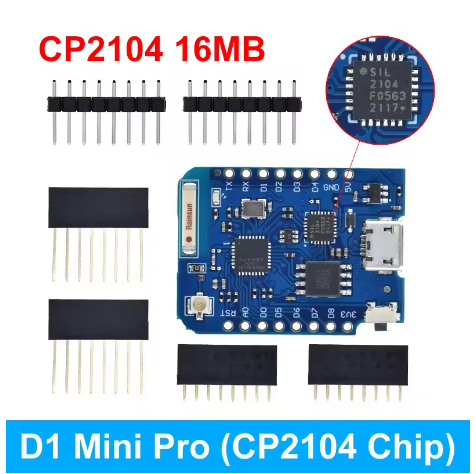
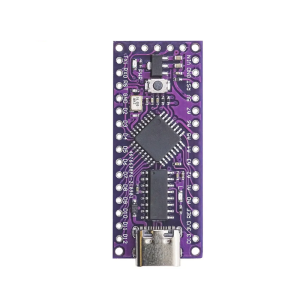
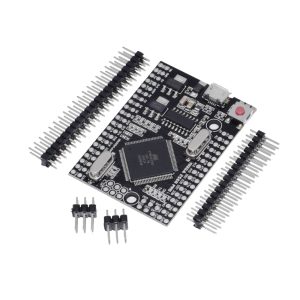
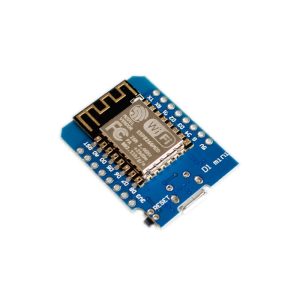
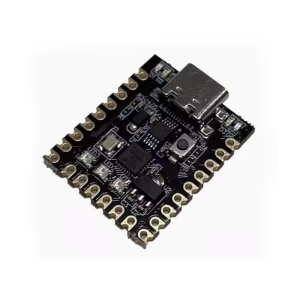
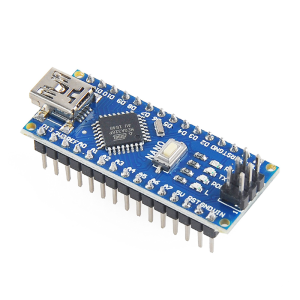
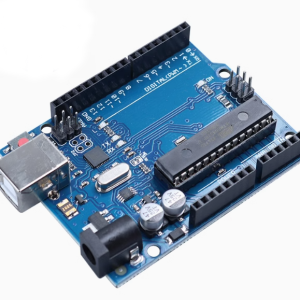
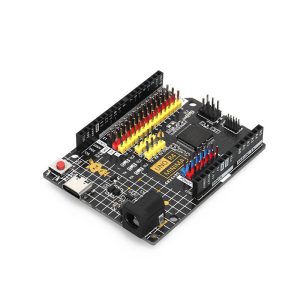
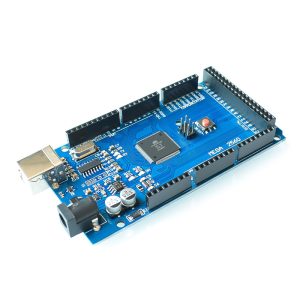
The Mini D1 PRO 2104 Chip NodeMcu Lua WiFi development board based on ESP8266 is a compact development board that features 16MB (128Mbit) of flash memory, an external antenna connector, and a CP2104 (or CH9102 depending on variant) USB-to-UART chip. It is widely available for purchase online.
| Specification |
Detail |
| Microcontroller |
ESP-8266EX |
| Operating Voltage |
3.3V |
| Digital I/O Pins |
11 (interrupt/pwm/I2C/one-wire support) |
| Analog Input Pins |
1 (max 3.2V) |
| Clock Speed |
80/160MHz |
| Flash Memory |
16MB (128Mbit) |
| USB-to-UART Chip |
CP2104 (or CH9102 depending on variant) |
| Antenna Options |
Built-in ceramic antenna or external antenna via IPEX port |
| Compatibility |
Arduino IDE, NodeMCU (Lua script), MicroPython |
The Mini D1 PRO 2104 Chip NodeMcu Lua WiFi development board is a versatile and cost-effective solution for a wide range of Internet of Things (IoT) and automation projects due to its integrated Wi-Fi capabilities and robust memory.
Common applications and use cases include:
- Smart Home Automation: Building custom systems to control lights, appliances, and security systems wirelessly.
- Wireless Sensor Networks: Creating networks for environmental monitoring, such as tracking temperature, humidity, and air quality, and transmitting data to the cloud for analysis.
- Remote Monitoring and Control: Developing systems to monitor machinery performance or access door locks remotely via the internet.
- IoT Prototyping: A great platform for developing and testing new concepts for connected electronic devices and smart gadgets.
- Robotics: Integrating the board into robotic projects for wireless control and data transmission.
- Wearable Electronics: Its low power consumption and small size make it suitable for battery-operated or portable projects.
Q: How do I program this board?
The board can be programmed using several popular platforms, including the Arduino IDE, NodeMCU (Lua scripting language), and MicroPython.
Q: Which driver do I need to install for the USB port?
This specific model uses the CP2104 USB-to-UART chip. You will need to install the corresponding Silicon Labs CP210x drivers on your computer for the board to appear as a serial port. (Some variants may use the CH340G chip, which requires different drivers).
Q: Can I connect an external antenna to improve range?
Yes, the D1 Mini Pro features both a built-in ceramic antenna and an IPEX connector for an external antenna. To use the external antenna, you will likely need to move a small 0-ohm SMD resistor on the PCB to select the external port input.
Q: What is the maximum input voltage for the analog pin?
The single analog input pin (A0) has a maximum input voltage of 3.2V.
Q: The board is not connecting to Wi-Fi reliably. What should I do?
Wi-Fi issues can stem from a few sources:
- Antenna Placement: Ensure the board’s antenna area is clear of other components or metal surfaces.
- Signal Strength: If in a low signal area, consider using the external antenna option.
- Code/Configuration: Check your code for proper Wi-Fi status checks and connection management logic, using
delay() might help. Ensure you have the correct network name (SSID) and password.
- Router Compatibility: Some specific router firmware versions may have compatibility issues with ESP8266 devices.
Q: What is the benefit of the 16MB flash memory?
The large 16MB (128Mbit) flash memory allows for much larger programs, the storage of web pages/images (SPIFFS/LittleFS), and enables Over-The-Air (OTA) firmware updates, which can be useful in permanent installations where physical access is difficult.