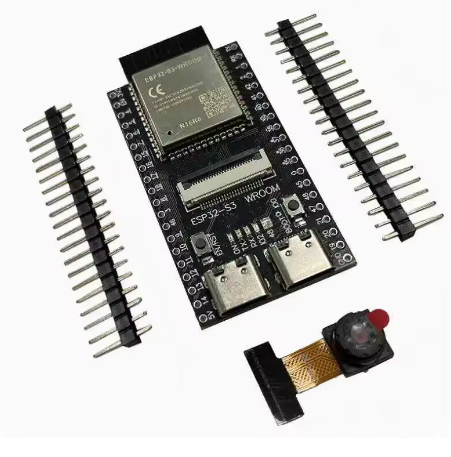
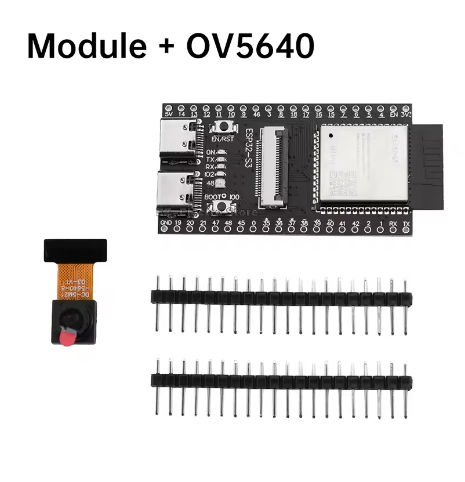
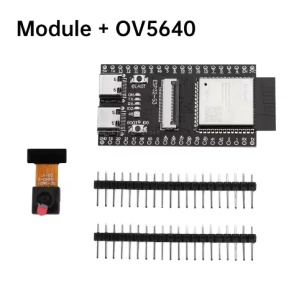
ESP32-S3-CAM with OV5640 using ESP32-S3-WROOM-1 development board 40pins with N16R8 CP2102 Chip have 2×Type-C interface

SKU: FA1053-0-1-14
Module

ESP32-S3-WROOM-1 (N16R8)

Camera

OV5640 (5 Megapixel, 2592 x 1944)

Processor

Dual-core 32-bit Xtensa® LX7 (up to 240 MHz)

Storage/RAM

16MB Flash / 8MB Octal PSRAM

USB Interface

2× Type-C (1x UART via CP2102, 1x Native USB S3)

USB Serial Chip

Silicon Labs CP2102

Wireless

2.4GHz Wi-Fi + BT 5.0 / BLE / Mesh

I/O Header

40-Pin (Breadboard Friendly)

Power Supply

5V via Type-C or Vin pin

This high-performance ESP32-S3-CAM development platform is a flagship AIoT solution featuring the ultra-high-definition OV5640 5MP camera and the ESP32-S3-WROOM-1 (N16R8) module. Designed for 2025’s most demanding vision tasks, it incorporates dual Type-C interfaces and the industry-standard CP2102 serial chip for professional-grade stability.

Product Description
The ESP32-S3-CAM N16R8 (OV5640 Edition) represents the pinnacle of the ESP32 vision series. By upgrading to the 5-Megapixel OV5640 sensor, this board provides significantly higher resolution, better low-light performance, and a wider field of view compared to standard 2MP models.
To handle 5MP image data, the board is equipped with 16MB Flash and 8MB Octal PSRAM, providing the massive memory buffer required for high-speed image processing and Edge AI. The dual Type-C interface offers a dual-channel workflow: the UART port (via CP2102) handles rock-solid programming and debugging, while the Native USB port allows the board to function as a high-definition USB Web Camera (UVC) or high-speed data storage device.
Key Features
  • 5MP Ultra-HD Vision: Includes the OV5640 camera module, supporting auto-focus and resolutions up to 2592 x 1944 pixels.
  • AI Acceleration: The ESP32-S3 core features built-in vector instructions that accelerate neural network inference for real-time face and object recognition.
  • Professional Memory Spec (N16R8): 16MB Flash and 8MB Octal PSRAM ensure zero “out-of-memory” crashes during high-res video streaming or AI processing.
  • Dual Type-C Design:
    • UART Port: Dedicated CP2102 chip for stable, high-speed serial communication.
    • Native Port: Direct S3 connection for USB OTG, HID, or UVC camera functionality.
  • Advanced Wireless: Wi-Fi 4 and Bluetooth 5.0 (LE) with mesh support for seamless cloud integration.
  • Expansion Ready: 40-pin header provides access to a wide array of GPIOs for industrial sensors and actuators.
Usage Scenarios
  • Industrial Inspection: High-resolution 5MP imaging for quality control, QR code scanning, and automated optical inspection (AOI).
  • High-End AIoT: Edge computing nodes requiring facial recognition, occupancy counting, or gesture control in smart offices.
  • Prototyping for Business: A reliable evaluation kit for companies developing commercial smart doorbells, pet monitors, or thermal imaging systems.
  • Content Creation: DIY 4K/HD time-lapse cameras and high-definition Wi-Fi streaming for hobbyists.
Q: Why are there two Type-C ports?

The UART port is used for code uploading and viewing serial logs via the CP2102 chip. The Native USB port connects directly to the S3 chip, allowing the board to act as a USB peripheral like a keyboard or a high-definition webcam.

Q: How do I enable the 5MP resolution and 8MB PSRAM?

In the Arduino IDE, select “ESP32S3 Dev Module”. Set “PSRAM” to “OPI PSRAM”. In your code, you must initialize the camera_config_t specifically for the OV5640 pins and set the frame_size to FRAMESIZE_QSXGA (2592×1944).

Q: Does this board support Auto-Focus with the OV5640?

Yes, the OV5640 hardware supports auto-focus. You can control the focus motor via I2C commands through the ESP32-S3 software libraries.

Q: Is the CP2102 better than the CH340 chip?

Yes, for professional use. The CP2102 is widely regarded as more stable, offering better driver support across various operating systems (Windows/Mac/Linux) and more consistent data transfer rates for large firmware files.

Q: Can I use this for battery-powered projects?

Yes, the board features deep-sleep modes. However, streaming 5MP video consumes significant power, so we recommend a high-capacity Li-ion battery or a permanent 5V supply for video applications.

Q: Is this board compatible with official Espressif libraries?
Absolutely. It is fully compatible with ESP-IDFArduino-ESP32MicroPython, and the ESP-WHO AI framework.