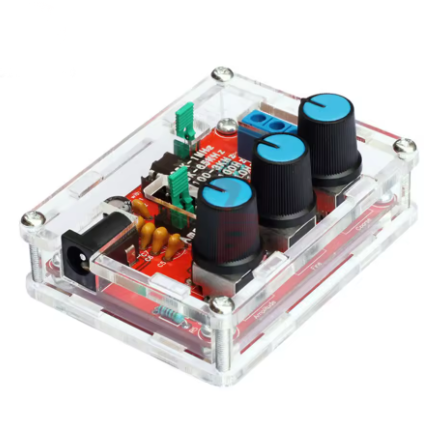
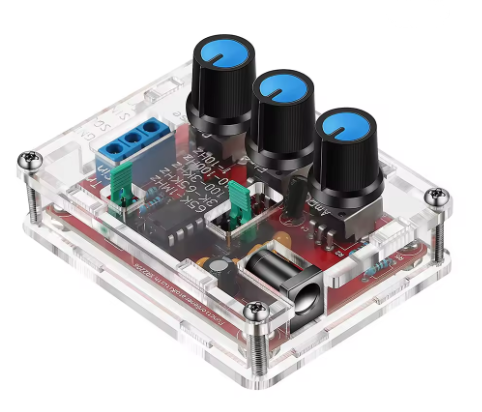
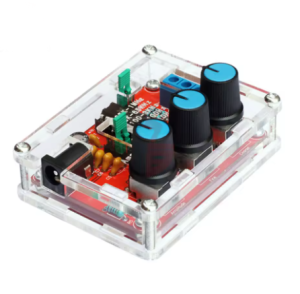
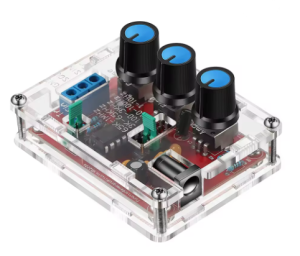
XR2206 High-Precision Signal Generator Kit – DIY Function Generator with Enclosure | Sine/Triangle/Square Wave Output (Welded)

SKU: FA1060-1
Power Supply

9V – 12V DC (Center Positive)

Frequency Range

1Hz – 1MHz

Waveforms

Sine, Triangle, Square

Output Impedance

600 Ohm ± 10%

Sine Wave

Amplitude: 0–3V (at 9V DC); Distortion: < 1%

Triangle Wave

Amplitude: 0–3V (at 9V DC); Linearity: < 1%

Square Wave

Amplitude: 8V (at 9V DC); Rise Time: < 50ns

Frequency Stability

200ppm / °C

Product Description
The XR2206 Welded Signal Generator is a ready-to-use, versatile benchtop instrument designed for electronic circuit testing, audio equipment calibration, and educational demonstrations. Unlike standard DIY kits, this version comes fully professionally soldered and assembled, saving time and ensuring optimal signal integrity right out of the box. 
Housed in a durable, crystal-clear acrylic enclosure, this generator utilizes the renowned XR2206 monolithic integrated circuit to produce stable, low-distortion waveforms. With a frequency range spanning from 1Hz to 1MHz, it provides the essential signals (Sine, Triangle, and Square) required for troubleshooting amplifiers, testing filter responses, or providing clock pulses for digital logic. It is an ideal entry-level laboratory tool for those who require a reliable signal source without the complexity of high-end DDS generators. 

Key Features
  • Ready-to-Use (Welded): Skip the assembly process. This unit is professionally soldered and tested for immediate deployment.
  • Three Standard Waveforms: Independent outputs for Sine, Triangle, and Square waves to suit various analog and digital testing needs.
  • High-Resolution Tuning: Features multi-turn potentiometers for Coarse and Fine frequency adjustment, allowing for precise hertz-level control.
  • Low Distortion Sine Output: Provides a high-quality sine wave with typically less than 1% distortion, perfect for audio fidelity testing.
  • Protective Enclosure: The pre-installed acrylic shell protects internal components from workbench debris and prevents accidental short circuits.
  • Compact Footprint: Small enough for any crowded workbench while remaining stable during adjustment. 
Usage Guide
  1. Power Input: Connect a 9V or 12V DC power adapter (not included) to the DC jack. Ensure the power indicator LED is illuminated.
  2. Frequency Selection: Use the onboard jumper headers to select the broad frequency band (e.g., 10Hz–100Hz, 100Hz–1kHz, etc.).
  3. Tuning:
    • Rotate the Coarse knob to move quickly to the target frequency range.
    • Adjust the Fine knob to lock in the exact frequency.
  4. Waveform Selection: Set the internal jumper to choose between Sine or Triangle output. The Square wave is usually available on a separate output terminal.
  5. Amplitude Control: Use the Amplitude potentiometer to scale the output voltage to match your target circuit’s input requirements.
  6. Connection: Connect your oscilloscope or circuit under test to the screw terminals or header pins provided
Q: Is this version already soldered, or do I need to build it?

This is the Welded Edition. It comes fully assembled, soldered, and housed in its enclosure. It is ready for use as soon as you connect a power supply

Q: Can I use this for professional audio testing?

Yes. The XR2206 is well-regarded for its low-distortion sine wave (under 1%), making it a cost-effective solution for testing audio amplifiers, speakers, and crossover networks

Q: Does it include a power supply?

Typically, no. It requires a standard 9V-12V DC power adapter. For the cleanest signal with the least noise, we recommend using a regulated linear power supply

Q: Is this suitable for business and educational procurement?

Absolutely. Business and educational customers prefer this pre-assembled version to ensure consistency across multiple workstations and to avoid the time-costs associated with DIY assembly

Q: What is the maximum output voltage?

For Sine and Triangle waves, the amplitude is approximately 0–3V at a 9V input. The Square wave output is higher, typically close to the input supply voltage (e.g., ~8V-9V), which is ideal for triggering digital logic

Q: Can it generate signals above 1MHz?

The device is rated for 1MHz. While it may push slightly higher, the waveform shape (specifically the sine wave) will begin to distort significantly beyond 1.2MHz