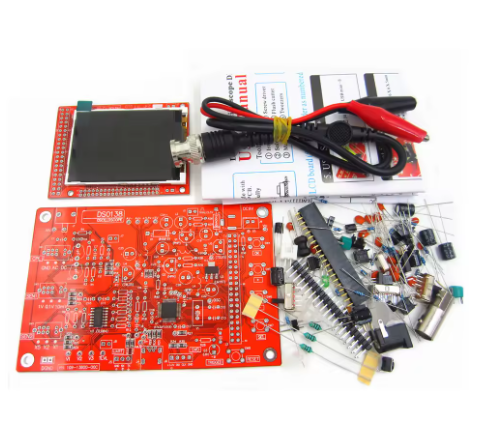
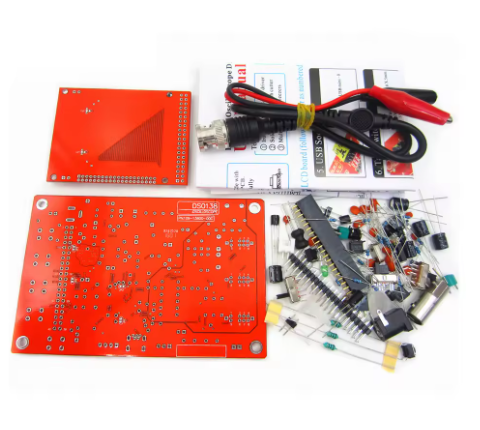
Product Description
The Laqiya DSO138 DIY Kit is the gold standard for educational electronics projects in 2026. It is a partially open-source digital oscilloscope designed specifically for students, makers, and hobbyists who want to understand the inner workings of electronic measurement tools. By assembling this kit, users gain hands-on experience with soldering, circuit layout, and signal processing.
The heart of the device is an ARM Cortex-M3 processor (STM32F103C8), providing a responsive 2.4-inch color TFT display for clear waveform analysis. While it arrives as a kit requiring assembly, all the sensitive Surface Mount Devices (SMD) are typically pre-soldered on the board, leaving the user to master through-hole soldering for the connectors, switches, and large capacitors. Once built, it serves as a fully functional 200KHz oscilloscope, perfect for audio testing, PWM analysis, and learning the fundamentals of digital signal capture.
Key Features
- Educational DIY Project: Designed to teach soldering and circuit theory. Provides a deep sense of accomplishment and a functional tool upon completion.
- Vivid 2.4″ Color TFT: High-contrast display featuring a grid for precise waveform measurement and clear real-time parameter readouts.
- Digital Trace Waveform: Includes “Hold” functionality to freeze waveforms for detailed inspection and measurement.
- Pre-soldered SMD Components: To ensure a high success rate, the complex integrated circuits are pre-installed; users only need to solder the through-hole components.
- Built-in Test Signal: Features a 1KHz / 3.3V square wave output for self-testing and probe calibration.
- Comprehensive Data: Automatically calculates and displays frequency, period, pulse width, duty cycle, Max/Min, and Peak-to-Peak values.