Description
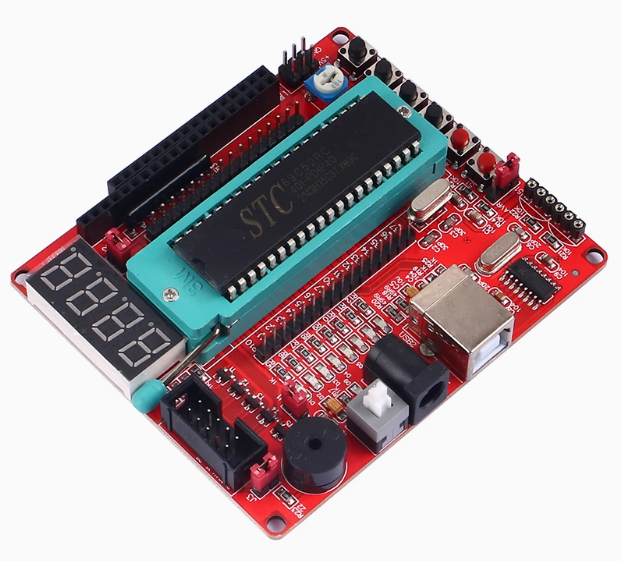
The 51/AVR Development Board Kit is a versatile and compact learning and prototyping platform designed for students, engineers, and DIY hobbyists. Centered around the classic STC89C52RC (8051 architecture) and compatible with various AVR and MSP microcontrollers, this “Minimum System Board” provides all the essential circuitry required to get a microcontroller up and running.
This kit eliminates the complexity of breadboarding by providing integrated power management, a high-stability crystal oscillator, and a USB-to-Serial interface for direct programming and debugging via PC. Whether you are learning the fundamentals of C language programming or developing industrial control logic, this board serves as a reliable foundation for your embedded systems projects.
Key Features
- Dual Compatibility: Supports a wide range of 40-pin microcontrollers, including the STC89 series, AT89S series, and various AVR/MSP chips (via adapter or compatible pinouts).
- Plug-and-Play Programming: Integrated USB interface for power and data, allowing for easy “One-Click” downloading of code without the need for an external programmer.
- Industrial Stability: Features a high-quality manual reset button and a professional-grade crystal oscillator (11.0592MHz) for accurate baud rate generation.
- Expandable I/O: All 40 pins are clearly labeled and broken out to standard headers, making it easy to connect external sensors, LCDs, relays, and motor drivers.
- Power Protection: Onboard power LED indicator and self-recovery fuse to protect your computer’s USB port from overcurrent or short circuits.
- Compact Design: Small footprint makes it ideal for embedding into final projects or fitting into crowded laboratory environments.