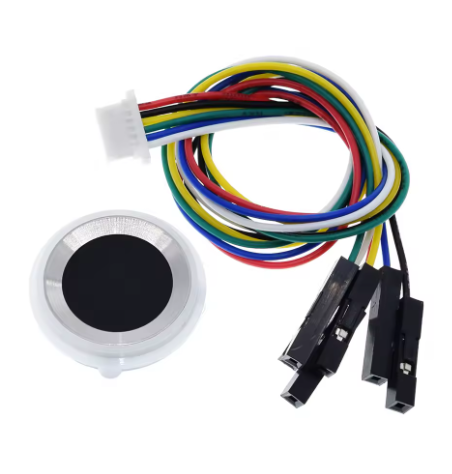
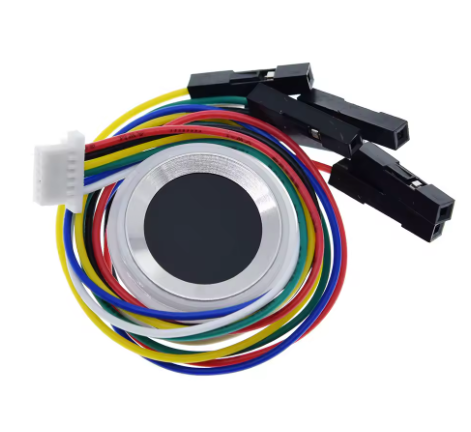
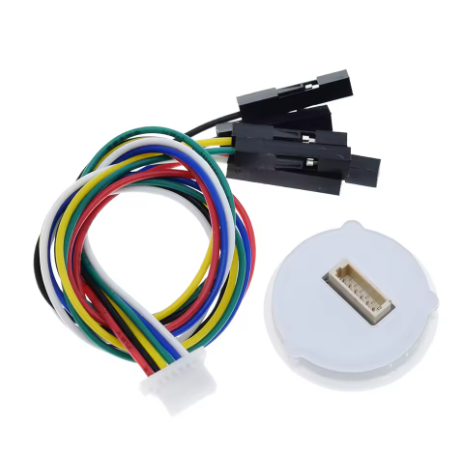
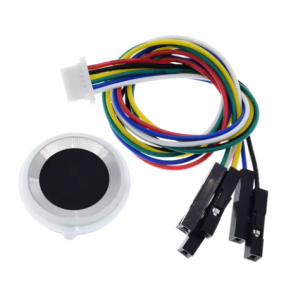
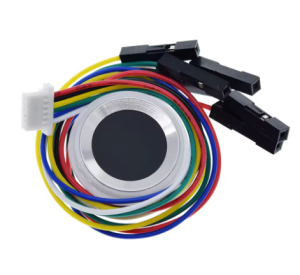
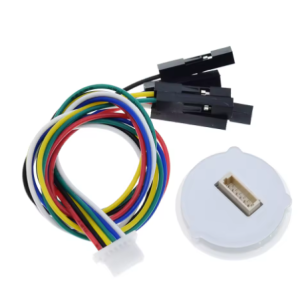
SFM-V1.7 integrated semiconductor circular capacitive acquisition and identification fingerprint sensor module UART communication

SKU: FA2038
Sensing Technology

Semiconductor Capacitive (Active)

Supply Voltage

DC 3.3V (Typical)

Operating Current

<40mA (Scanning); <5uA (Standby/Sleep)

Fingerprint Capacity

100 – 200 Templates (Model dependent)

Resolution

508 DPI

Matching Mode

1:1 (Verification) / 1:N (Identification)

Search Time

< 0.2 seconds

Interface

UART (TTL Serial)

Baud Rate

9600 – 115200 bps (Default: 57600)

False Acceptance Rate (FAR)

< 0.0001%

False Rejection Rate (FRR)

< 1.0%

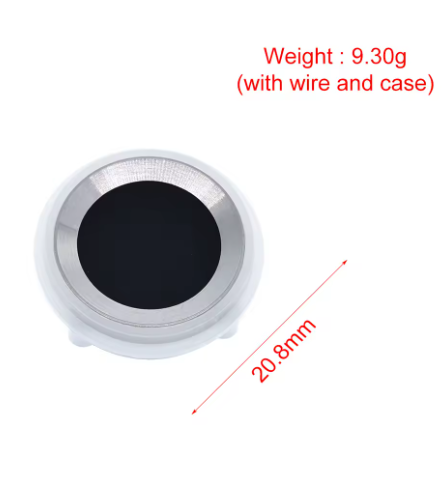
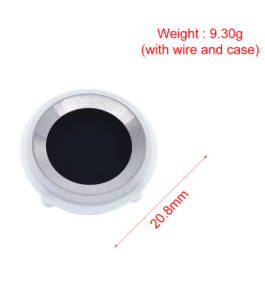
Dimensions

Approx. 21mm (Outer Diameter)

Product Description
The SFM-V1.7 is a premium, small-form-factor fingerprint identification module that utilizes advanced semiconductor capacitive sensing technology. Unlike traditional optical sensors that use a camera and light, the SFM-V1.7 measures the electrical capacitance of a finger’s ridges and valleys. This results in a much higher level of security, as it is nearly impossible to fool with a 2D printed image or a bypass “fake finger.”
This module is an “All-in-One” biometric solution featuring a circular, aesthetic design with an integrated high-speed processor. It handles the entire process of fingerprint entry, image processing, feature extraction, and template matching internally. With its UART (Universal Asynchronous Receiver/Transmitter) communication, it is easily integrated into any microcontroller-based system, offering a sleek, smartphone-like unlocking experience for modern hardware.
Key Features
  • Capacitive Sensing Technology: Offers superior anti-spoofing capabilities and higher recognition accuracy compared to optical sensors.
  • 360-Degree Recognition: Allows the user to place their finger at any angle; the internal algorithm automatically adjusts for rotation.
  • Ultra-Thin & Circular Design: The compact, round form factor is ideal for embedding into door handles, drawer fronts, and handheld mobile devices.
  • Self-Learning Algorithm: The module continuously updates the stored fingerprint template with each successful scan to account for minor skin changes over time.
  • Intelligent “Wake-up”: Features a low-power sensing pin that alerts the host controller only when a touch is detected, preserving battery life.
  • Sleek Visual Feedback: The circular rim is designed to fit seamlessly into high-end consumer electronics and professional office hardware.

Usage Scenarios
  • Single User / Home Security: High-end smart door locks, biometric safes, luxury jewelry boxes, and personalized computer “Power-on” buttons.
  • Business / Professional: Secure office cabinets, shared laboratory equipment access, high-security server racks, and “time-clocking” for mobile workforces
Q: What is the main advantage of this capacitive sensor over an optical one?

Capacitive sensors like the SFM-V1.7 are more secure because they detect the physical “live” electrical properties of the skin. They are also much smaller and work better in direct sunlight where optical sensors may struggle with glare

Q: Can this module be powered by a battery?

Yes. Its very low standby current (in the microamp range) makes it perfect for battery-powered devices. It only consumes significant power for the fraction of a second it takes to scan a finger

Q: Does it work with wet or dry fingers?

Semiconductor sensors are generally better at handling dry fingers than optical sensors. While extreme wetness can interfere with capacitance, the SFM-V1.7 is designed to be highly adaptive to various skin conditions

Q: Is the data on the sensor encrypted?

The sensor stores a mathematical “feature template” rather than a photo of the fingerprint. This provides a high level of privacy, as the actual image of the finger cannot be retrieved or reconstructed from the device

Q: How do I change the LED light behavior?

The LED ring behavior is usually controlled via serial commands sent from your microcontroller. You can program it to flash green for a successful match or red for a failed attempt

Q: Is this sensor compatible with 5V systems like the Arduino Uno?

Most capacitive sensors operate at 3.3V. If using a 5V Arduino, it is recommended to use a level shifter or a simple voltage divider on the RX/TX lines to ensure long-term reliability.