Product Description
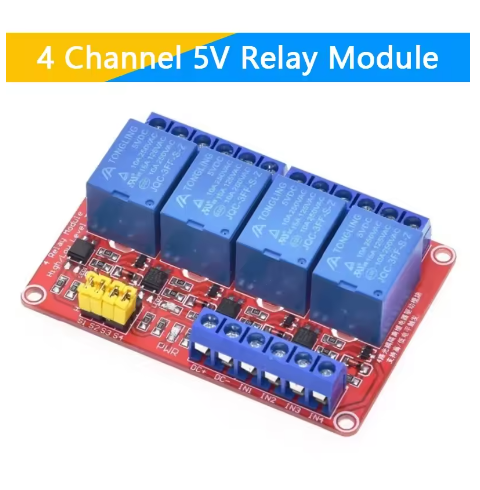
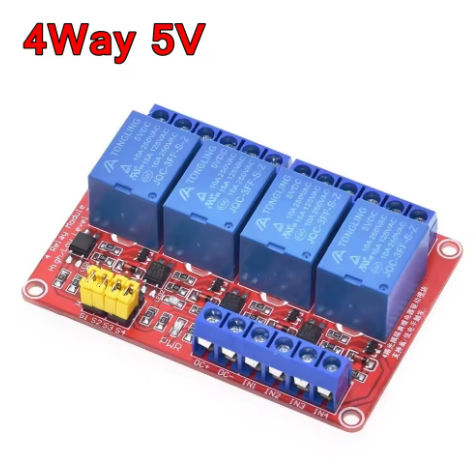
The 4-Channel 5V Opto-Isolated Relay Module is the definitive solution for projects demanding both reliable high-power switching and absolute protection for sensitive control electronics. This module perfectly bridges the gap between low-voltage microcontrollers and high-power AC/DC loads by incorporating advanced optocoupler isolation on every channel. Each of the four channels features a high-quality electromagnetic relay, but unlike non-isolated designs, the control signal is first passed through an optical isolator. This creates a complete electrical barrier, ensuring that voltage spikes, electrical noise, and potential ground loops from the load side cannot damage your Arduino, Raspberry Pi, or other controller.
Offering selectable high or low-level trigger via a convenient jumper, this module provides unmatched flexibility to match any control logic, from simple microcontroller outputs to industrial PLC signals. The integration of status LEDs for both relay activation and opto-isolation, combined with robust screw terminals, makes it a professional-grade component. Whether you’re building a reliable home automation system, a noise-resistant industrial interface, or a complex prototype, this opto-isolated relay module delivers safety, versatility, and peace of mind in a compact and user-friendly package.
Key Features
-
Full Optical Isolation per Channel: Each input is protected by an optocoupler, providing 2500Vrms of isolation to shield your microcontroller from high-voltage transients and noisy load circuits.
-
Selectable Trigger Logic: A simple jumper for each channel allows selection between High-Level (active-HIGH) or Low-Level (active-LOW) trigger, ensuring compatibility with any control system.
-
Four Independent High-Current Relays: Control up to four separate AC or DC circuits with relays rated for 10A, suitable for a wide range of appliances and equipment.
-
Dual Status Indication: Features two LEDs per channel: one indicates the opto-isolator is activated by the control signal, and another shows the physical state of the relay, providing clear diagnostic feedback.
-
Integrated Flyback Protection: Each relay coil includes a flyback diode to suppress voltage spikes when de-energizing, protecting the driving transistor and ensuring long-term reliability.
-
5V Logic Level Compatible: Designed for direct use with 5V microcontrollers like Arduino, with inputs that are easy to drive from standard digital pins.
-
Secure & Safe Connections: All high-power load connections use screw terminals, while control connections use a standard pin header for a clean and reliable setup.
-
Robust PCB Design: Built with high-quality components and a clear, silkscreened layout for easy installation and integration.
Main Parameters
-
Channels: 4 Independent Relays
-
Control Signal Voltage: 5V DC (TTL Logic)
-
Trigger Mode: High or Low Level (Jumper Selectable per channel)
-
Isolation Rating: 2500V RMS (Optocoupler)
-
Relay Contact Rating: 10A @ 250VAC / 10A @ 30VDC
-
Relay Type: Electromagnetic, SPDT (Single Pole Double Throw)
-
Input Current: ~5mA per channel (to activate optocoupler)
-
Dimensions: Approx. 120mm x 75mm x 20mm
Typical Applications / Usage
-
Industrial Control Interfaces: Safely connect PLC or microcontroller outputs to industrial equipment like motors, solenoids, and heaters, where electrical noise is common.
-
Noise-Immune Home Automation: Build reliable smart home controllers that are unaffected by interference from inductive loads like motorized appliances or HVAC systems.
-
Laboratory & Test Equipment: Integrate into custom test setups where sensitive measurement instruments must be protected from switching noise generated by the loads under control.
-
Renewable Energy Systems: Control pumps, fans, or diverters in solar/wind setups where varying loads and long wire runs can create ground potential differences.
-
Automotive & Marine Electronics: Interface vehicle computers or sensors with high-power accessories (lights, winches) while protecting the sensitive vehicle bus from voltage spikes.
-
Educational & Prototyping: The ideal, safe choice for teaching control system concepts and for prototyping products that will later be deployed in electrically harsh environments.
Connection & Configuration Guide:
-
Trigger Configuration: For each channel, place the jumper cap over the two pins labeled “H” for High-Level trigger (relay activates on 5V signal) or “L” for Low-Level trigger (relay activates on 0V/GND signal).
-
Power & Control Wiring: Connect the module’s VCC and GND to a 5V DC supply. Connect the signal pins (IN1-IN4) to your microcontroller’s digital outputs. The optocoupler requires only ~5mA, making it easy for any microcontroller pin to drive.
-
Load Wiring: Connect the power source for your device (AC Mains or DC) to the relay’s Common (COM) terminal. Connect the device to the Normally Open (NO) terminal to be powered when the relay activates. CRITICAL: Always disconnect high-voltage power before wiring. Use an appropriate enclosure for safety.
Q: Why is optical isolation important, and when do I need it?
Optical isolation creates a break in the electrical connection, allowing only a light signal to pass through. It is critical when your control circuit and the load being switched use separate power suppliesor are in environments with high electrical noise(e.g., from motors). It prevents damaging voltage spikes, ground loops, and noise from interfering with or destroying your microcontroller.
Q: How do I choose between High-Level and Low-Level trigger?
Choose based on your controller’s default “active” state.
-
High-Level (H): The relay activates when you set the control pin to HIGH (5V). This is the standard for most Arduino sketches (digitalWrite(pin, HIGH)to turn ON).
-
Low-Level (L): The relay activates when you set the control pin to LOW (0V/GND). This is common in “sinking” logic systems and can be safer, as a broken wire defaults to the OFF state.
Q: Can I use this with a 3.3V microcontroller like an ESP32?
Yes, for High-Level trigger mode. While the module’s VCC should be 5V, the 3.3V HIGH signal from an ESP32 is typically sufficient to activate the optocoupler’s internal LED. For the most reliable operation, ensure the jumper is set to “H” and test in your specific setup. Low-Level trigger mode will also work, as 0V is 0V regardless of the logic level.
Q: Does the isolation protect the load from the microcontroller, or vice-versa?
It protects the microcontroller (control side) from any electrical issues originating on the load side. The optocoupler prevents high voltages or noise from the load circuit from traveling back into your sensitive control electronics.
Q: The module has two LEDs per channel. What do they indicate?
-
The first LED (often near the input pin): Lights up when the optocoupler is activated by your control signal. It shows the command is received.
-
The second LED (near the relay): Lights up when the relay coil is energized and the physical contacts have switched. It shows the command has been executed.
Q: Can I control both AC and DC loads?
Yes. The relay contacts themselves are agnostic to the current type. You can switch AC mains (up to 250VAC) or DC power (up to 30VDC) on any channel, as long as you do not exceed the 10A current rating.
Q: Do I need an external power supply, or can I power it from my Arduino's 5V pin?
You can power the control side (VCC for the optocouplers) from the Arduino’s 5V pin, as it draws very little current (~20mA for all four). However, the relay coils are powered separately through the JD-VCC jumper. For reliable operation of the relays, it is highly recommended to use a separate 5V power supply connected to the JD-VCC and GND pins to avoid overloading the Arduino’s voltage regulator.
Q: Is this a suitable product for business or light industrial use?
Absolutely. The optical isolation, robust relay ratings, professional terminal blocks, and flexible triggering make this module an excellent choice for integration into commercial products, industrial control panels, kiosks, and custom automation solutions where reliability and electrical protection are non-negotiable. We offer volume pricing for business clients.