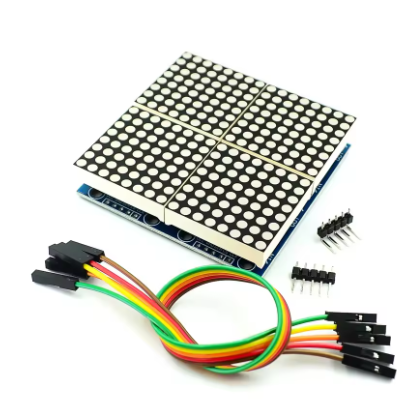
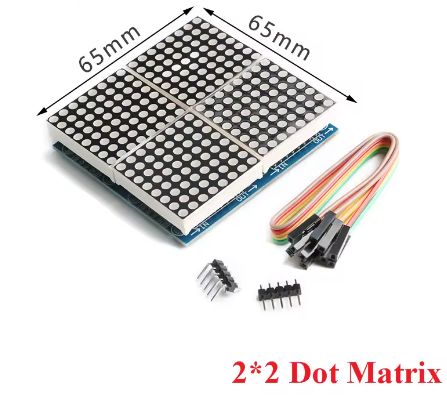
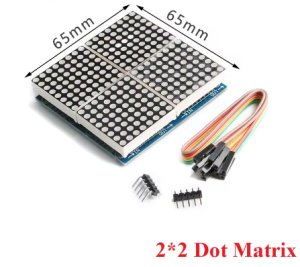
4-Bit MAX7219 dot matrix module 8*16 single-chip microcomputer control drive LED display module RED 1088AS Common Cathode

SKU: FA2092-0-1
Operating Voltage

5V DC (4.0V – 5.5V)

Operating Current

60mA – 160mA (typical) / 640mA (max, all LEDs on)

Shutdown Mode Current

150 µA

Display Resolution

8 × 32 pixels (four 8×8 matrices side by side)

Total LEDs

256 red LEDs

LED Matrix Type

1088AS Common Cathode

Driver IC

MAX7219 (one per 8×8 matrix or cascaded configuration)

Communication Protocol

SPI (Serial Peripheral Interface)

I/O Pin Requirements

3 pins (DIN, CS, CLK) + VCC, GND

Description

The 4-Bit MAX7219 Dot Matrix Module is a powerful and versatile LED display solution that combines four 8×8 dot matrix units into a single extended display panel. This module integrates four individual 1088AS common cathode red LED matrices to create a combined display area of 8 rows by 32 columns (8×32 pixels) – totaling 256 individually addressable red LEDs.

This module is specifically designed for single-chip microcomputer (MCU) control applications, offering a convenient and space-efficient way to add scrolling text, graphics, and real-time data visualization to your embedded projects. Whether you need to display sensor readings, scrolling messages, animations, or simple video game graphics, this 4-bit module provides ample resolution in a compact form factor.

At the heart of this module is the MAX7219 integrated circuit driver (typically one driver per 8×8 matrix, or a single driver with cascaded outputs depending on the board design). The MAX7219 is a specialized serial input/output common-cathode display driver that dramatically simplifies the process of controlling LED matrices. It handles all the complex multiplexing and refresh timing internally, eliminating the need for constant microcontroller intervention and ensuring flicker-free display performance. The driver includes an 8×8 static RAM for storing display data, a BCD decoder, a multiplex scan circuit, and segment drivers—all integrated into a single chip.

The module communicates via a simple 3-wire or 4-wire SPI interface (VCC, GND, DIN, CS, CLK), requiring only three I/O pins from your microcontroller to control all 256 LEDs. This efficient communication protocol allows the module to be easily integrated with popular development platforms including Arduino, ESP32, ESP8266, STM32, 8051, AVR, PIC, Raspberry Pi, and other SPI-compatible microcontrollers. The module also features input and output headers on opposite sides, allowing multiple units to be cascaded in a daisy-chain configuration to create even larger displays (e.g., 8×64, 8×128, or larger).

Key design benefits include:

  • Flicker-free operation – The MAX7219 automatically refreshes the display at high frequency

  • Software-controlled brightness – 16 discrete brightness levels from 0 to 15

  • Low microcontroller overhead – SPI communication minimizes CPU usage

  • 4-in-1 compact design – Four 8×8 modules pre-assembled into 8×32 resolution

  • Low power consumption – Shutdown mode consumes only 150µA

  • Cascading capability – Connect multiple modules to build larger displays

The module uses 1088AS common cathode red LEDs, providing bright, high-contrast red illumination that is clearly visible in both indoor and well-lit environments. The red color offers excellent visibility and is the most common choice for general-purpose displays. The PCB features mounting holes for secure installation and standard 2.54mm pin headers for easy connection to your development board.

Whether you need to build a scrolling message board for retail signage, a real-time data display for IoT projects, a scoreboard for sports events, a status indicator for industrial equipment, or simply want to add dynamic visual output to your next electronics project, this 4-bit MAX7219 dot matrix module delivers reliable, bright, and easy-to-control LED display capability in a space-saving 8×32 configuration.

Key Features

  • 4-in-1 Integrated Design – Four 8×8 dot matrix modules pre-assembled into a single 8×32 pixel display panel (256 total LEDs)

  • MAX7219 Driver Chip(s) – Handles all multiplexing and refresh timing automatically for flicker-free display

  • 1088AS Common Cathode LED Matrices – Bright red LEDs with excellent visibility and contrast

  • Simple SPI Interface – Only 3 I/O pins required to control all 256 LEDs (DIN, CS, CLK)

  • Software Brightness Control – 16 adjustable brightness levels via register setting (0x0 to 0xF)

  • 5V Operating Voltage – Compatible with 5V microcontrollers; 3.3V logic devices may require level shifting

  • Cascadable Design – Input and output headers allow multiple modules to be daisy-chained for larger displays

  • Individual LED Control – Each of the 256 LEDs can be addressed independently

  • Low Power Shutdown Mode – Consumes only 150µA in power-down mode

  • Library Support – Extensive community libraries available (LedControl, MD_Parola, MD_MAX72XX, MaxMatrix)

Technical Parameters

Parameter Value
Operating Voltage 5V DC (4.0V – 5.5V)
Operating Current 60mA – 160mA (typical) / 640mA (max, all LEDs on)
Shutdown Mode Current 150 µA
Display Resolution 8 × 32 pixels (four 8×8 matrices side by side)
Total LEDs 256 red LEDs
LED Matrix Type 1088AS Common Cathode
Driver IC MAX7219 (one per 8×8 matrix or cascaded configuration)
Communication Protocol SPI (Serial Peripheral Interface)
I/O Pin Requirements 3 pins (DIN, CS, CLK) + VCC, GND

Usage Guide

Hardware Overview

The module consists of four 1088AS 8×8 red LED matrix panels arranged side by side, driven by MAX7219 ICs (either one IC per matrix or a single IC with cascaded outputs). The module features input and output headers allowing multiple units to be cascaded for larger displays.

Component Identification:

  • LED Panels: Four 1088AS 8×8 red LED matrices (8 rows × 32 columns total)

  • MAX7219 ICs: Driver chips (one per matrix or cascaded design)

  • Input Header (5 pins) : Connects to your microcontroller

  • Output Header (5 pins) : For cascading to additional modules

1088AS Common Cathode Information

The 1088AS is a standard 8×8 common cathode red LED matrix. In a common cathode configuration, all LEDs in the same row share a common cathode (negative) connection, while columns provide the anode (positive) connections. This configuration is specifically designed for use with the MAX7219 driver IC. The MAX7219 works by sourcing current to up to 8 anodes (columns) and sinking current from one common cathode (row) at a time, scanning across all rows at high frequency (approximately 800 Hz) to create a flicker-free image.

Pinout Description

The module uses a standard 5-pin header (2.54mm pitch) for connections:

Pin Label Function Connection
VCC Power Supply Connect to 5V (do not exceed 5.5V)
GND Ground Connect to common ground with microcontroller
DIN Data Input Connect to microcontroller MOSI/SPI Data pin
CS Chip Select Connect to any digital I/O pin (library configurable)
CLK Clock Connect to microcontroller SPI Clock pin

Wiring Instructions

Step 1 – Connect to Microcontroller

Arduino Uno/Nano Connection:

Module Pin Arduino Pin
VCC 5V
GND GND
DIN Pin 11 (MOSI)
CS Pin 10 (configurable)
CLK Pin 13 (SCK)

ESP32 Connection:

Module Pin ESP32 Pin
VCC 5V (external power recommended for multiple modules)
GND GND
DIN GPIO23 (MOSI)
CS GPIO5 (configurable)
CLK GPIO18 (SCK)

ESP8266 Connection:

Module Pin ESP8266 Pin
VCC 5V (external power recommended)
GND GND
DIN GPIO13 (MOSI – HSPI)
CS GPIO15 (configurable)
CLK GPIO14 (SCK – HSPI)

Raspberry Pi Connection:

Module Pin Raspberry Pi GPIO (BCM)
VCC 5V Pin
GND GND Pin
DIN GPIO10 (MOSI)
CS GPIO8 (CE0)
CLK GPIO11 (SCLK)

8051/AVR/PIC Single-Chip Microcomputer Connection:

Module Pin MCU Connection
VCC 5V power supply
GND System ground
DIN Any available I/O pin (software SPI) or hardware MOSI pin
CS Any available I/O pin
CLK Any available I/O pin (software SPI) or hardware SCK pin

⚠️ Important: For Raspberry Pi and other 3.3V logic devices, the MAX7219 requires 5V power, but the logic signals (DIN, CS, CLK) should ideally be level-shifted from 3.3V to 5V for reliable operation. While some users report success without level shifting, voltage level converters are recommended for production installations.

Step 2 – Power Considerations

  • A single 4-bit (8×32) module draws approximately 60-160mA under normal operation

  • Maximum current can reach 640mA when all 256 LEDs are illuminated at full brightness

  • Most microcontroller 5V pins can supply 400-500mA, which may be insufficient for this module at full brightness

  • For reliable operation, especially at higher brightness levels, use an external 5V power supply rated for at least 1A

  • For cascaded modules or high-brightness applications, use a higher-current external power supply

  • Adding a filter capacitor (100µF or larger) across VCC and GND near the module can improve stability

Step 3 – External Power Supply Wiring (Recommended)

When using an external power supply:

  1. Connect external 5V supply positive to module VCC

  2. Connect external 5V supply negative to module GND

  3. Connect microcontroller GND to module GND (common ground)

  4. Do not connect microcontroller 5V to module VCC when using external power

Cascading Multiple Modules

To create larger displays, connect additional modules in a daisy chain:

  1. Connect the output header of the first module to the input header of the second module

  2. Match pins: VCC→VCC, GND→GND, DIN→DOUT, CS→CS, CLK→CLK

  3. Update the MAX_DEVICES parameter in your code to match the total number of 8×8 units (each 4-bit module counts as 4 devices)

Cascading Example:

  • 1 module (4-bit) = 8×32 pixels (4 devices)

  • 2 modules = 8×64 pixels (8 devices)

  • 4 modules = 8×128 pixels (16 devices)

Software Setup

Arduino – LedControl Library

  1. Install Library: Open Arduino IDE → Tools → Manage Libraries → Search “LedControl” → Install

  2. Basic Initialization Code (for 4-bit module as 4 devices) :

cpp
#include "LedControl.h"

// Pin connections: DIN, CLK, CS, number of 8x8 devices (4 for this module)
LedControl lc = LedControl(11, 13, 10, 4);

void setup() {
  // Initialize all 4 matrices
  for (int device = 0; device < 4; device++) {
    lc.shutdown(device, false);    // Wake up from power-saving mode
    lc.setIntensity(device, 4);    // Set brightness (0=min, 15=max) - start with lower brightness
    lc.clearDisplay(device);       // Clear the display
  }
}

void loop() {
  // Light a single LED on the first matrix (device 0, row 0, col 0)
  lc.setLed(0, 0, 0, true);
  delay(500);
  lc.setLed(0, 0, 0, false);
  delay(500);
  
  // Light a single LED on the fourth matrix (device 3, row 7, col 7)
  lc.setLed(3, 7, 7, true);
  delay(500);
  lc.setLed(3, 7, 7, false);
  delay(500);
}

Arduino – MD_Parola Library (Scrolling Text Across 8×32 Display)

For advanced scrolling text effects, install both MD_Parola and MD_MAX72XX libraries:

cpp
#include <MD_Parola.h>
#include <MD_MAX72xx.h>
#include <SPI.h>

// Hardware type – try FC16_HW first for common cathode modules
#define HARDWARE_TYPE MD_MAX72XX::FC16_HW
#define CS_PIN 10
#define MAX_DEVICES 4  // Four 8x8 devices = 8x32 total

MD_Parola display = MD_Parola(HARDWARE_TYPE, CS_PIN, MAX_DEVICES);

void setup() {
  display.begin();
  display.setIntensity(6);   // Brightness 0-15 (start moderate)
  display.displayClear();
}

void loop() {
  display.displayScroll("Hello World!", PA_CENTER, PA_SCROLL_LEFT, 80);
  while (!display.displayAnimate()) { /* wait */ }
  delay(1000);
}

Important Note on Hardware Type: If the displayed text appears reversed or upside down, change the HARDWARE_TYPE definition:

  • #define HARDWARE_TYPE MD_MAX72XX::FC16_HW (most common for 1088AS matrices)

  • #define HARDWARE_TYPE MD_MAX72XX::PAROLA_HW

  • #define HARDWARE_TYPE MD_MAX72XX::GENERIC_HW

Display Patterns on 8×32 Layout

The 8×32 display is organized as four adjacent 8×8 matrices:

Device Position Columns
Device 0 Leftmost Columns 0-7
Device 1 Second Columns 8-15
Device 2 Third Columns 16-23
Device 3 Rightmost Columns 24-31

To display a pattern across the full 8×32 display:

cpp
// Define patterns for each 8x8 matrix
byte pattern0[8] = { /* pattern for leftmost matrix */ };
byte pattern1[8] = { /* pattern for second matrix */ };
byte pattern2[8] = { /* pattern for third matrix */ };
byte pattern3[8] = { /* pattern for rightmost matrix */ };

// Display on all four matrices
for (int row = 0; row < 8; row++) {
  lc.setRow(0, row, pattern0[row]);
  lc.setRow(1, row, pattern1[row]);
  lc.setRow(2, row, pattern2[row]);
  lc.setRow(3, row, pattern3[row]);
}

8051/AVR/PIC Single-Chip Microcomputer Integration

For traditional MCUs like 8051, AVR (non-Arduino), or PIC, you can drive the MAX7219 using bit-banged SPI or hardware SPI. The key steps are:

  1. Set up three I/O pins for DIN, CLK, and CS

  2. Send 16-bit commands (register address in high byte, data in low byte)

  3. Pulse the CLK pin for each bit (MSB first)

  4. Toggle CS/LOAD to latch the data

Basic bit-bang sequence for any MCU:

  • Set CS low

  • For each of 16 bits (MSB to LSB):

    • Set DIN to bit value

    • Pulse CLK high then low

  • Set CS high to latch data

Installation Tips

  • Power Supply: Use an external 5V power supply (1A minimum, 2A recommended) for reliable operation, especially at higher brightness levels

  • Mounting: Secure using mounting holes with M3 screws or double-sided tape

  • Ventilation: Ensure adequate airflow around the module, especially when running at full brightness for extended periods

  • Cable Length: Keep SPI wires as short as possible (under 50cm) to prevent signal degradation

  • Level Shifting: For 3.3V microcontrollers, use a 4-channel bi-directional logic level converter

  • Filter Capacitors: Adding a 100µF or larger capacitor across VCC and GND near the module improves stability

  • Enclosure: For outdoor installations, protect the module in a weatherproof enclosure

  • Initial Brightness: Start with lower brightness (intensity 3-5) during testing to avoid excessive current draw

Q: What does "4-Bit" mean in this product name?

“4-Bit” refers to the fact that this module contains four 8×8 dot matrix units, creating a combined display of 8×32 pixels. The term “bit” in this context refers to each individual 8×8 matrix module.

Q: What is the difference between common cathode and common anode?
Feature Common Cathode (This Module) Common Anode
Row/Column Wiring Cathodes (negative) are common per row Anodes (positive) are common per row
MAX7219 Compatibility Directly compatible Requires additional components
Current Flow Sinks current through cathodes Sources current through anodes

The 1088AS common cathode matrix is specifically designed to work directly with the MAX7219 driver without additional circuitry.

Q: Can I use this module with 3.3V microcontrollers like ESP32 or Raspberry Pi?

The MAX7219 requires 5V power for reliable operation. For 3.3V logic devices:

  • Power: Connect VCC to 5V (from external supply or 5V pin)

  • Signals: Use a logic level converter for DIN, CS, and CLK pins

  • The ESP32 has 5V-tolerant pins, but level shifters are still recommended for production use

Q: What power supply do I need for this module?

This 4-bit module can draw up to 640mA when all 256 LEDs are illuminated at full brightness. Most microcontroller 5V pins cannot supply this much current. An external 5V power supply rated for at least 1A is strongly recommended. For cascaded modules, increase the power supply rating accordingly (2A for 2 modules, 3A for 3 modules, etc.).

Q: What library should I use for Arduino?

Three popular libraries are:

  • LedControl: Simple, good for basic patterns and custom animations

  • MD_Parola (with MD_MAX72XX): Advanced scrolling text effects, multiple fonts, and alignment options

  • MaxMatrix: Good for basic matrix control

Q: Why is my text displayed backwards or upside down?

This is a common issue caused by incorrect hardware type definition. Try changing the HARDWARE_TYPE in your code:

cpp
#define HARDWARE_TYPE MD_MAX72XX::FC16_HW    // Most common for 1088AS
#define HARDWARE_TYPE MD_MAX72XX::PAROLA_HW
#define HARDWARE_TYPE MD_MAX72XX::GENERIC_HW
Q: Can I cascade multiple 4-bit modules together?

Yes. Connect the output header of one module to the input header of the next. Each 4-bit module contains four 8×8 matrices, so update the MAX_DEVICES parameter to 4 × number_of_modules (e.g., 2 modules = 8 devices).

Q: How do I control the brightness?

Brightness can be adjusted in software using:

  • LedControllc.setIntensity(device, value) where value = 0 (min) to 15 (max)

  • MD_Paroladisplay.setIntensity(value)

The MAX7219 supports 16 discrete brightness levels. Start with a lower brightness (3-5) during testing to avoid excessive current draw.

Q: What is the maximum current draw?
  • Normal operation (typical pattern): approximately 60-160mA

  • All 256 LEDs at medium brightness: approximately 300-400mA

  • All 256 LEDs at maximum brightness: up to 640mA

  • For cascaded modules, total current adds: 2 modules could draw over 1.2A at full brightness

  • Always use an external power supply for this module

Q: Can I use this module for both home and business applications?

Home users: Scrolling message boards, IoT status displays, clock projects, home automation status indicators, simple games, weather information displays.

Business users: Retail signage (scrolling promotions), industrial equipment status displays, queue management displays, laboratory equipment readouts, small public information boards, production line indicators, scoreboards.