Product Overview
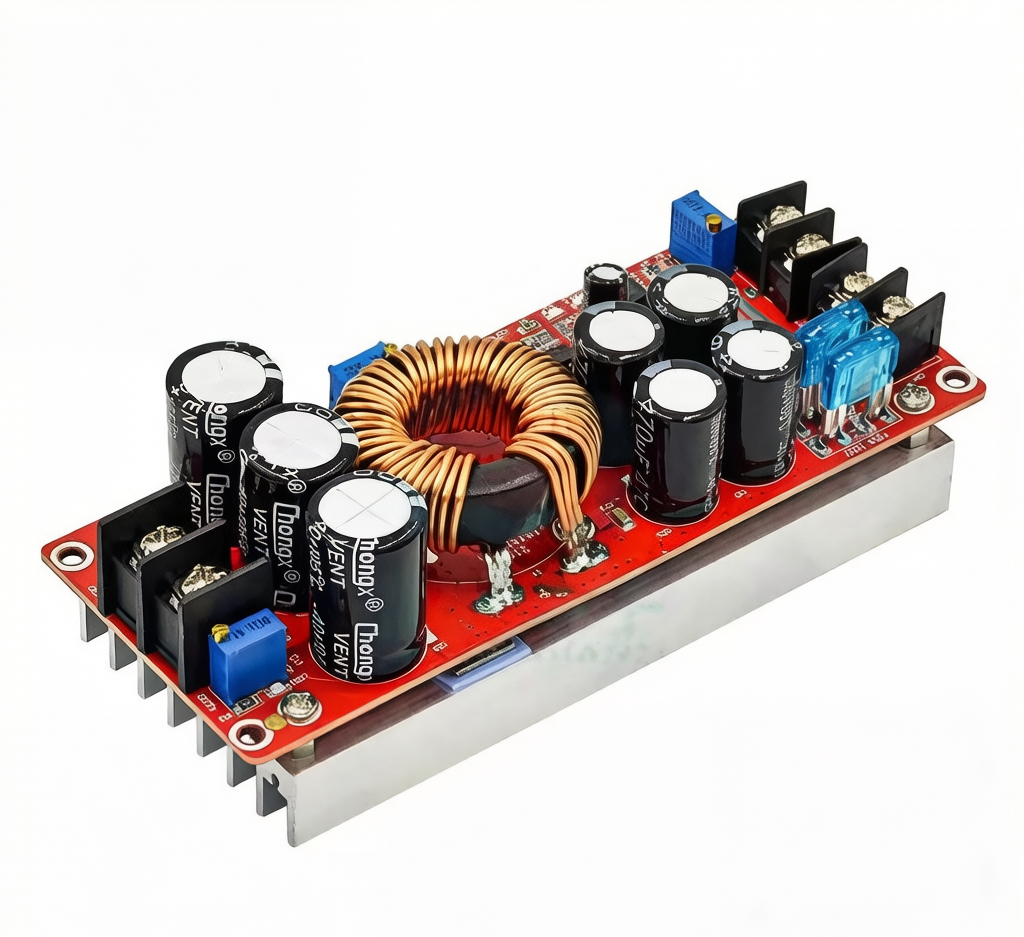
The 1200W DC-DC Boost Converter Module is a professional-grade, high-power step-up voltage regulator designed for the most demanding power conversion applications. This non-isolated boost converter accepts a wide DC input range of 10V to 60V and delivers an adjustable output of 12V to 90V with a maximum output current of 20A and peak power of 1200W.
What sets this module apart is its comprehensive protection system and true Constant Voltage (CV) and Constant Current (CC) control capability. Independent multi-turn potentiometers allow precise adjustment of both output voltage and current limit, making it ideal for lithium battery charging, high-power LED driving, solar system boosting, and industrial equipment power supply.
The module features dual heatsinks (large aluminum base plate and finned secondary heatsink) for excellent thermal management. An optional temperature-controlled fan can be added – it automatically activates when the module exceeds approximately 55-60°C and stops when temperatures drop, effectively reducing noise and extending fan life. The 27mm iron silicon aluminum magnetic ring inductor with multiple 1.2mm pure copper enameled wire windings ensures high efficiency and stable performance under heavy loads.
Power Rating Explanation: A 1200W rating does not mean the module can output 1200W from a 12V battery. Due to the 20A input current limit, the effective output power equals input voltage × 20A. For example, 12V input × 20A = 240W effective output; 24V input × 20A = 480W; 36V input × 20A = 720W; 48V input × 20A = 960W; 60V input × 20A = 1200W. This is not a limitation of the module but a result of the laws of physics—the input current rating determines achievable output power at lower voltages.
Key Features
-
1200W High Power Output: Delivers up to 1200W output power at 60V input. For applications requiring more than 20A, two modules can be connected in parallel (e.g., two modules at 15A each for 30A total).
-
Adjustable CV/CC Control: Independent multi-turn potentiometers allow precise setting of output voltage (12-90V) and constant current limit (0.5-20A), essential for battery charging and LED driving.
-
Wide Input/Output Range: Accepts DC input from 10V to 60V, with output adjustable from 12V to 90V. Input voltage must be lower than output voltage for boost operation.
-
High Conversion Efficiency: Achieves 92-97% efficiency (efficiency is highest when the difference between input and output voltage is small), minimizing power loss and heat generation.
-
Comprehensive Protection System:
-
Input Reverse Polarity Protection: 150A power MOS prevents damage from accidental reverse connection – can be reversed for a long time without damage
-
Overcurrent Protection: Automatically reduces output voltage when input exceeds 25-35A (model dependent)
-
Short Circuit Protection: Dual-layer protection including input 30A fuse
-
Low Battery Protection: Adjustable (8-50V) with self-recovery function – automatically shuts down when battery voltage drops too low
-
Temperature-Controlled Fan: Hydraulic bearing fan only activates when module temperature exceeds ~55°C and stops when cool, balancing noise and heat dissipation.
-
Dual Heatsink Design: Large aluminum base plate (5mm thick) plus finned secondary heatsink with black oxidation treatment for superior thermal conductivity.
-
High-Quality Components: Insulation board made of high-quality alumina (10× better thermal conductivity than ordinary pads), oversized ferrosilicon aluminum magnetic ring inductor with 1.2mm pure copper dual-wire windings.
-
Wide Operating Temperature: Rated for -40°C to +85°C, suitable for demanding industrial environments.
Technical Specifications
Pinout & Connection Guide
The module features clearly labeled screw terminals for input and output connections.
Input Terminals (Power Source)
Output Terminals (Load Connection)
Adjustment Controls
Additional Features
⚠️ Critical Safety Notes:
-
This module has input reverse polarity protection (150A MOS) – connecting input backward will not damage the module
-
However, it remains best practice to double-check wiring before applying power
-
The module cannot regulate output voltage below input voltage (boost only)
-
For loads exceeding 15A, active cooling (the built-in fan or additional external fan) is mandatory
Usage Guide
Important First-Time Setup
⚠️ Use a Multimeter: The factory default output is often set to a random voltage (typically 19V). Always measure the output with a multimeter before connecting your load and adjust the CV potentiometer to the exact voltage required.
Wiring Instructions
-
Set Initial Outputs: Before powering on, turn both potentiometers counter-clockwise about 20 turns to set minimum.
-
Connect Input: Connect your DC power source (10V-60V) to the IN+ and IN- terminals. The module has reverse polarity protection, so accidental reversal won’t damage it, but correct wiring is still best practice.
-
Set Output Voltage (CV Mode): Place a multimeter on output terminals. Apply input power. Slowly turn CV potentiometer clockwise while watching the multimeter until reaching desired voltage.
-
Set Current Limit (CC Mode) :
-
For LED loads: Set CC potentiometer to minimum, connect LED, then slowly increase CC pot while monitoring ammeter
-
For battery charging: Use a discharged battery when setting the current limit – a charged battery will draw less current, making adjustment difficult
-
Important: Do not short the output to set current – the boost converter circuit cannot regulate current in a short-circuit condition
-
Connect Permanent Load: Turn off input power, connect your permanent load, and re-apply power.
Thermal Management & Power Derating
The maximum safe output power depends on input voltage and cooling:
Important: If the module temperature exceeds 65°C, a cooling fan is mandatory. The module includes a temperature-controlled fan that automatically activates at approximately 55-60°C.
Cooling Fan Operation
The module features a smart temperature-controlled fan:
-
Fan off: During light loads or when temperature is below ~55°C
-
Fan on: Automatically activates when temperature reaches ~55-60°C
-
Benefit: Reduces noise and extends fan lifespan
Typical Applications
Q: How much real power can this module actually deliver at different input voltages?
The module’s maximum output power is determined by the formula: Input Voltage × 20A. For example:
-
12V input × 20A = 240W effective output
-
24V input × 20A = 480W effective output
-
36V input × 20A = 720W effective output
-
48V input × 20A = 960W effective output
-
60V input × 20A = 1200W maximum output
This is not a limitation of the module but a result of the laws of physics—the same input current at lower voltage yields proportionally less power. The module draws up to 20A input current peak, but sustained operation above 15A requires active cooling.
Q: Can I use this module to charge a battery?
Yes, this module is well-suited for battery charging applications. It features:
-
Constant Current (CC) mode for the bulk charge phase
-
Constant Voltage (CV) mode for the topping charge phase
-
Output anti-reverse protection (no external diode needed for charging)
Important: When setting the current limit for battery charging, use a discharged battery – a charged battery will draw less current, making it difficult to set the limit accurately. Set the output voltage to the battery’s float voltage (e.g., 4.2V × number of cells in series for Li-ion).
Q: Does this module have reverse polarity protection? What happens if I connect the input backward?
Yes, this module has comprehensive reverse polarity protection using a 150A power MOS that prevents damage from accidental reverse connection. It can be reversed for a long time without damage. However, it remains best practice to double-check your wiring before applying power.
Q: Do I need a cooling fan for this module?
For loads under 200W, passive cooling (the built-in heatsink) may suffice. For loads above 200W or with input below 24V, a cooling fan is highly recommended. The module includes a smart temperature-controlled fan that automatically activates when the module exceeds approximately 55°C and stops when temperatures drop.
Q: What are the power output differences between various 1200W modules on the market?
There are multiple 1200W-rated modules with different specifications:
-
Standard version (1200W/20A): 12-80V output, 20A input current. Effective power = input voltage × 20A
-
High-power version (1800W/40A): 12-97V output, 40A input current. Higher capacity at lower input voltages
Ensure you select the version that matches your power requirements. The “1200W” rating is achievable only at higher input voltages (≥60V).
Q: What happens if I exceed the input current limit?
The module has input overcurrent protection that automatically reduces output voltage when input current exceeds approximately 25-35A (model dependent). The input 30A fuse provides additional short circuit protection.
Q: Why does my 12V system struggle to deliver high power?
This module draws up to 20A input current. At 12V input, this limits output to approximately 240W (12V × 20A = 240W) . For 48V-90V output applications, start with a 24V-48V input for better performance.
Q: Can I connect two modules in parallel for more power?
Yes, but with caution. Two or more modules can be connected in parallel to increase total output current. For example, if you need 30A output, use two modules in parallel with each adjusted to 15A. Ensure the input power supply can handle the combined current draw.
Q: Can this module regulate current down to 0A for trickle charging?
No. This module cannot regulate current down to zero – it has a minimum current that drifts. This is important for applications requiring very low currents, such as final-stage trickle charging. For full CC/CV battery charging, this module works well for the bulk charge phase but may not completely shut off at the end of the cycle.
Q: Is this module suitable for high-power LED lighting?
Yes, using constant current (CC) mode. However, note that some LED types may not work well with pulsed DC output. Test with your specific LEDs before permanent installation. For LED applications, set CC mode to the LED’s rated current and the CV pot to the maximum forward voltage of the LED array.
Q: What is the default output voltage from the factory?
The factory default output is often set to a random voltage, typically around 19V. Always measure the output with a multimeter before connecting your load and adjust the CV potentiometer to the exact voltage required by your device.
Q: What is the difference between this 1200W module and 600W versions?
The primary differences are:
-
Input current rating: 1200W version draws 20A input (versus 10A on 600W versions)
-
Effective power at low voltages: At 12V input, 1200W version delivers 240W (versus 120W on 600W versions)
-
Component sizing: Larger inductor, heavier heatsinks, and higher-rated components
-
Maximum output voltage: Up to 90V (compared to 60-80V on 600W versions)