Product Overview
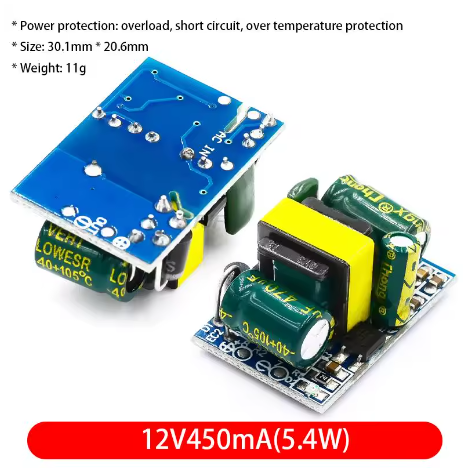
The 12V 450mA 5.4W Isolation Switching Power Supply Module is a compact, high-efficiency AC-DC converter designed to power industrial controls, embedded systems, IoT devices, and automation equipment directly from a wall outlet. Rated at 5.4 Watts (12V @ 450mA), this encapsulated module eliminates the need for bulky external power bricks by converting hazardous AC mains voltage (85V–265V) into a stable, regulated 12V DC output.
This module is an ideal power solution for relays, solenoid valves, LED lighting strips, wireless communication modules, PLCs, Arduino, ESP32, STM32, and various industrial sensors. Unlike traditional linear transformers that waste energy as heat, this switching mode power supply (SMPS) achieves up to 82% efficiency while maintaining a compact footprint.
The module features a built-in high-frequency transformer that provides 3kV galvanic isolation between the dangerous high-voltage AC input and the low-voltage DC output, ensuring the safety of both your sensitive electronics and the personnel handling the equipment. Its fully encapsulated design protects against dust, moisture, and vibration, making it ideal for integration into industrial panels, home appliances, and commercial electronic products.
Key Features
-
Compact Encapsulated Design: Fully potted module protects against dust, moisture, and physical stress, ideal for industrial environments and PCB mounting
-
Wide Universal Input Voltage: Accepts AC 85V ~ 265V (47-440Hz) or DC 100V ~ 370V, making it compatible with global mains standards (110V, 220V, 240V) without jumpers
-
High Power Output: Delivers stable 12V DC at up to 450mA continuous current – 5.4W total output power
-
High Efficiency: Converts AC power with up to 82% efficiency (75-82% typical), minimizing energy waste and heat generation
-
3kV Galvanic Isolation: High-frequency transformer provides complete electrical isolation between AC input and DC output, enhancing safety and noise immunity
-
Multiple Protection Features: Built-in overcurrent, overtemperature, short-circuit, and overload protection; some models include OVP (overvoltage protection)
-
Low No-Load Power Consumption: Minimal standby power draw (<0.1W) meets modern energy efficiency standards
-
Wide Operating Temperature: Rated for -40°C to +85°C (varies by model), suitable for demanding industrial environments
-
PCB Through-Hole Mounting: Standard 4-pin or DIP package for easy soldering and robust mechanical attachment
-
Safety Certifications: Compliant with UL, CSA, TUV, CE, and RoHS standards for industrial and commercial applications
Technical Specifications
Pinout & Connection Guide
The module uses a standard 4-pin DIP arrangement. Pin labeling may vary slightly between manufacturers—always verify the silkscreen on your specific module.
AC Input Side (Primary / High Voltage)
DC Output Side (Secondary / Low Voltage)
Note: Some modules may have additional pins for mounting or case ground—refer to specific datasheet.
⚠️ Critical Safety Warning
This module deals with potentially lethal high voltage. Always ensure the device is UNPLUGGED during wiring. Use appropriately rated insulated wire (18-22 AWG) for AC connections. It is strongly recommended to add a fuse (e.g., 1A slow-blow) and a physical on/off switch in series with the Live/L input for safety.
Usage Guide
1. Safety First
⚠️ HIGH VOLTAGE RISK – Always ensure the module is DISCONNECTED FROM MAINS POWER before handling, soldering, or modifying connections. Do not touch any part of the AC side while the module is powered.
2. Mounting
-
For Prototyping: Solder the module directly to a PCB or use a DIP socket for easy removal. The 4 corner pins provide robust mechanical support.
-
For Permanent Installation: Solder the module to your custom PCB. The encapsulation protects against vibration and environmental contaminants.
3. AC Input Connection
Using 18-22 AWG stranded or solid-core wire:
-
Connect L (Live) to the AC Live wire (through a 1A slow-blow fuse and switch for safety)
-
Connect N (Neutral) to the AC Neutral wire
-
Connect FG (Frame Ground) if present – to Earth Ground
4. DC Output Connection
Connect your 12V load to the output pins:
-
+V → Positive terminal of your device (e.g., relay coil, LED strip, sensor)
-
-V / GND → Negative terminal / Ground return
Tip: For powering sensitive analog circuits, add a 100µF electrolytic capacitor across the output terminals to reduce switching ripple.
5. Testing
Before connecting expensive equipment:
-
Double-check all AC and DC connections for shorts
-
Plug module into AC outlet. Use a multimeter to verify output voltage is 12V ±0.5V
-
Measure with a load (e.g., a 12V LED) to ensure stable operation
-
Add a small heatsink if operating near maximum load in enclosed spaces
6. Typical Applications
-
Industrial Control Panels: Power PLCs, relays, contactors, and indicator lights
-
IoT & Embedded Systems: ESP32, Arduino, STM32, Raspberry Pi Pico
-
LED Lighting: 12V LED strips, architectural lighting, signage
-
Automation: Solenoid valves, small motors, actuators
-
Security Systems: Alarms, access control panels, cameras
-
Test & Measurement: Bench power for prototypes and sensors
Q: Can I use this module to power a 12V relay directly?
Yes, absolutely. This module is ideal for powering industrial relays, small solenoid valves, and other 12V actuators. Ensure the load does not exceed the 450mA continuous current rating.
Q: What is the maximum load I can connect (450mA)? How much power is that?
At 12V, 450mA equals 5.4 watts. This is sufficient for a small relay (20-80mA), a 5W LED strip segment, or a basic sensor network. For motorized devices, a higher-current supply is recommended.
Q: Is this power supply truly isolated? Is it safe to touch the output wires while powered?
Yes and Yes. This module provides 3kV galvanic isolation between the input AC mains and the output DC voltage. There is no direct electrical path, so touching the 12V output wires is safe (though you should never touch the AC input side).
Q: Why is my multimeter reading slightly less than 12.00V?
The specification allows a tolerance of ±0.2V to ±0.5V (11.5V – 12.5V). This is normal for switch-mode power supplies and is well within the operating limits of all 12V electronics.
Q: Can I use this module to charge a 12V lead-acid or lithium battery?
No, not directly. This is a Constant Voltage (CV) power supply. A battery requires a Constant Current/Constant Voltage (CC/CV) charging profile. Using this directly could over-current and damage the battery. Always use a dedicated battery charger module.
Q: The module gets warm during use. Is this normal?
Yes. At near-maximum load (450mA), the module will generate some heat due to inefficiency (~1W of heat at 75% efficiency). However, if it is too hot to touch, ensure adequate airflow and that you are not exceeding the 450mA limit.
Q: Does this module require external components to work?
No, it is a standalone power supply. Simply connect the AC input and DC output. However, adding a fuse and switch on the AC line is strongly recommended for safety.
Q: Can I use a 12V DC input to power this "AC-DC" module?
No. This module is designed specifically for AC mains voltage. The internal transformer expects 85-265V AC. Applying 12V DC will not be sufficient to start the control circuitry.
Q: What happens if I short-circuit the output?
The module includes short-circuit protection (SCP). When a short occurs, the output will shut down to protect itself. Once the short is removed, the module typically recovers automatically (or may require a brief power cycle).
Q: What is the difference between this module and a standard USB phone charger?
Both are AC-DC converters, but this is a bare-board PCB module designed for permanent installation inside equipment. Phone chargers are external accessories with USB connectors. This module integrates directly into your product’s PCB, saving space and eliminating loose cables