Description
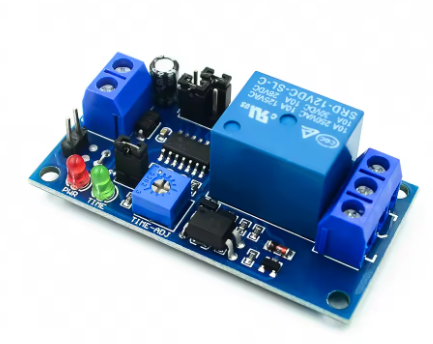
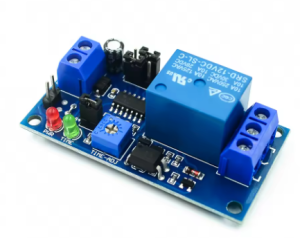
The 12V Normally Open Vibration-Activated Delay Relay Module is an intelligent, standalone vibration detection and timed switching device designed for security systems, industrial equipment protection, and automation applications. Operating on a standard 12V DC supply—compatible with automotive systems, security panels, battery backups, and industrial control circuits—this module combines a high-sensitivity vibration sensor with a precision delay timer and a powerful built-in relay.
What sets this module apart is its Normally Open (NO) trigger design combined with an adjustable delay circuit. The module remains in a low-power standby state until vibration is detected. Upon detection, the relay instantly closes (activates) and remains closed for the programmed delay period—even if the vibration stops immediately. This “latch and hold” behavior ensures that alarms sound long enough to be noticed, equipment shutdowns complete properly, and notification signals are reliably transmitted .
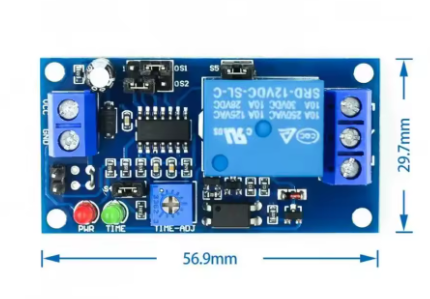
The module features dual adjustment capabilities: a sensitivity potentiometer allows you to set the vibration threshold from light taps to heavy impacts, while a delay time potentiometer (or DIP switches on advanced models) lets you program the relay activation duration from as short as 0.1 seconds up to 1 hour or more . An optocoupler-isolated trigger input provides excellent noise immunity, preventing false triggering from electrical interference .
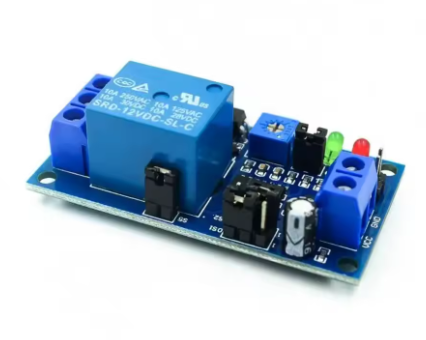
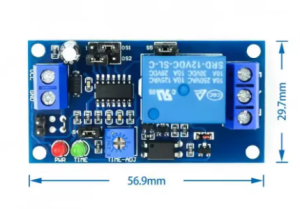
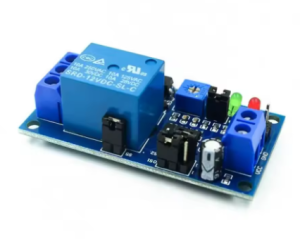
LED indicators provide clear visual feedback: a red LED shows power status, and a green LED illuminates when the relay is activated . The relay output is rated for 10A at 250V AC or 30V DC, capable of controlling alarms, sirens, lights, motors, contactors, or PLC inputs directly .
Whether you need to create a vibration-triggered burglar alarm for a safe or tool cabinet, detect tampering with industrial equipment, monitor conveyor belt jams, protect a workshop from unauthorized access, or build a seismic alert system, this 12V Normally Open Vibration-Activated Delay Relay Module delivers reliable, programmable protection without requiring microcontrollers or complex programming.
Key Features
-
Normally Open (NO) Trigger Design – Relay remains open (inactive) under normal conditions; closes (activates) when vibration is detected. Ideal for alarm and notification applications.
-
Adjustable Vibration Sensitivity – Onboard potentiometer allows precise threshold setting from light touch detection to heavy impact only.
-
Wide Adjustable Delay Range – Programmable delay from 0.1 seconds up to 1 hour (selectable via DIP switches or potentiometer, depending on model) .
-
12V DC Operation – Compatible with automotive systems, security panels, industrial controls, and battery-powered installations.
-
High-Power Relay Output – 10A / 250V AC or 10A / 30V DC contact rating controls alarms, sirens, lights, motors, and contactors directly .
-
Optocoupler-Isolated Trigger Input – Provides excellent noise immunity and prevents false triggering from electrical interference .
-
Anti-Reverse Protection Diode – Protects the module from damage due to accidental reverse polarity connection .
-
Dual LED Indicators – Red LED indicates power ON; green LED illuminates when relay is activated (vibration detected + delay active) .
-
Standalone Operation – No microcontroller, programming, or software required – works immediately after wiring and adjustment.
-
Compact Form Factor – Small footprint (approx. 60mm x 44mm) fits easily into security panels, equipment enclosures, or DIY projects .
Technical Parameters
Usage Guide
How It Works
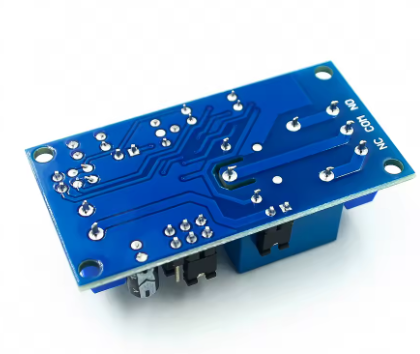
The module continuously monitors for vibration through its high-sensitivity sensor. Under normal conditions (no vibration), the relay remains open (inactive) – this is the “Normally Open” state. When vibration exceeding the sensitivity threshold is detected, the trigger circuit activates, and the relay immediately closes (activates) , connecting the COM and NO terminals. The relay remains closed for the entire programmed delay period, regardless of whether the vibration continues or stops. After the delay period expires, the relay opens again and returns to standby mode, waiting for the next vibration event .
Important behavior: If additional vibration is detected during the delay period, most versions of this module will reset the timer – meaning the delay restarts from zero, keeping the relay active for another full delay cycle . This ensures that continuous or repeated tampering keeps the alarm active.
Wiring Instructions
Step 1 – Power Connection
-
Connect a 12V DC power supply to the VCC (+) and GND (-) terminals.
-
Suitable sources: 12V battery, 12V automotive system, 12V security panel supply, or regulated 12V power adapter.
-
The module includes reverse polarity protection – but still double-check connections before applying power .
Step 2 – Load (Device) Connection
Wiring Example (Alarm Siren – Activates on vibration):
-
Connect alarm siren positive wire → NO terminal
-
Connect 12V power supply positive → COM terminal
-
Connect alarm siren negative → power supply negative directly
Wiring Example (Warning Light + Buzzer – Both activate on vibration):
-
Connect warning light positive → NO terminal
-
Connect buzzer positive → NO terminal (parallel connection)
-
Connect 12V power supply positive → COM terminal
⚠️ Safety Warning: For AC loads (110V/220V), ensure all connections are properly insulated. Use appropriate gauge wire and mount the module in an enclosure. The relay contacts are rated for 10A – do not exceed this rating.
Sensitivity Adjustment
-
Power on the module and place the sensor in the target location.
-
Locate the sensitivity potentiometer (usually labeled “SENS” or “ADJ”).
-
Use a small screwdriver to adjust:
-
Test by creating controlled vibration (tap near the sensor) and observe the green LED.
-
Repeat adjustment until the desired sensitivity is achieved.
Tip: Start with the potentiometer at mid-position (50%), then fine-tune based on your testing.
Delay Time Adjustment
Method 1 – Potentiometer Adjustment (Basic Models):
-
Locate the delay potentiometer (usually labeled “DELAY” or “TIME”)
-
Turn clockwise to increase delay time
-
Turn counter-clockwise to decrease delay time
-
Delay range is typically continuous from approximately 1 second to 240 seconds (4 minutes)
Method 2 – DIP Switch + Potentiometer (Advanced Models):
Advanced versions of this module feature 3-position DIP switches (S1, S2, S4) that allow selection of 8 different time ranges, from as short as 0.1 seconds up to 1 hour. The potentiometer then provides fine adjustment within the selected range .
Note: Actual switch settings may vary by model – consult the included documentation.
Delay Time Guidelines:
Sensor Placement Tips
-
Mount the vibration sensor firmly to the equipment or surface being monitored – loose mounting reduces sensitivity.
-
For best results, mount on a rigid, flat surface using screws or strong double-sided tape.
-
The sensor can be mounted remotely using the included cable (up to 2 meters without sensitivity loss; longer runs may be possible with shielded cable) .
-
Avoid mounting near sources of constant vibration (e.g., running motors) that may cause continuous triggering – or adjust sensitivity to ignore background noise.
-
For outdoor or wet environments, protect the sensor in a weatherproof housing.
Testing the Module
-
Apply 12V power – the red power LED should illuminate.
-
Set sensitivity to mid-range and delay to 10 seconds (or a known duration).
-
Tap the sensor or the surface it’s mounted on firmly.
-
The green LED should illuminate immediately, and the relay should click.
-
The green LED and relay should remain active for the programmed delay time.
-
After the delay expires, the green LED should turn off, and the relay should click open.
-
If you tap again during the delay period, the timer should reset (delay restarts from zero) .
Q: What does "Normally Open Trigger" mean for this module?
Normally Open (NO) means the trigger circuit is open (inactive) under normal, no-vibration conditions. The relay contacts between COM and NO are also open, so no current flows to your connected device (alarm, light, etc.). When vibration is detected, the trigger circuit closes, and the relay closes (activates), completing the circuit and powering your device for the programmed delay period. This is the standard configuration for alarm and notification applications
Q: What is the difference between NO and NC outputs on this module?
Both terminals are available on the same module – use NO for alarms and notifications, or NC for equipment shutdown applications .
Q: What happens if vibration continues during the delay period?
In most versions of this module, if additional vibration is detected while the relay is already active (during the delay period), the timer resets and restarts from zero. This means the relay will remain active for another full delay cycle. This “retriggerable” behavior ensures that continuous tampering or ongoing vibration keeps the alarm active until the disturbance stops
Q: What is the maximum delay time available?
Basic models offer adjustable delay from 1 second to 240 seconds (4 minutes) via potentiometer . Advanced models with DIP switches offer 8 selectable time ranges from as short as 0.1 seconds up to 1 hour , with the potentiometer providing fine adjustment within the selected range
Q: Can I use this module for both home and business applications?
Home users: Burglar alarm for safes, tool cabinets, gun lockers, or jewelry boxes; garage door tamper detection; sump pump vibration monitoring; workshop equipment protection; DIY seismic alert system.
Business users: Industrial equipment tamper detection, conveyor belt jam monitoring, CNC machine vibration shutdown, security cabinet protection, warehouse door tamper alarm, pump cavitation detection, compressor monitoring, vending machine tamper alarm, ATM vibration detection.
Q: Can I use this module in a vehicle (12V car system)?
Yes. The 12V version is specifically designed for automotive applications. It can be used for:
-
Vehicle anti-theft systems (detects towing, impact, or door tampering)
-
Dashboard camera trigger (start recording on vibration)
-
Engine bay tamper detection
-
Trailer vibration monitoring
Connect to a switched 12V source (fuse box, accessory power) or directly to the battery with an inline fuse (2A recommended). The module’s low standby current (<5mA) is suitable for always-on security applications.
Q: What is the standby current consumption?
The module consumes less than 5mA in standby mode (relay idle, no vibration detected) . This low power draw makes it suitable for battery-powered security systems and always-on installations where long-term power efficiency is important.
Q: How sensitive is this module? Can it detect light taps?
Yes. With the sensitivity potentiometer adjusted to maximum (fully counter-clockwise), the module can detect very light vibrations – as subtle as a finger tap on the mounting surface, footsteps on the floor nearby, or a door opening. For industrial applications where only heavy impacts should trigger, sensitivity can be reduced to ignore minor background vibration.
Q: Does the module remember delay and sensitivity settings after power loss?
-
Sensitivity: The potentiometer is a mechanical component – its position does not change when power is removed. Sensitivity settings are effectively permanent.
-
Delay (Potentiometer models) : Potentiometer-based delay settings are also mechanical and persist after power loss.
-
Delay (DIP switch models) : DIP switch positions are mechanical and do not change when power is removed. Settings are retained permanently.
Q: Why does my relay activate without any vibration?
Possible causes:
-
Sensitivity too high – Turn the sensitivity potentiometer clockwise to require stronger vibration.
-
Sensor mounting too loose – Secure the sensor firmly to prevent false triggering from its own movement.
-
Electrical noise – The optocoupler-isolated input provides good noise immunity, but severe electrical interference (from motors, welders, etc.) may still cause false triggers. Relocate the module or add shielding.
-
Sensor defective – Disconnect the sensor; if the module still triggers, the sensor may need replacement.