Product Description
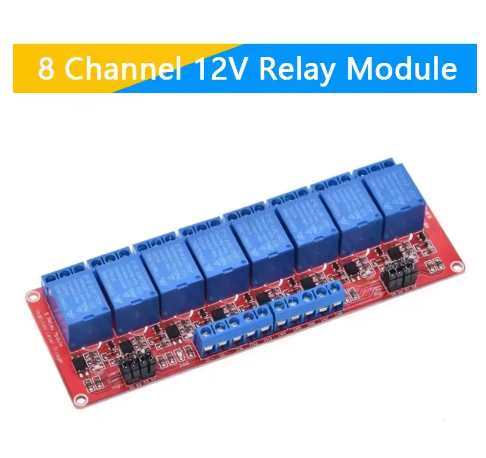
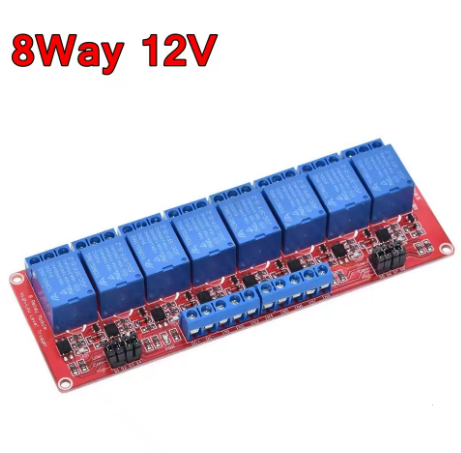
The 8-Channel Opto-Isolated 12V Relay Module is a professional, high-density interface designed for complex industrial control systems, sophisticated automation, and applications where managing multiple circuits with absolute electrical integrity is critical. This advanced module provides eight completely independent, optically isolated channels, allowing you to safely interface 12V control systems—such as PLCs, industrial controllers, or 12V logic—with a wide array of high-power AC or DC loads. Each channel is fortified with its own optocoupler, establishing a robust 2500V isolation barrier that completely separates the sensitive control side from potentially noisy and hazardous load circuits, preventing ground loops, voltage spikes, and electrical interference.
Engineered for maximum flexibility, the module features selectable high or low-level trigger logic for each channel via convenient jumpers, ensuring seamless compatibility with any 12V sinking or sourcing control logic. The integration of dual status LEDs per channel provides unparalleled diagnostic clarity, indicating both the opto-isolator activation and the physical relay state. With its eight high-current relays, secure screw terminals, and industrial-grade construction, this module is the definitive solution for building reliable control panels, machine interfaces, and multi-zone automation systems where safety, noise immunity, and high channel count are non-negotiable.
Key Features
-
High-Density 8-Channel Control: Manage up to eight completely independent electrical circuits from a single, integrated module, maximizing control capability in complex systems.
-
Full Optical Isolation per Channel: Each channel features an independent optocoupler providing 2500Vrms of isolation, ensuring total protection for your 12V controller from load-side transients and noise.
-
Selectable Trigger Logic: Individual jumper selection for each channel allows configuration as either High-Level (active-HIGH) or Low-Level (active-LOW) trigger, for perfect compatibility with any 12V control system (PLC, microcontroller, etc.).
-
Industrial 12V Compatibility: Designed specifically for 12V DC control systems commonly used in industrial automation, automotive, and PLC environments.
-
High-Current Relay Outputs: Eight industrial-grade electromagnetic relays with SPDT contacts, each capable of switching up to 10A loads, suitable for motors, solenoids, heaters, and lighting.
-
Comprehensive Diagnostic Indicators: Dual LEDs per channel provide clear visual feedback: one for opto-isolator input status and one for relay coil/output status, simplifying installation and troubleshooting.
-
Robust & Secure Connections: All high-power load and control power connections utilize heavy-duty screw terminals for reliable, vibration-resistant wiring in demanding environments.
-
Integrated Protection Circuits: Includes flyback diodes across each relay coil to suppress inductive voltage spikes and protect the driving circuitry.
Main Parameters
-
Number of Channels: 8 Independent Relays
-
Control & Logic Voltage: 12V DC
-
Trigger Mode: High or Low Level (Jumper Selectable per channel)
-
Isolation Rating: 2500V RMS (Optocoupler)
-
Relay Contact Rating: 10A @ 250VAC / 10A @ 30VDC
-
Relay Type: Electromagnetic, SPDT (Single Pole Double Throw)
-
Input Current (per channel): ~5-10mA (to activate optocoupler)
-
Dimensions: Approx. 145mm x 100mm x 25mm
Typical Applications / Usage
-
Industrial Machine Control Panels: Interface 12V PLC output cards with multiple actuators, solenoid valves, motor starters, and indicator lights on factory automation equipment.
-
Building Management Systems (BMS): Centralized control of HVAC zones, exhaust fans, and lighting circuits in commercial buildings using a 12V DC control backbone.
-
Complex Automotive/Marine Automation: Control a suite of high-power accessories (lighting arrays, winches, pumps, audio) in custom vehicle or boat installations from a central 12V controller.
-
Telecommunications & Server Rack Management: Control power sequencing, cooling fans, and auxiliary devices across multiple equipment racks in a data center environment.
-
Agricultural and Environmental Control: Automate multi-zone irrigation valves, greenhouse ventilation, and grow lights in large-scale agricultural setups.
-
Prototyping Heavy-Duty Control Systems: The ultimate development tool for engineers designing industrial controllers, test benches, or custom automation solutions requiring multiple isolated outputs.
Connection & Configuration Guide:
-
Trigger Configuration: For each channel, place the jumper cap over the pins labeled “H” (High-Level trigger) or “L” (Low-Level trigger) to match your controller’s output logic (sourcing or sinking).
-
Power & Control Wiring: Connect a stable 12V DC power supply to the module’s VCC and GND terminals. Connect the eight signal input pins (IN1-IN8) to the digital outputs of your 12V PLC or controller.
-
Load Wiring: For each channel, connect the power source for your load (AC Mains or DC) to the relay’s Common (COM) terminal. Connect the device to be controlled to the Normally Open (NO) or Normally Closed (NC) terminal as required by your application logic.
-
Critical Safety: Always disconnect all high-voltage power before making connections. This module must be installed in a properly rated industrial enclosure. Adhere to all local electrical codes and standards for wiring, especially for AC mains connections.
Q: Why is a 12V-specific relay module preferred in industrial settings?
12V DC is a standard control voltage in industrial automation due to its optimal balance of safety (low voltage), noise immunity, and ability to power solenoids and sensors over longer wire runs without excessive voltage drop. This module is built to integrate directly into that ecosystem.
Q: What's the advantage of having optical isolation on an industrial 12V module?
Even in 12V systems, switching high-power inductive loads (motors, solenoids) can generate significant electrical noise and voltage spikes on the ground plane. Optical isolation prevents this noise from coupling back into the sensitive logic circuits of the PLC or controller, which can cause malfunctions, false triggers, or damage.
Q: My controller outputs 24V. Can I use this 12V module?
No, you cannot directly. Applying 24V to the control inputs or VCC will damage the optocouplers and other components. You would need either a 24V-to-12V DC/DC converter to power the module, or a module specifically designed for 24V control logic.
Q: How do I choose between High and Low-Level trigger for my PLC?
Check your PLC’s output specifications.
Q: What is the power consumption of the module?
The control side (opto-couplers) draws minimal current (~5-10mA per active channel). The main power draw is from the relay coils. Each 12V coil draws approximately 80-100mA when activated. With all 8 relays on, the module can draw 640-800mA from your 12V supply. Ensure your 12V power source is adequately rated.
Q: Can I control 3-phase motors directly with this module?
No. The relays are single-pole (SPDT). To control a 3-phase motor, you use one channel of this module to energize the coil of a 3-pole contactor, which is specifically designed to switch all three phases simultaneously and safely.
Q: Do the eight channels share a common terminal on the load side?
No. Each relay’s COM, NO, and NC terminals are completely independent. This allows you to switch circuits with different voltages (e.g., 120VAC, 240VAC, 24VDC) on different channels, provided the ratings are not exceeded.
Q: Is this module suitable for OEM integration into our industrial product?
Absolutely. Its industrial-grade design, high channel density, optical isolation, and flexible triggering make it an excellent choice for OEM integration into machinery, control panels, and automated systems. We offer volume pricing, custom labeling, and can discuss modified specifications (e.g., specific terminal types, connectorized versions) for qualified business and industrial clients.