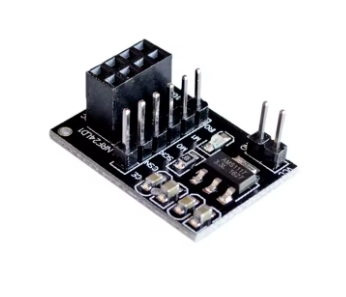
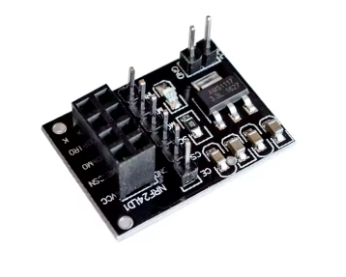
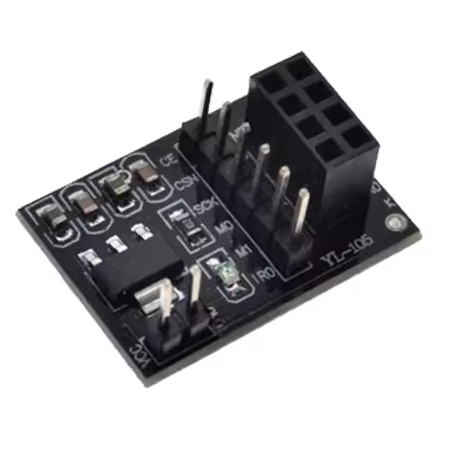
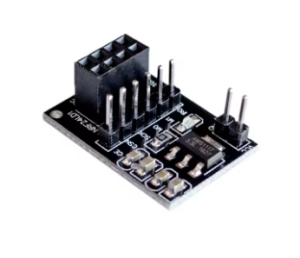
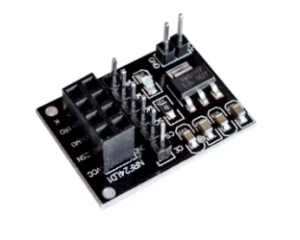
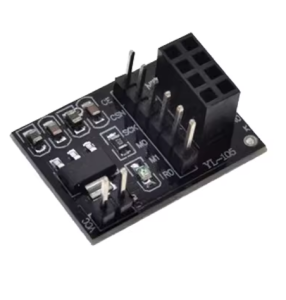
- Integrated Voltage Regulation: Onboard AMS1117-3.3 chip converts a standard 5V input to a steady 3.3V output.
- Enhanced Signal Integrity: Built-in bypass capacitors filter out power supply noise, significantly improving wireless range and transmission stability.
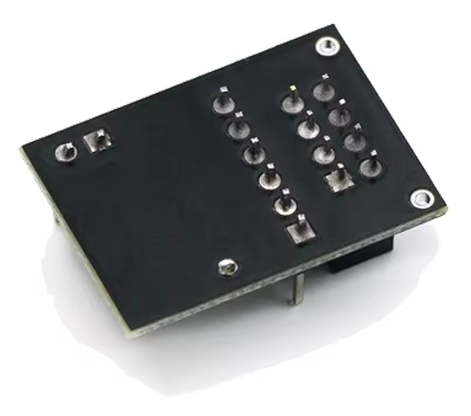
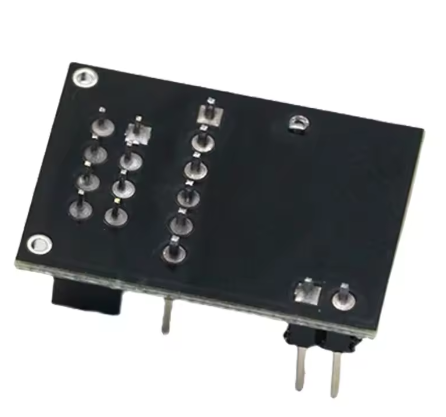
- Simple Pinout: Breaks out the complex 8-pin header into a single-row header that is breadboard-friendly and easy to label.
- Power Status LED: A built-in SMD indicator provides immediate visual confirmation that the module is receiving power.
- Reverse Polarity Protection: Protects your expensive nRF24L01 modules from damage due to incorrect wiring.
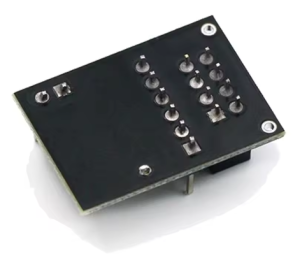
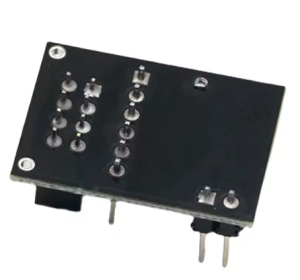
8-Pin NRF24L01 Socket Adapter for Wireless Transmitter Module – Plug & Play
| Input Voltage | 4.8V to 12V DC |
|---|---|
| Output Voltage | 3.3V DC (Fixed) |
| Maximum Output Current | 800mA (Well above the peak requirements of the nRF24L01+ PA/LNA versions) |
| Interface | 8-Pin socket for nRF24L01+; 6-Pin header for Microcontroller connection (VCC, GND, CE, CSN, SCK, MO, MI, IRQ) |
| Dimensions | 26mm x 19mm x 12mm |
| Operating Temperature | -40°C to +85°C |


- Installation: Insert your nRF24L01+ module into the 8-pin female socket on the adapter. Ensure the orientation matches the silkscreen markings.
- Power Connection: Connect your power source (typically 5V from an Arduino or external supply) to the VCC and GND pins on the adapter.
- Data Connection: Connect the SPI pins (CSN, CE, MOSI, MISO, SCK) directly to your microcontroller’s corresponding SPI pins.
- Note: While the adapter accepts 5V for power, ensure your microcontroller’s logic levels are compatible (the nRF24L01+ pins are generally 5V tolerant for data, but always check your specific module datasheet).
The 3.3V pin on many microcontrollers cannot provide enough current during the high-power “burst” phases of wireless transmission. This leads to dropped packets. This adapter uses its own regulator to ensure the radio always has the current it needs.
Yes. In fact, it is highly recommended for the high-power versions, as they draw significantly more current than the standard “on-board antenna” versions.
Most adapters come with pre-soldered headers and sockets, making them a 100% plug-and-play solution.
No, this adapter regulates the power supply (VCC). However, the nRF24L01+ data pins are 5V tolerant, meaning you can typically connect them directly to a 5V microcontroller without a logic level shifter.
Absolutely. For business customers, these adapters reduce assembly errors and field failures caused by power fluctuations, making them a cost-effective choice for scaled deployments.