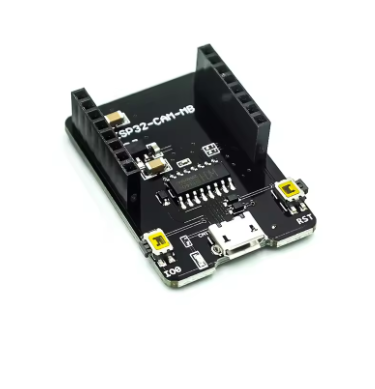
CAM Download board CH340 Micro-USB interface for ESP32-CAM

SKU: FA1053-2-3
Interface Type

Micro-USB

USB-to-Serial Chip

CH340G

Output Voltage

5V DC (to ESP32-CAM)

Programming Logic

Automatic Boot/Reset (No manual jumper needed)

Compatible Modules

All standard ESP32-CAM 16-pin variants (AI-Thinker, etc.)

Data Rate

Supports up to 115200 bps (Standard) and higher

Operating Temp

-40°C to +85°C

This CAM Download Board (CH340 Edition) is a professional-grade programming and power-management interface specifically designed for the ESP32-CAM series of modules. In 2025, it remains the essential tool for both rapid business prototyping and individual makers, providing a “plug-and-play” USB connection for a module that lacks a native USB port.
Product Description
The ESP32-CAM is world-renowned for its low-cost vision capabilities, but its lack of an on-board USB port makes programming and powering the module a challenge. The CAM Download Board (MB) solves this by providing a high-stability CH340 USB-to-Serial bridge and a convenient Micro-USB interface.
This board acts as a “motherboard” or “dock” for the camera module. It not only handles the automatic switching into “Flash Mode” (eliminating the need to manually bridge GPIO 0 to Ground) but also provides a reinforced power regulation system. This ensures the ESP32-CAM receives the stable current required for Wi-Fi transmission and image processing—two tasks that frequently cause “brown-out” resets when powered by standard, low-current serial adapters.
Key Features
  • One-Click Programming: Features automatic bootloader entry logic; simply hit “Upload” in your IDE without holding physical buttons.
  • High-Stability Serial Chip: Utilizes the CH340G bridge, known for its wide driver compatibility and reliable data transfer rates across Windows, macOS, and Linux.
  • Reinforced Power Delivery: Designed to provide a steady 5V output to the camera module, preventing reboots during high-load Wi-Fi or Flash LED bursts.
  • Micro-USB Convenience: Uses a standard Micro-USB interface for easy connection to any modern PC or 5V power adapter.
  • Dual-Purpose Dock: Serves as both a programming fixture during development and a stable power base for permanent deployments.
  • Compact & Modular: Small footprint that matches the ESP32-CAM’s dimensions, keeping the overall assembly slim.
Usage Scenarios
  • Business / B2B: An essential tool for engineering teams to rapidly flash firmware onto dozens of camera nodes during small-batch production.
  • Single User / Maker: The safest way to learn ESP32-CAM development without the risk of incorrect wiring or “brownout” resets.
  • Educational Institutions: Simplifies classroom hardware setups by providing a standard USB interface, reducing student troubleshooting time.
Q: Do I need to press the "IO0" or "Reset" buttons to upload code?

No. The CAM Download Board includes an automatic reset circuit. When you click “Upload” in the Arduino IDE or ESP-IDF, the board automatically handles the entry into flash mode for you

Q: My computer doesn't see a COM port. What should I do?
You likely need to install the CH340 driver. You can find the latest 2025 drivers on the WCH official website. Also, ensure you are using a “Data” USB cable, not a “Power-only” cable.
Q: Can I leave the camera plugged into this board permanently?

Yes. Many users use the Download Board as a permanent base for their project. It provides a more stable power source than powering the camera via its 5V/GND pins directly.

Q: Does this work with the 8MB PSRAM version of the ESP32-CAM?

Yes. It is fully compatible with all memory variants (4MB, 8MB) and all lens types (OV2640, OV5640) of the standard ESP32-CAM form factor.

Q: The board is connected, but the camera stream is laggy. Why?

While the CH340 handles data, the USB cable and port quality are vital. High-resolution streaming requires significant current. Use a high-quality cable and a USB 3.0 port or a 5V/2A wall adapter for the best results.

Q: Is this board compatible with the ESP32-S3-CAM?
Generally, no. This board is specifically designed for the classic ESP32-CAM (AI-Thinker style) with the 16-pin (2×8) header layout. ESP32-S3 boards usually have their own on-board USB ports.