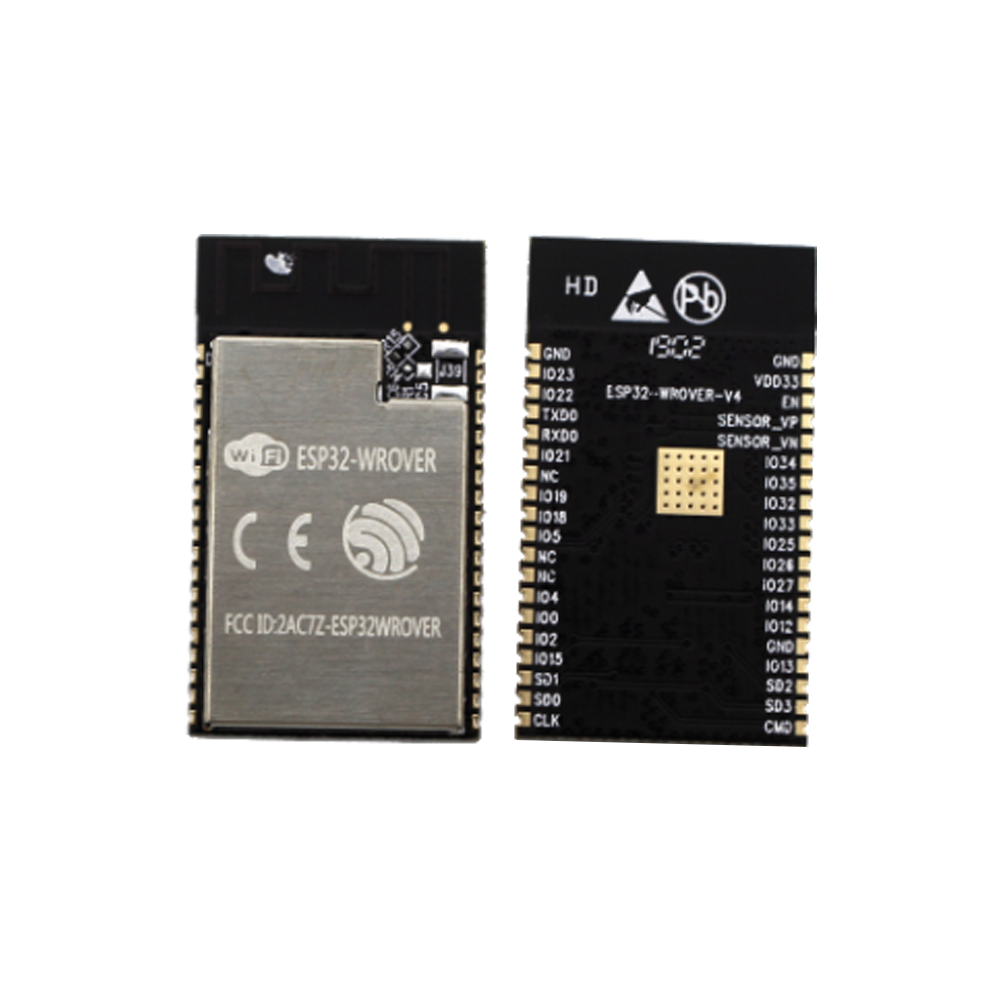
ESPRESSIF ESP32-WROVER Module

SKU: FA1053-1-0-3
Microcontroller

ESP32-D0WD (or ESP32-D0WDQ6 for early versions)

Clock Speed

80 – 240 MHz

Flash Memory

4MB / 8MB / 16MB (Quad SPI)

PSRAM

8MB (Quad SPI)

Wireless

Wi-Fi 802.11 b/g/n, Bluetooth v4.2 BR/EDR + BLE

Operating Voltage

3.0 – 3.6 V

Operating Temperature

-40°C to +85°C

Dimensions

18.0 × 31.4 × 3.3 mm

The ESP32-WROVER is a powerful, general-purpose Wi-Fi + Bluetooth + Bluetooth LE MCU module from Espressif Systems, designed for applications that demand both wireless connectivity and substantial memory capacity. Unlike the standard ESP32-WROOM series, the WROVER module integrates an additional 8MB SPI PSRAM (Pseudo Static RAM), making it exceptionally well-suited for memory-intensive tasks such as voice encoding, audio streaming, MP3 decoding, and AIoT applications.

At its core, the module uses the ESP32-D0WD (or ESP32-D0WDQ6 in earlier versions) chip, featuring a dual-core Xtensa 32-bit LX6 microprocessor with adjustable clock frequency from 80 MHz to 240 MHz. The two CPU cores can be individually controlled, and a low-power co-processor can monitor peripherals while the main cores are powered down. This architecture provides exceptional flexibility for balancing performance and power consumption.

The module supports Wi-Fi (802.11 b/g/n) with data rates up to 150 Mbps and Bluetooth v4.2 (BR/EDR and BLE). Antenna output power reaches up to 20 dBm, ensuring maximum wireless range. The chip’s sleep current is below 5 μA, making it suitable for battery-powered wearable electronics and low-power sensor networks.

The ESP32-WROVER series is available in multiple configurations. The ESP32-WROVER-B and ESP32-WROVER-IB versions use the ESP32-D0WD chip and are available with 4MB, 8MB, or 16MB Flash paired with 8MB PSRAM. The “B” suffix indicates 3.3V PSRAM operating at 133 MHz, while earlier versions used 1.8V PSRAM at 144 MHz. The ESP32-WROVER-E and ESP32-WROVER-IE represent the current generation, using the ESP32-D0WD-V3 chip.

Antenna options include the PCB onboard antenna (ESP32-WROVER-B, -E) and the IPEX/U.FL external antenna connector (ESP32-WROVER-IB, -IE) for applications requiring external antennas or metal enclosure compatibility.

Important Note: Espressif has marked the ESP32-WROVER-B and ESP32-WROVER-IB series as NRND (Not Recommended for New Designs). For new product development, the ESP32-WROVER-E and ESP32-WROVER-IE series are the recommended replacements, offering updated chip revisions and continued manufacturing support.

Development support is extensive, with official support for Espressif’s ESP-IDF and the Arduino IDE through the Arduino-ESP32 core. The module has achieved CE-RED, FCC, and SRRC certifications, ensuring compliance for international markets.

Whether you are building audio products, AI edge devices, industrial gateways, or memory-intensive IoT applications, the ESP32-WROVER module provides a proven, high-performance platform with the memory headroom to handle demanding tasks.


Features

  • 8MB PSRAM — Additional pseudo-static RAM for memory-intensive applications like audio processing and AIoT

  • Dual-Core Processing — Xtensa 32-bit LX6 dual-core microprocessor, up to 240 MHz

  • Integrated Wireless — Wi-Fi 802.11 b/g/n (up to 150 Mbps) and Bluetooth v4.2 BR/EDR + BLE

  • Low Sleep Current — Below 5 μA for battery-powered applications

  • Rich Peripheral Set — SD card, UART, SPI, SDIO, I2C, I2S, PWM, ADC, DAC, capacitive touch

  • Flexible Flash Options — Available in 4MB, 8MB, and 16MB configurations

  • Antenna Options — PCB onboard antenna or IPEX/U.FL external connector

  • Certified — CE-RED, FCC, and SRRC certified for international markets


Technical Specifications 

# Parameter Specification
1 Microcontroller ESP32-D0WD (or ESP32-D0WDQ6 for early versions)
2 Clock Speed 80 – 240 MHz
3 Flash Memory 4MB / 8MB / 16MB (Quad SPI)
4 PSRAM 8MB (Quad SPI)
5 Wireless Wi-Fi 802.11 b/g/n, Bluetooth v4.2 BR/EDR + BLE
6 Operating Voltage 3.0 – 3.6 V
7 Operating Temperature -40°C to +85°C
8 Dimensions 18.0 × 31.4 × 3.3 mm

Usage

Getting Started

  1. Select your module variant — Choose between PCB antenna (WROVER-B/-E) or IPEX connector (WROVER-IB/-IE) based on your enclosure requirements.

  2. Install the development environment — Install Arduino IDE with ESP32 board support, or set up ESP-IDF.

  3. Configure board parameters — Select “ESP32 Wrover Module” in Arduino IDE. This ensures PSRAM is properly enabled.

  4. Connect the module — Use a USB-to-UART adapter (3.3V logic) connected to TX, RX, GND, and EN pins. The bare module requires external 3.3V power supply.

  5. Upload your sketch — If uploading fails, hold the BOOT button (GPIO0 to GND) during the “Connecting…” phase.

Important PSRAM Note

GPIO16 and GPIO17 are used internally for PSRAM chip select and clock signals on ESP32-WROVER modules. These GPIOs are not available for external use when PSRAM is enabled. Ensure your application does not conflict with these pins.

Typical Applications

  • Audio streaming and MP3 decoding — 8MB PSRAM handles large audio buffers

  • AI edge computing — Memory headroom for TensorFlow Lite and image processing

  • Industrial IoT gateways — Reliable wireless communication with data buffering

  • Voice encoding and recognition — PSRAM supports demanding audio processing

  • Battery-powered remote sensors — Ultra-low sleep current extends operational life

Notes for Business Buyers

  • NRND status — The WROVER-B and WROVER-IB series are marked NRND. For new designs, consider the WROVER-E and WROVER-IE series.

  • Memory advantage — 8MB PSRAM provides significant headroom for complex applications compared to WROOM modules.

  • Certification — CE-RED, FCC, and SRRC certified, simplifying international market access.

  • Suitable for bulk purchasing — Ideal for audio products, AIoT devices, and industrial applications.

Q: What is the ESP32-WROVER module used for?

It is a Wi-Fi and Bluetooth MCU module with additional 8MB PSRAM, designed for memory-intensive IoT applications including audio streaming, voice encoding, MP3 decoding, and AIoT devices.

Q: What is the difference between ESP32-WROVER and ESP32-WROOM?

The WROVER adds 8MB PSRAM to the WROOM’s feature set, providing significantly more memory for data buffering and complex applications. The WROVER is also slightly larger (18 × 31.4 mm vs. 18 × 25.5 mm).

Q: How much PSRAM does the WROVER have?

The standard ESP32-WROVER series includes 8MB PSRAM. Some earlier or custom variants may have different capacities.

Q: What is the difference between WROVER-B and WROVER-E?

WROVER-B uses the ESP32-D0WD chip and is marked NRND. WROVER-E uses the updated ESP32-D0WD-V3 chip and is the current recommended version for new designs.

Q: What is the difference between the PCB and IPEX antenna versions?

The PCB version (WROVER-B, WROVER-E) has an onboard PCB antenna. The IPEX version (WROVER-IB, WROVER-IE) uses a U.FL connector for an external antenna, suitable for metal enclosures.

Q: Which GPIOs are unavailable when using PSRAM?

GPIO16 and GPIO17 are used internally for PSRAM chip select and clock signals and are not available for external use.

Q: What is the operating voltage?

The module operates from 3.0 to 3.6 V, with 3.3 V being the typical supply.

Q: Does it support low-power modes?

Yes. The sleep current is below 5 μA, making it suitable for battery-powered applications.

Q: Is the ESP32-WROVER recommended for new designs?

The WROVER-B and WROVER-IB are marked NRND. For new designs, use the WROVER-E or WROVER-IE series, which use updated chip revisions and continue to receive manufacturing support.

Q: Can I purchase in bulk for a product development project?

Yes. The module is suitable for both individual users and business purchasing. For new designs, confirm availability of the WROVER-E series with your supplier.