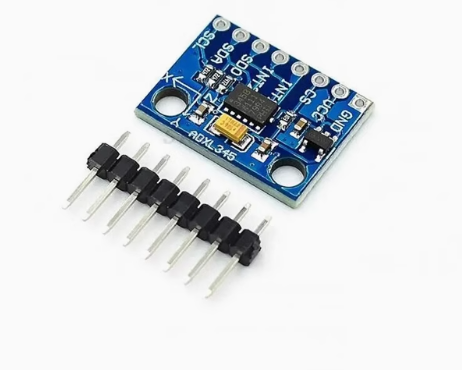
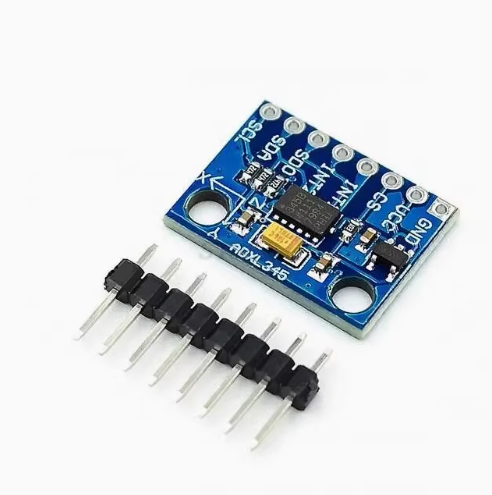
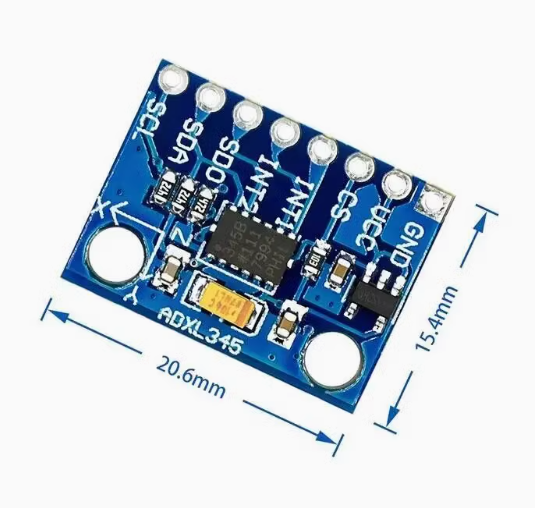
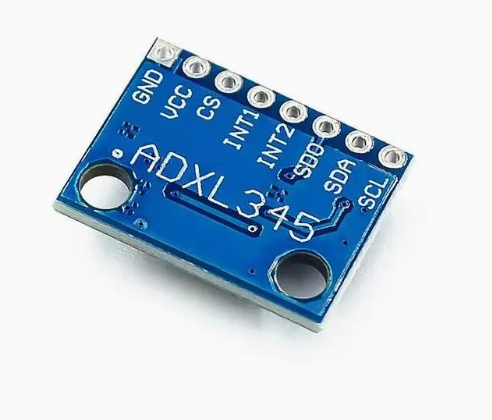
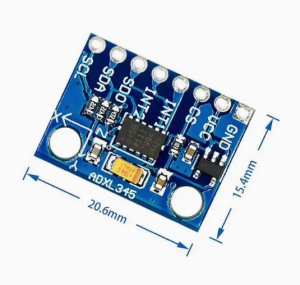
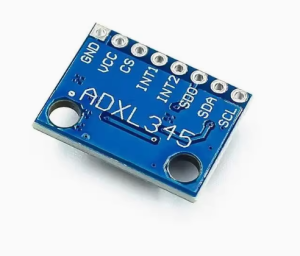
GY-291 ADXL345 Digital 3-Axis Accelerometer Module with Pin Header (Tilt/Gravity Sensor – Original Chips)

SKU: FA2169-1
Sensor Chip

ADXL345 (Original Analog Devices)

Operating Voltage

3.3V – 5V DC

Communication

I²C (400kHz) / SPI (10MHz)

Acceleration Ranges

±2g, ±4g, ±8g, ±16g (selectable)

Resolution

13-bit (at ±16g) / 10-bit (at ±2g)

Sensitivity

3.9 mg/LSB to 256 mg/LSB (range dependent)

Current Consumption

40 µA (active), 0.1 µA (standby)

Module Size

21mm (L) × 15mm (W) × 4mm (H) with headers

Description

The GY-291 ADXL345 is a professional-grade, low-power, 3-axis accelerometer module designed for precise tilt, motion, and gravity sensing applications. At its core is the original ADXL345 integrated circuit from Analog Devices — not a clone, not a reclaimed chip, but factory-original stock. This guarantees consistent sensitivity, low noise, and long-term reliability for both prototyping and production use.

The module measures dynamic acceleration (motion, shock, vibration) and static acceleration (gravity, tilt). With selectable ranges of ±2g, ±4g, ±8g, or ±16g and 13-bit resolution at the highest range, it can detect inclination changes as small as 0.25 degrees. Communication is handled via I²C or SPI digital interfaces, making it compatible with 3.3V and 5V systems thanks to onboard voltage regulation and logic level shifting.

This version comes with pre-soldered pin headers for immediate breadboard or PCB integration. The “Original Chips” designation means you receive genuine ADXL345 dies from authorized supply chains — essential for applications where measurement accuracy and part traceability matter. Whether you are a hobbyist building a gesture-controlled robot or a business integrating vibration monitoring into industrial equipment, the GY-291 delivers trusted performance in a compact 21mm × 15mm package.


Key Features

  • Original ADXL345 IC – Factory-original Analog Devices chip, not generic or refurbished.

  • Wide Measurement Range – Selectable ±2g, ±4g, ±8g, or ±16g via software.

  • High Resolution – 13-bit (at ±16g) for fine motion and tilt detection.

  • Dual Digital Interfaces – I²C (up to 400kHz) and SPI (up to 10MHz) for flexible microcontroller integration.

  • Ultra-Low Power – Consumes only 40µA in active mode, ideal for battery-powered IoT devices.

  • Built-in Motion Detection – Free-fall sensing, tap/double-tap, activity/inactivity interrupts.

  • Wide Voltage Compatibility – Operates on 3.3V to 5V with onboard level shifting.

  • Ready to Use – Pre-soldered 2.54mm pin headers included (no soldering required).


Technical Specifications 

Specification Value
Sensor Chip ADXL345 (Original Analog Devices)
Operating Voltage 3.3V – 5V DC
Communication I²C (400kHz) / SPI (10MHz)
Acceleration Ranges ±2g, ±4g, ±8g, ±16g (selectable)
Resolution 13-bit (at ±16g) / 10-bit (at ±2g)
Sensitivity 3.9 mg/LSB to 256 mg/LSB (range dependent)
Current Consumption 40 µA (active), 0.1 µA (standby)
Module Size 21mm (L) × 15mm (W) × 4mm (H) with headers

Typical Usage

  • Tilt & Inclination Measurement – Platform leveling, solar tracker positioning, robotic arm angle feedback.

  • Motion & Vibration Sensing – Intrusion alarms, shock detection, vehicle data logging, machine health monitoring.

  • Wearable Devices – Step counters (pedometers), fall detection for elderly care, gesture recognition.

  • IoT & Remote Monitoring – Wireless sensor nodes, smart agriculture (tree/branch movement), structural health monitoring.

  • Educational Projects – Learn accelerometer fundamentals, digital motion processing, sensor fusion basics.

  • Industrial Controls – Conveyor belt tilt monitoring, crane angle limiting, vibration-based predictive maintenance.

  • Human-Machine Interfaces (HMI) – Motion-enabled remote controls, gaming controllers, handheld device orientation.

Q: What does "Original Chips" mean?

It means the module uses a genuine ADXL345 integrated circuit sourced from Analog Devices or authorized distributors, not counterfeit, recycled, or clone parts. This ensures accurate data sheets specifications, consistent performance, and long-term reliability.

Q: Can I use this with a 5V Arduino like Uno or Mega?

Yes. The module accepts 3.3V to 5V power, and the I/O pins are 5V tolerant thanks to onboard level shifting. Connect VCC to 5V, GND to GND, SDA to A4 (or dedicated SDA), SCL to A5 (or dedicated SCL).

Q: Does it work with 3.3V logic systems (ESP32, Raspberry Pi, STM32)?

Absolutely. The module can be powered at 3.3V, and all signal lines operate at 3.3V logic by default. No extra level converters are needed.

Q: How do I switch between I²C and SPI modes?

Default is I²C. To use SPI: disconnect the SDO/ALT ADDRESS pin, pull CS high for idle, and drive CS low for each transaction. Use the ADXL345 datasheet for complete SPI timing.

Q: Can this sensor measure static tilt accurately?

Yes. Because gravity is a constant 1g vector, the ADXL345 can calculate tilt angles with <1° typical accuracy. For higher precision (≤0.5°), perform a simple one-time calibration (offset and sensitivity).

Q: What is the maximum output data rate?

The ADXL345 supports output data rates up to 3200 Hz (3.2 kHz) in low-noise mode, and up to 1600 Hz in normal mode — suitable for vibration analysis up to ~1.6 kHz.

Q: Does the module include tap/double-tap detection?

Yes. This feature is built into the ADXL345 chip. You can configure threshold, duration, latency, and which axes are monitored. It is commonly used for wake-up or UI control.

Q: Is this module suitable for commercial or industrial products?

Yes. The ADXL345 itself is rated for -40°C to +85°C operation. Many businesses use this module for prototyping and then transition to the bare ADXL345 chip for mass production. The original chip guarantees same performance in both scenarios.

Q: Do I need external components to use this module?

No. The module includes all necessary decoupling capacitors, pull-up resistors for I²C (typically 4.7kΩ to 10kΩ on SDA/SCL), and voltage regulation. Just connect power and digital lines.

Q: Where can I find example code and wiring diagrams?

The ADXL345 library support is widely available for Arduino (Adafruit ADXL345, SparkFun ADXL345), Raspberry Pi (python-periphery or smbus2), STM32 (STM32Cube), and ESP32 (ESP-IDF or Arduino). We recommend the official Analog Devices datasheet for register-level programming. We do not provide printed code or diagrams with the module.