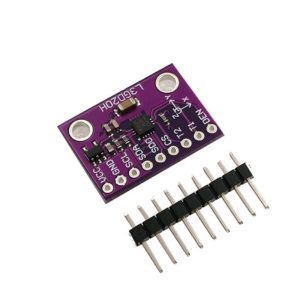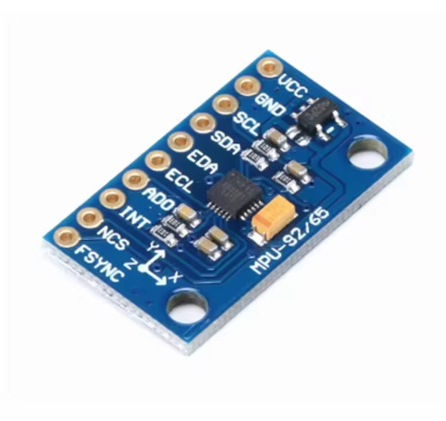
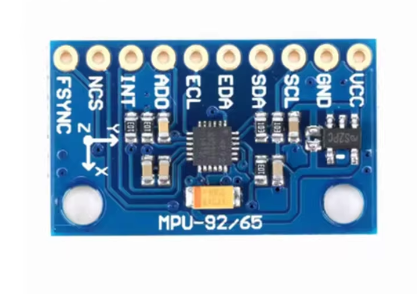
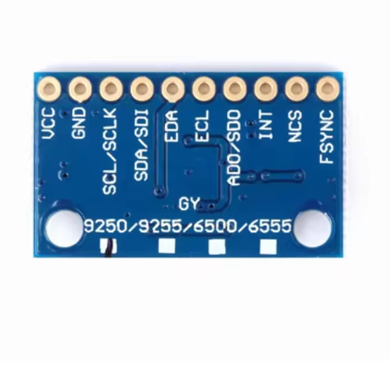
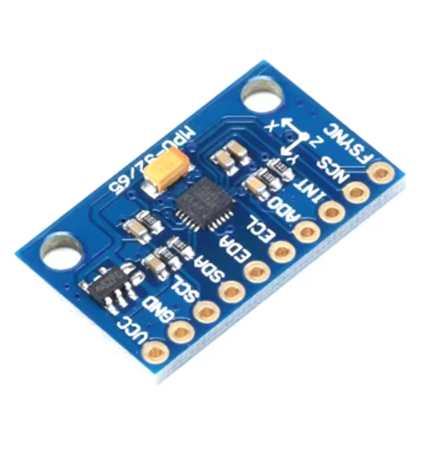
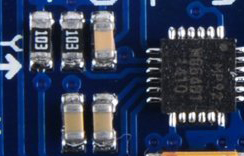
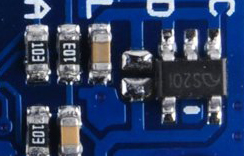
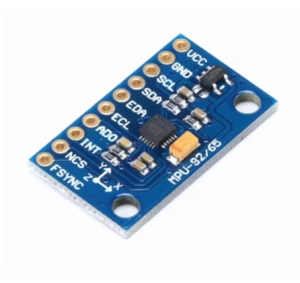
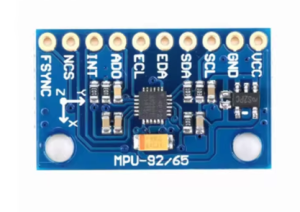
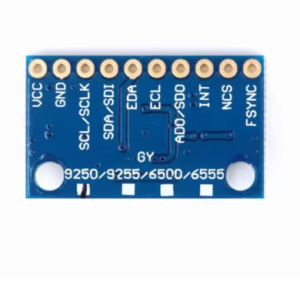
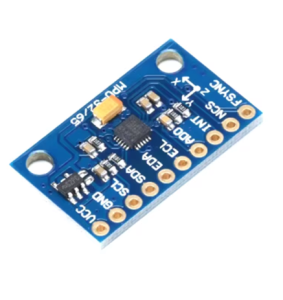
The GY-9150 MPU-9150 9-Axis IMU Module is a high-integration motion tracking solution that combines a 3-axis gyroscope, a 3-axis accelerometer, and a 3-axis magnetometer (electronic compass) into a single compact board. This module provides a complete 9-Degrees of Freedom (9-DOF) sensing capability, allowing for precise tracking of orientation, motion, and heading relative to magnetic North.
Product Description
The GY-9150 Module is built around the authentic InvenSense MPU-9150 System in Package (SiP), which integrates three distinct micro-electro-mechanical systems (MEMS) sensors: an accelerometer, a gyroscope, and an AK8975 3-axis electronic compass. This high level of integration dramatically simplifies hardware design and PCB footprint for complex applications such as full-featured drone flight controllers, augmented reality devices, and advanced human-machine interfaces.
By providing 9-DOF data, the module can execute complex “sensor fusion” algorithms (often using its internal Digital Motion Processor, or DMP) to deliver highly stable, drift-compensated orientation data (Quaternions or Euler angles). It operates via a standard I2C communication interface and includes an onboard voltage regulator, making it compatible with both 3.3V and 5V microcontrollers like Arduino, Raspberry Pi, and industrial PLCs. The GY-9150 is the ideal solution for projects requiring absolute orientation awareness in a three-dimensional space.
Key Features
- True 9-Axis Sensing: Combines accelerometer, gyroscope, and magnetometer in a single module.
- Digital Motion Processor (DMP): Onboard processing engine offloads sensor fusion calculations from the host MCU.
- Auxiliary I2C Bus: Can connect external sensors to the internal I2C bus for enhanced system integration.
- Wide Voltage Compatibility: Onboard regulator allows operation from 3V to 5V DC power supplies.
- High Resolution: 16-bit Analog-to-Digital Converters (ADCs) for all 9 channels capture detailed motion data.
- Standard I2C Communication: Simple 2-wire digital interface for seamless integration.
- Integrated Temperature Sensor: Provides ambient temperature data.