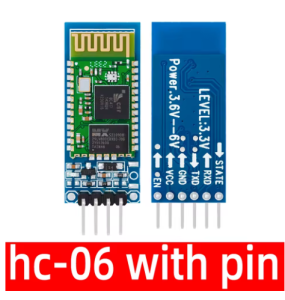
HC-06 4pin Bluetooth Module with Button (Compatible versions Type-C )

SKU: FA2040-1-1
Bluetooth Protocol

Bluetooth V2.0 + EDR (Classic)

Operating Voltage

3.6V – 6.0V DC

Operating Current

~35mA (Pairing); < 10mA (Connected)

Logic Level (I/O)

3.3V TTL (VCC is 5V compatible)

Communication Interface

UART (Universal Asynchronous Receiver/Transmitter)

Default Baud Rate

9600 bps

Default Pairing PIN

1234

Frequency Band

2.4GHz ISM Band

Transmission Range

~10 Meters (Class 2)

Operating Temperature

-20°C to +75°C

Product Description
The HC-06 (Compatible Type-C) is a high-performance Bluetooth 2.0+EDR (Enhanced Data Rate) slave module designed for seamless, short-range wireless serial communication. Engineered specifically for Slave-only operation, it is the industry standard for projects where a peripheral device needs to be “discovered” and controlled by a Master device, such as an Android smartphone, tablet, or PC.
The Type-C Compatible version features a refined hardware layout optimized for low-latency data throughput and high pairing stability. It acts as a “Transparent Serial Bridge”—once a wireless connection is established, the module passes TTL serial data back and forth as if there were a physical cable between your hardware and the remote controller. With its streamlined 4-pin interface and integrated voltage regulation, it offers a “plug-and-play” experience for ArduinoRaspberry Pi, and Industrial PLC systems.
Key Features
  • Dedicated Slave Operation: Optimized as a “set-and-forget” peripheral, ensuring rapid discovery and stable pairing with master controllers.
  • Transparent Data Transmission: No complex Bluetooth protocol handling is required; functions exactly like a wireless RS232 cable for standard TTL serial communication.
  • Enhanced Type-C Firmware: Features an updated instruction set for better compatibility with modern Android versions and Windows 10/11 Bluetooth stacks.
  • Wide Power Input: The onboard breakout board includes a 3.3V LDO regulator, allowing the module to be powered safely by any source between 3.6V and 6.0V DC.
  • Low Energy Consumption: Optimized for active data transmission with a low operating current, making it suitable for battery-powered IoT devices.
  • Visual Status LED: Features a bright onboard LED: fast flashing indicates searching/pairing mode, while a steady light indicates a successful connection.
Usage Scenarios
  • Single User & Hobbyist: Smartphone-controlled DIY robotics, remote-controlled smart lighting, and wireless sensor telemetry for home weather stations.
  • Business & Commercial: Wireless serial debugging for factory machinery, cable-free point-of-sale (POS) systems, and wireless diagnostic interfaces for medical or automotive tools.
Q: Can the HC-06 connect to an iPhone or iPad?

No. The HC-06 uses Bluetooth Classic (2.0). Apple iOS devices only support “Bluetooth Low Energy” (BLE 4.0+) for serial data profiles. This module is fully compatible with Android, Windows, macOS, and Linux

Q: What is the difference between the HC-06 and the HC-05?

The HC-05 can act as both a Master (initiates connections) and a Slave. The HC-06 is Slave-only, which makes it much simpler to set up for 90% of projects where you just want to connect your phone to your hardware.

Q: How do I change the Bluetooth name or PIN?

While the module is unpaired (LED is flashing), send AT commands via a serial monitor at 9600 baud. For example: AT+NAME=MyProject or AT+PIN=5678. Note: The HC-06 typically does not require a newline (\r\n) after the command.

Q: Do I need a level shifter for the data pins?

While the VCC pin is 5V compatible, the RX/TX pins are 3.3V logic. For long-term reliability when using a 5V Arduino, we recommend a simple voltage divider (1kΩ and 2kΩ resistors) on the RX line of the HC-06 to step down the 5V signal.

Q: Why is the module visible but refuses to pair with my PC?

Ensure the LED is flashing rapidly. If the LED is steady, it is already connected to another device. Also, ensure your PC’s Bluetooth drivers are updated and support Bluetooth 2.0/Classic profiles

Q: Does it save my custom settings after power-off?

Yes. All configurations changed via AT commands (Baud rate, Name, PIN) are stored in the module’s internal non-volatile Flash memory and are preserved through power cycles.