Industrial-Grade TTL/RS232 Bidirectional Converter Module (Single Channel, EXAR Chipset) – Flashing Cable

SKU: FA2045-2
Main Chipset

EXAR (MaxLinear) Industrial Series

Operating Voltage

3.0V – 5.5V DC

Logic Level (TTL)

3.3V / 5V Fully Compatible

Conversion Mode

Full-Duplex Bidirectional

Max Transmission Speed

460 kbps (Typical)

RS232 Connector

DB9 Female (Industrial Grade)

TTL Connector

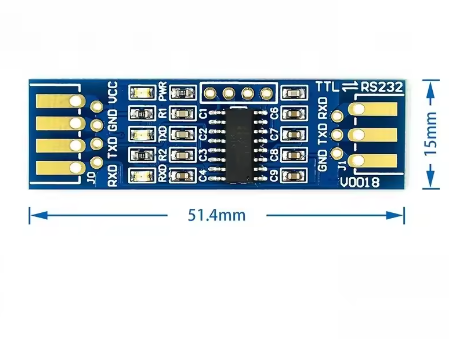
4-Pin Header (VCC, GND, TXD, RXD)

Operating Temp

-40°C to +85°C

Product Description
The Industrial-Grade EXAR TTL to RS232 Converter is a high-performance serial bridge engineered for mission-critical data transmission and hardware recovery. Built with a genuine EXAR (MaxLinear) chipset, this module offers superior signal stability and higher baud rate support compared to standard consumer-grade transceivers.
This module is specifically favored for “Flashing” applications—the process of updating or recovering firmware on routers, hard drives, satellite receivers, and industrial PLCs. Its robust electrical design provides a clean, noise-free bidirectional link between high-voltage RS232 equipment and low-voltage (3.3V/5V) TTL microcontrollers. Whether you are a field engineer performing on-site diagnostics or a developer building a permanent industrial interface, the EXAR chipset ensures that every bit of data arrives exactly as intended.
Key Features
  • High-Performance EXAR Silicon: Offers enhanced driver strength for longer cable runs and superior resistance to electromagnetic interference (EMI).
  • Optimized for Flashing: Stable timing and high-speed support make it the ideal tool for unbricking hardware and performing high-speed firmware uploads.
  • True 3.3V/5V Dual Compatibility: Features an auto-sensing logic interface that safely pairs with 3.3V (Raspberry Pi/STM32) and 5V (Arduino/Industrial PLC) systems.
  • Industrial ESD Protection: Integrated static protection (±15kV) safeguards your sensitive TTL-side equipment from voltage spikes on the RS232 line.
  • High Baud Rate Support: Capable of handling communication speeds up to 460kbps (and higher depending on configuration), far exceeding the limitations of generic clones.
  • Compact Single-Channel Design: A streamlined footprint that fits easily into tight enclosures or portable “flashing” toolkits.
Usage & Applications
  • Firmware Recovery (Flashing): The primary choice for “unbricking” consumer electronics, hard drive controller repairs, and updating router firmware via the serial console.
  • Industrial PLC Interfacing: Connecting modern laptops to legacy factory automation hardware for programming and monitoring.
  • Telecommunications: Accessing the command-line interface (CLI) of high-end switches, servers, and radio base stations.
  • Medical & Lab Equipment: Providing a stable serial bridge for diagnostic devices where data integrity is non-negotiable.
  • Vehicle Diagnostics: Interfacing with automotive ECU consoles that utilize RS232 communication standards.
Q: Why should I choose the EXAR chipset over a standard MAX3232?

The EXAR chipset is an industrial-grade solution known for better timing accuracy and higher current drive. In “flashing” scenarios where a single dropped bit can fail a firmware update, the EXAR chip provides the extra reliability needed for successful data transfers

Q: Can I use this with my 3.3V Raspberry Pi or ESP32?

Yes. By powering the module from your device’s 3.3V pin, the logic levels are automatically matched to 3.3V, ensuring your microcontroller pins are never exposed to damaging voltages

Q: Does this module require a driver?

No. This is a hardware-level voltage converter. It does not require drivers. However, if you are connecting it to a computer via a USB-to-RS232 cable, you will still need the driver for that specific cable

Q: What do I do if the module isn't communicating?

First, verify your power (VCC/GND). Second, the most common issue is a TX/RX swap. If you aren’t receiving data, try swapping the TX and RX wires on the TTL side

Q: Is the DB9 connector male or female?

This module features a Female DB9 connector, designed to plug directly into a standard PC COM port or a USB-to-RS232 adapter cable