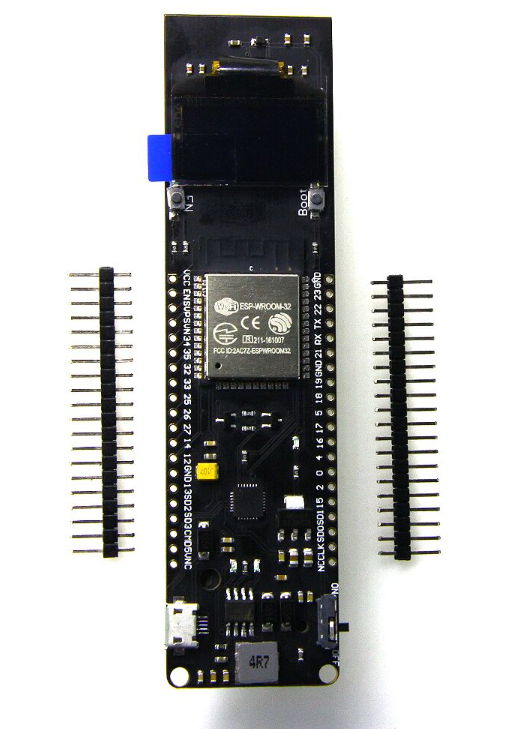
wemos ESP32 WIFI wireless Bluetooth module with 18650 battery holder + 0.96 inch OLED development board

SKU: FA1053-5
Microcontroller

ESP32-WROOM-32 (Dual-core, 240 MHz)

Display

0.96" OLED, 128×64 resolution, SSD1306

Wireless

2.4GHz Wi-Fi, Bluetooth 4.2 (BLE/BR/EDR)

Memory

4MB Flash, 520KB SRAM

Battery Type

1x 18650 Lithium Ion (Not Included)

Input Voltage

5V via Micro-USB; 5V–7V via Solar Input Pin

Charging Current

~500mA Max

I/O Logic Level

3.3V

The Wemos ESP32 18650 Battery Module is a robust, self-contained IoT development platform designed for maximum portability and endurance. It integrates the powerful ESP32-WROOM-32 microcontroller, a built-in 18650 battery holder, and an onboard 0.96-inch OLED display, creating an “install and forget” solution for remote sensor applications.
Long Description
This module solves the common challenge of powering remote IoT projects. By integrating a standard 18650 Li-ion battery holder and a robust charging circuit (via Micro-USB), the Wemos board can operate autonomously for extended periods, making it ideal for solar-powered weather stations, remote agricultural sensors, or long-term data loggers. The onboard 0.96″ 128×64 pixel OLED screen provides immediate, clear local feedback on battery status, sensor readings, or connectivity strength, which is essential during field deployment.
For business purchasers, this provides a durable, reliable hardware foundation that streamlines the development of commercial off-grid solutions, minimizing maintenance costs. For individual makers, it offers an unparalleled balance of power, wireless connectivity (Wi-Fi and Bluetooth), and visual feedback, making sophisticated, battery-powered projects highly achievable.
Key Features
  • Integrated Power Solution: Built-in 18650 battery holder and charging circuit with LED indicators (Red: Charging, Green: Charged).
  • Onboard Visual Feedback: 0.96″ I2C OLED (SSD1306 driver) for immediate display of data.
  • High-End Connectivity: Dual-mode Wi-Fi and Bluetooth 4.2 capability for versatile network integration.
  • Solar Input Ready: Features a separate pin header for connecting a solar panel for continuous charging in remote areas.
  • Robust & Efficient: Designed for low power consumption in deep sleep modes to maximize battery life.
Usage Instructions
  1. Insert Battery: Place a high-quality, unprotected 18650 battery into the holder, ensuring correct polarity.
  2. Hardware Connection: Connect to a computer via a Micro-USB data cable.
  3. Driver Setup: Install the necessary CH340 or CP2102 USB-to-Serial driver for your operating system.
  4. IDE Configuration:
    • In the Arduino IDE, install the ESP32 board manager package.
    • Select “ESP32 Dev Module” as your target board.
  5. Display Library: Install and use the Adafruit_SSD1306 or U8g2 library. The default I2C pins are typically GPIO 5 (SDA) and GPIO 4 (SCL), with address 0x3C.
  6. Power Management: Use deep sleep functions in your code to drastically increase battery duration.
Q: Is the 18650 battery included in the package?

No, the battery must be purchased separately. This allows users to choose the specific capacity (mAh) they require for their project needs.

Q: Can I charge the battery and run the board simultaneously?

Yes, the board is designed to safely operate while simultaneously charging the connected 18650 battery via the Micro-USB port.

Q: What are the I2C pins used for the OLED display? I can't find them in the documentation.

The manufacturer typically hardwires the OLED to specific pins to free up others. The standard pins for this specific module are GPIO 5 (SDA) and GPIO 4 (SCL).

Q: Does this board work with solar power?

Yes. There is a dedicated 2-pin JST connector or pin header designed to accept a 5V solar panel input, which feeds into the battery charging circuit.

Q: Is it safe to use a "protected" 18650 battery?

Yes, protected batteries are generally safer. However, ensure the battery fits physically within the holder, as protected cells can sometimes be slightly longer. The board has its own basic overcharge protection built-in.