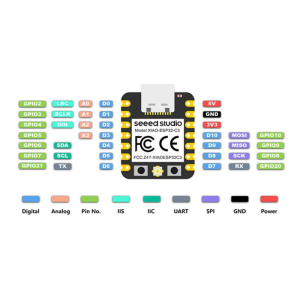
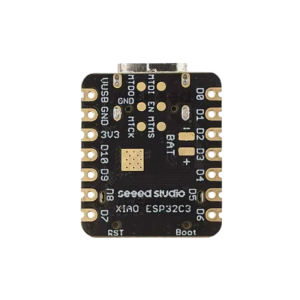
Seeed studio XIAO ESP32C3 ESP32 Development board

SKU: FA1053-1-1-2
Microcontroller

ESP32-C3 SoC (RISC-V single-core 32-bit)

Clock Speed

Up to 160 MHz

Memory

400 KB SRAM & 4 MB Flash

Wireless

Wi-Fi 802.11 b/g/n (2.4 GHz), Bluetooth 5.0/Bluetooth Mesh

GPIO / ADC

11 digital I/O (PWM), 4 analog inputs (ADC)

Deep Sleep Current

Approximately 44 µA

Battery Input

3.7V LiPo (BAT pin); 5V (VIN pin)

Dimensions

21 × 17.8 mm

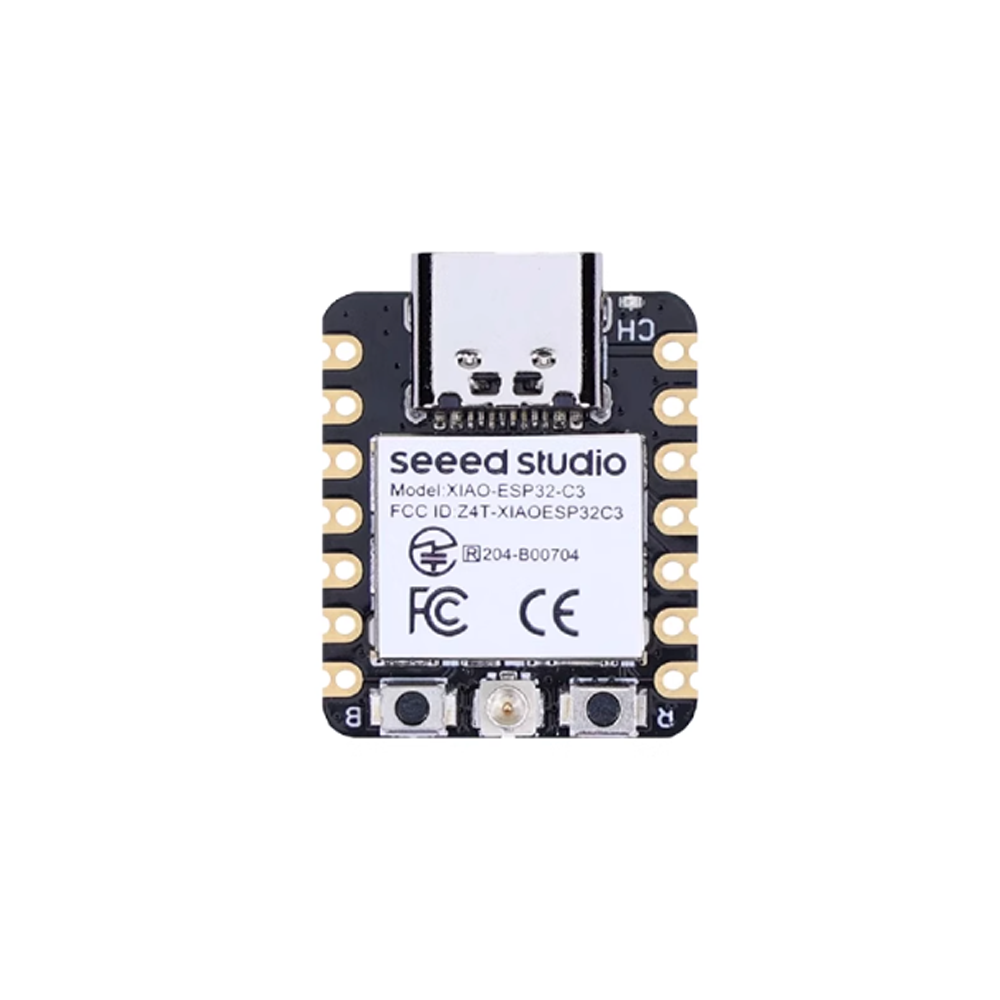
The Seeed Studio XIAO ESP32C3 is an ultra-compact, high-performance IoT development board built around Espressif’s ESP32-C3 RISC-V microcontroller. It packs Wi-Fi, Bluetooth 5.0, battery management, and a capable 32-bit processor into a thumb-sized 21 × 17.8 mm form factor — making it one of the smallest wireless development boards available for IoT, wearable, and space-constrained applications .

At its core is a 32-bit RISC-V single-core processor with a four-stage pipeline running at up to 160 MHz. The chip integrates 400 KB SRAM and 4 MB Flash, providing sufficient memory for complex IoT applications and data storage . This RISC-V architecture offers a modern, efficient alternative to traditional ARM-based microcontrollers, with strong performance and excellent power efficiency.

The board supports a complete 2.4 GHz Wi-Fi subsystem (IEEE 802.11 b/g/n) with Station, SoftAP, SoftAP+Station, and promiscuous modes, along with Bluetooth Low Energy 5.0 and Bluetooth Mesh . An included U.FL/IPEX external antenna enables wireless communication over 100 meters, significantly extending range compared to onboard PCB antennas .

Power efficiency is exceptional. The board offers four working modes with a deep sleep current as low as 44 µA, making it ideal for battery-powered devices that require extended operational life . An onboard lithium battery charge management chip supports 3.7V LiPo batteries with fast (380 mA) and trickle (40 mA) charging, allowing seamless battery-powered deployment .

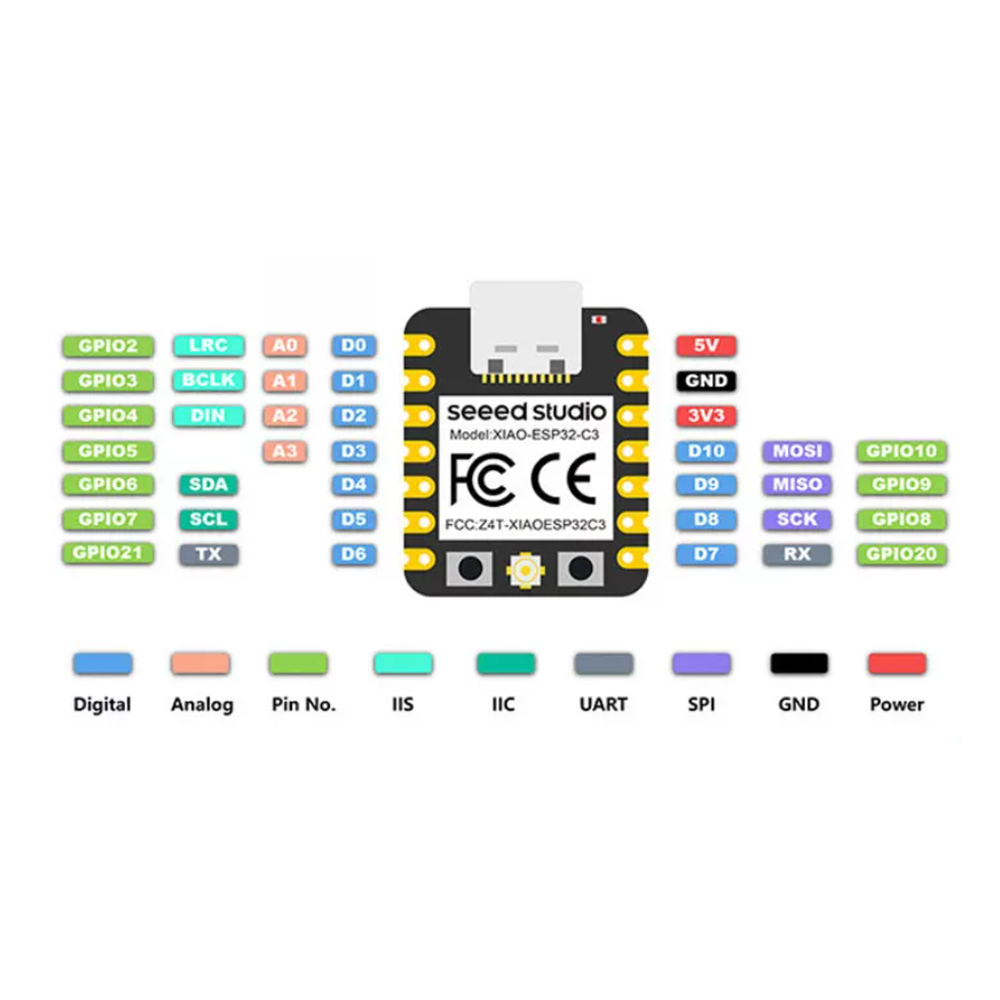
The board exposes 11 digital I/O pins (all PWM-capable) and 4 analog inputs (ADC), along with UART, I2C, and SPI interfaces for connecting sensors, displays, and peripherals . A USB Type-C connector handles power and programming, and the board includes reset and BOOT buttons for easy operation .

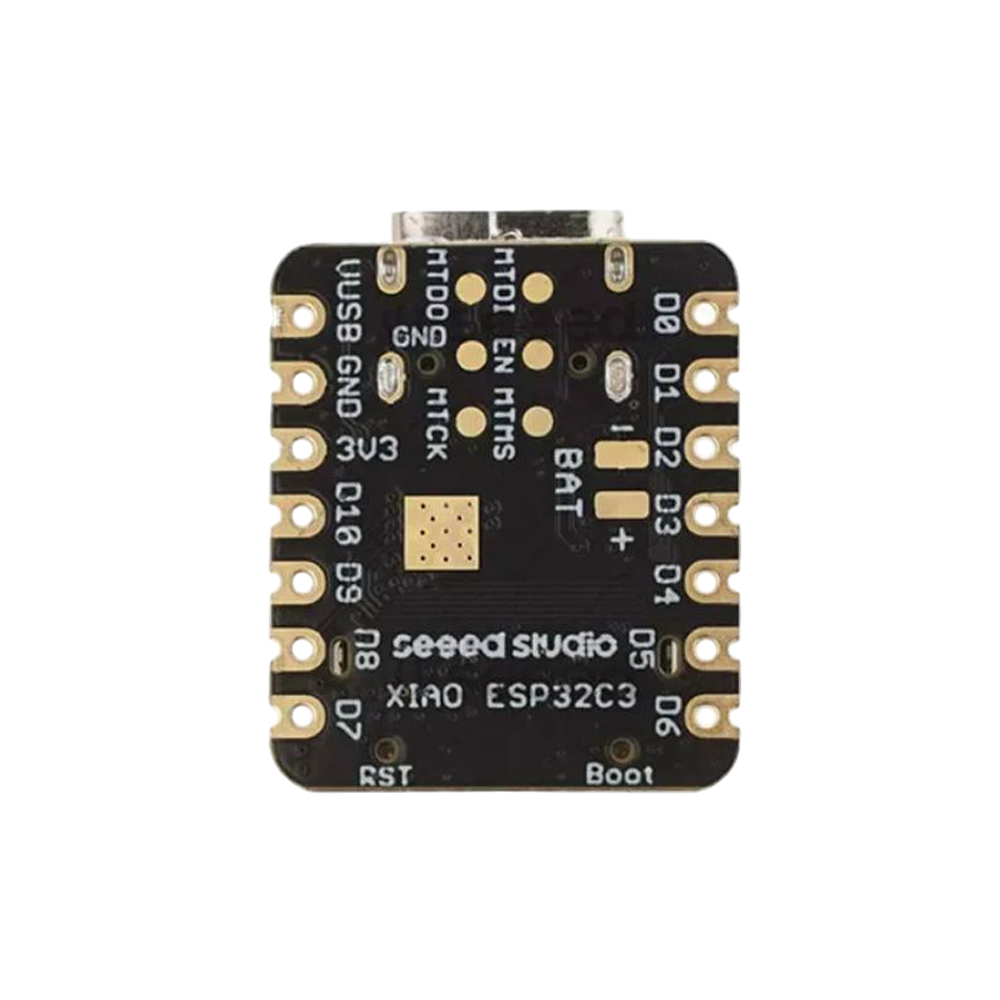
The XIAO ESP32C3 features a production-ready SMD design with no components on the back and standardized stamp holes, making it suitable for direct integration into commercial PCBA designs . It is supported by Arduino IDE, MicroPython, CircuitPython, PlatformIO, ESP-IDF, and Zephyr, with extensive community libraries and examples available .

Whether you are building a wearable health monitor, a smart home sensor, a remote tracking device, or a compact IoT gateway, the Seeed Studio XIAO ESP32C3 offers a powerful, production-ready foundation in an exceptionally small package. It is suitable for individual makers, students, and businesses purchasing in bulk for product development or educational programs .

Features

  • ESP32-C3 RISC-V single-core processor — 32-bit architecture at up to 160 MHz with four-stage pipeline

  • Ultra-compact form factor — Thumb-sized at 21 × 17.8 mm, ideal for wearables and space-constrained designs

  • Complete Wi-Fi subsystem — 802.11 b/g/n with Station, SoftAP, SoftAP+Station, and promiscuous modes

  • Bluetooth 5.0 & Bluetooth Mesh — Full BLE support for versatile wireless connectivity

  • Ultra-low power consumption — Deep sleep current approximately 44 µA for battery-powered applications

  • Onboard lithium battery charging — Supports 3.7V LiPo batteries with fast/trickle charging management

  • U.FL external antenna included — Enables communication over 100 meters

  • Rich I/O interface — 11 PWM-capable GPIOs, 4 ADC inputs, 1× I2C, 1× SPI, 1× UART

  • USB Type-C connector — Modern reversible connector for power and programming

  • Production-ready SMD design — No components on back, standardized stamp holes for PCBA integration

  • Wide development support — Arduino, MicroPython, CircuitPython, PlatformIO, ESP-IDF, Zephyr

Technical Specifications 

# Parameter Specification
1 Microcontroller ESP32-C3 SoC (RISC-V single-core 32-bit)
2 Clock Speed Up to 160 MHz
3 Memory 400 KB SRAM & 4 MB Flash
4 Wireless Wi-Fi 802.11 b/g/n (2.4 GHz), Bluetooth 5.0/Bluetooth Mesh
5 GPIO / ADC 11 digital I/O (PWM), 4 analog inputs (ADC)
6 Deep Sleep Current Approximately 44 µA
7 Battery Input 3.7V LiPo (BAT pin); 5V (VIN pin)
8 Dimensions 21 × 17.8 mm 

Usage

Getting Started

  1. Connect via USB-C — Use a USB Type-C data cable to connect the board to your computer .

  2. Install board support — In Arduino IDE, add the ESP32 board manager URL and install the ESP32 package via Boards Manager .

  3. Select the board — Choose “XIAO_ESP32C3” from the ESP32 Arduino board list .

  4. Upload your sketch — If uploading fails, hold the BOOT button, press and release RESET, then release BOOT to enter download mode .

  5. Test with Blink — Connect an LED to D10 (with a 150Ω resistor) and upload the Blink example to verify operation .

Battery Usage

The XIAO ESP32C3 supports 3.7V lithium batteries via the BAT pin. The onboard charge management chip handles charging automatically when USB power is connected. Important: No LED indicators are active during battery-only operation, so verify operation through your program logic .

Typical Applications

  • Wearable devices — Fitness trackers, smart watches, and portable electronics

  • IoT sensor nodes — Remote monitoring with WiFi/BLE connectivity and battery power

  • Smart home devices — Connected switches, sensors, and controllers

  • Low-power networking — Battery-operated devices requiring extended operational life

  • Rapid prototyping — Compact form factor for space-constrained proof-of-concept builds

  • Production integration — SMD design enables direct PCBA integration for commercial products

Notes for Business Buyers

  • Production-ready design — SMD construction with no back-side components and standardized stamp holes simplifies integration into commercial PCBA workflows .

  • Ultra-low power consumption — 44 µA deep sleep enables multi-year battery life in appropriate applications .

  • RISC-V architecture — Modern, efficient processing with strong toolchain support across Arduino, ESP-IDF, and Zephyr .

  • Suitable for bulk purchasing — Compact size and low cost make it practical for IoT product development and volume deployment.

Q: What is the Seeed Studio XIAO ESP32C3 used for?

It is an ultra-compact IoT development board for wireless projects including wearables, sensor nodes, smart home devices, and space-constrained applications requiring WiFi and Bluetooth connectivity .

Q: What makes the XIAO ESP32C3 different from other ESP32 boards?

Its thumb-sized 21 × 17.8 mm form factor and production-ready SMD design make it uniquely suited for wearables and commercial integration. It also includes an external U.FL antenna for extended range and onboard battery charging .

Q: Is the XIAO ESP32C3 compatible with the Arduino IDE?

Yes. Install the ESP32 board package and select “XIAO_ESP32C3” from the board list. The wiki provides a complete getting-started guide .

Q: What is the deep sleep current of this board?

The deep sleep current is approximately 44 µA, making it suitable for battery-powered applications requiring extended operational life .

Q: Does this board support battery charging?

Yes. The board includes a lithium battery charge management chip supporting 3.7V LiPo batteries. Fast charging is 380 mA, with trickle charging at 40 mA .

Q: What antenna does the board use?

The XIAO ESP32C3 includes an external U.FL/IPEX antenna that enables wireless communication over 100 meters. The antenna is included in the package .

Q: What is the difference between the ESP32-C3 and ESP32-WROOM-32?

The ESP32-C3 uses a RISC-V single-core processor at 160 MHz, while the ESP32-WROOM-32 uses a dual-core Xtensa LX6. The C3 is more compact and power-efficient, ideal for wearables, while the WROOM-32 offers more processing power and GPIOs.

Q: Does this board support Bluetooth 5.0?

Yes. The ESP32-C3 supports Bluetooth 5.0 (LE) and Bluetooth Mesh for versatile wireless connectivity .

Q: What development environments are supported?

The board supports Arduino IDE, MicroPython, CircuitPython, PlatformIO, ESP-IDF, and Zephyr, with extensive community libraries and examples .

Q: Can I purchase in bulk for a product development project?

Yes. The XIAO ESP32C3 is suitable for both individual users and business purchasing. Its production-ready SMD design and standardized stamp holes make it practical for commercial PCBA integration and volume deployment .