LilyPad LiPower 5V
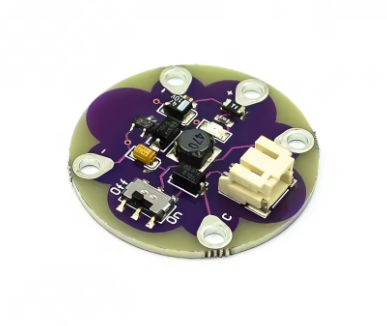
The LilyPad LiPower 5V is an essential power management board designed for use in wearable and e-textile projects. It is a simple yet vital component that enables the use of standard single-cell 3.7V Lithium Polymer (LiPo) batteries to power your entire LilyPad circuit at a regulated 5V output.
This board simplifies battery integration by providing a JST connector for the battery input and clear, sewable tabs for regulated 5V power and ground output. It is a foundational component for both hobbyists and businesses creating portable, reliable wearable electronics.
Description
Powering wearable electronics can be tricky, as most components prefer a steady voltage (typically 3.3V or 5V), but batteries run down over time, dropping their voltage output. The LilyPad LiPower 5V solves this problem by taking the variable input voltage from a single-cell 3.7V LiPo battery (which ranges from about 4.2V when full to 3V when empty) and boosting it to a consistent, regulated 5V output.
This regulated 5V is crucial for components that require precise voltage, such as 5V microcontrollers (like the Arduino UNO R3) or certain sensors and actuators. The board maintains this output until the battery voltage drops too low, at which point a built-in low voltage cutoff circuit safely shuts down the power to protect your valuable LiPo battery from deep discharge damage.
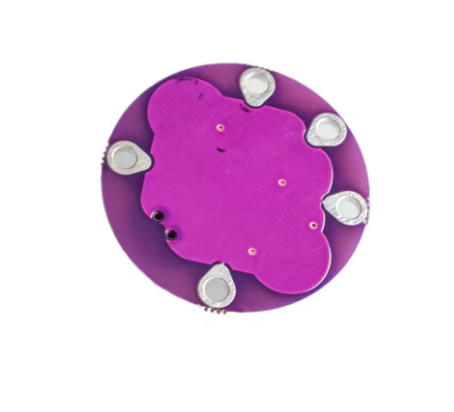
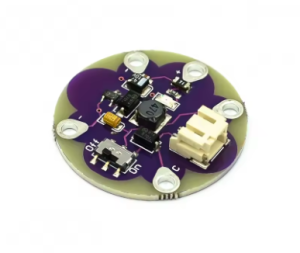
Designed within the standard LilyPad philosophy, the board features a circular profile and large “sew tabs” labeled for input (battery) and output (5V power). Connections are made using conductive thread, ensuring seamless integration into fabric projects without bulky wires. The small size, high efficiency (typically around 80-90%), and robust design make it an indispensable tool for building professional, battery-operated wearable projects.
Features
- Voltage Regulation: Converts variable LiPo battery voltage (3.7V nominal) into a constant, regulated 5V output.
- LiPo Protection: Includes a low-voltage cutoff circuit to safely protect 3.7V LiPo batteries from damage caused by over-discharging.
- Battery Connector: Features an on-board JST connector for easy plug-and-play connection of standard LiPo batteries.
- Sewable Design: Utilizes large “sew tabs” for secure integration into e-textile projects using conductive thread.
- Compact Form Factor: Small, circular, lightweight design optimized for wearable applications.
- Efficient Operation: High efficiency typically maintains stable 5V output as long as the battery has sufficient charge.
- Simple Interface: Clearly labeled input (Bat) and output (5V) tabs for easy wiring.