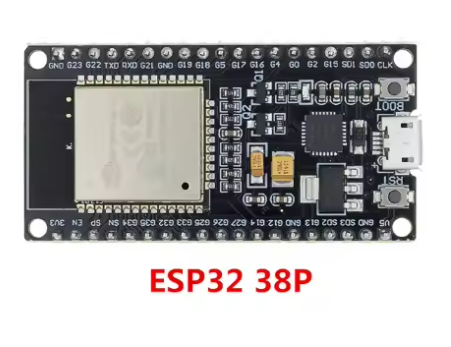
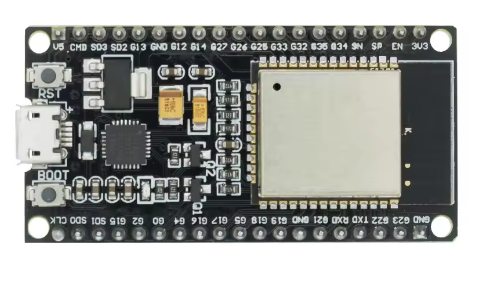
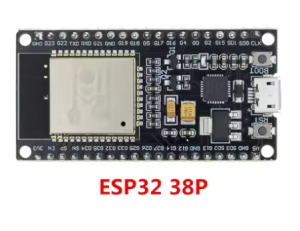
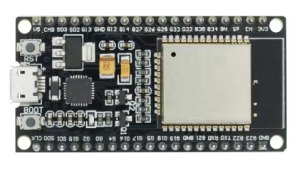
The Espressif ESP32-WROOM-32 development board (38-pin version), often marketed as the NodeMCU-32S, is a powerful and versatile platform for Internet of Things (IoT) applications. Featuring an integrated ESP32-D0WDQ6 dual-core processor, built-in Wi-Fi and Bluetooth capabilities, and a wide array of GPIO pins, this board provides a comprehensive solution for both hobbyists and professional developers. The 38-pin configuration offers expanded connectivity and is designed to be breadboard-friendly.
Description
The NodeMCU-32S development board is a highly integrated, production-ready solution based on the robust ESP-WROOM-32 module. At its heart lies the powerful Xtensa® 32-bit LX6 dual-core microprocessor, with a clock frequency adjustable from 80 MHz to 240 MHz, capable of handling complex computational tasks and real-time processing with ease.
This board is a true “2-in-1” wireless solution, integrating 2.4 GHz dual-mode Wi-Fi (802.11b/g/n) and Bluetooth (v4.2 BR/EDR and BLE), enabling a wide range of connectivity options from direct internet access via a router to smartphone communication using low-energy beacons. The entire solution occupies minimal PCB area thanks to high integration of antenna switches, RF balun, power amplifiers, and filters.
The 38-pin version is specifically designed for prototyping efficiency, providing more accessible GPIO pins than its 30-pin counterpart while remaining narrow enough for easy use on a standard breadboard. It includes the reliable CP2102 USB-to-UART bridge, ensuring stable and fast programming and debugging via a Micro-USB connection.
With excellent power management features, including a deep-sleep mode drawing less than 5 µA, the board is highly suited for low-power, battery-operated, and wearable electronic applications. It supports multiple development environments like the Arduino IDE, ESP-IDF (Espressif IoT Development Framework), and MicroPython, offering extensive flexibility for software development.
Features
- Powerful Dual-Core Processing: Xtensa® 32-bit LX6 dual-core CPU, running at up to 240 MHz.
- Integrated Wi-Fi & Bluetooth: Supports 802.11 b/g/n Wi-Fi and Bluetooth 4.2 BR/EDR and BLE specifications.
- Extended GPIO Access: The 38-pin form factor breaks out more I/O pins for versatile project design.
- Efficient Power Management: Features ultra-low power consumption with various sleep modes for battery optimization.
- Reliable USB Interface: Utilizes the CP2102 USB-to-UART bridge for stable communication during development.
- Rich Peripheral Interfaces: Includes support for UART, SPI, I²C, I²S, PWM, ADC (18 channels), DAC (2 channels), touch sensors (10), and a Hall sensor.
- Wide Compatibility: Programmable with Arduino IDE, ESP-IDF, Lua, and MicroPython.
- Robust Security: Built-in hardware accelerators for security features like secure boot, flash encryption, and TLS 1.2 support.
Parameters
| Feature | Detail |
|---|---|
| Microcontroller | ESP32-D0WDQ6 (within the ESP-WROOM-32 module) |
| Processor Cores | Xtensa dual-core 32-bit LX6 |
| Clock Speed | 80 MHz to 240 MHz (adjustable) |
| SRAM | 520 KB |
| Flash Memory | 4 MB SPI Flash (32 Mbit) |
| Operating Voltage | 3.3V (Logic level) |
| Input Voltage (via USB) | 5V DC (recommended input current >500mA) |
| Connectivity | Wi-Fi (802.11b/g/n), Bluetooth 4.2 BR/EDR & BLE |
| USB Interface Chip | CP2102 (USB-to-UART bridge) |
| Pin Count | 38 Pins (DIP-38 package) |
| Operating Temperature | –40°C to +85°C (module level) |