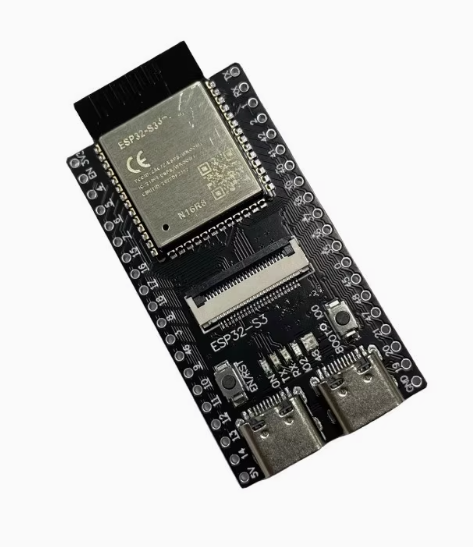
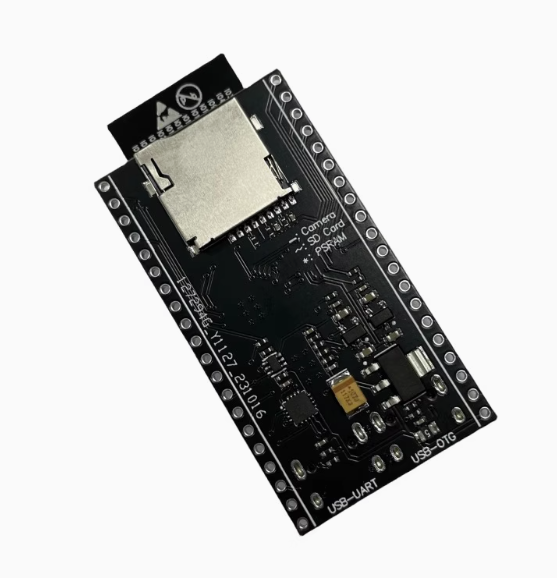
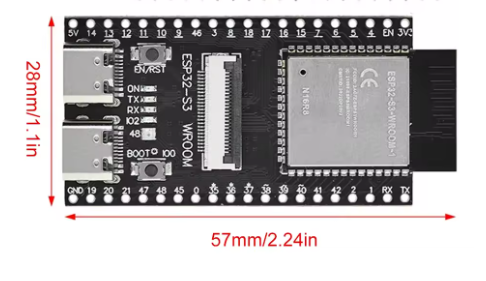
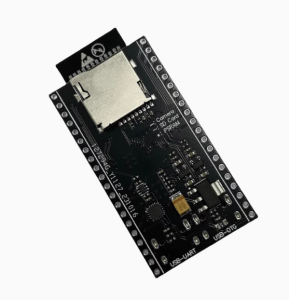
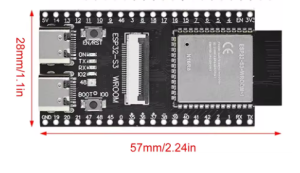
This high-performance ESP32-S3-CAM development board features the ESP32-S3-WROOM-1 (N16R8) module, optimized for advanced AIoT and vision applications. It is uniquely configured with dual Type-C interfaces and a CP2102 serial chip for stable, high-speed professional development.
Product Description
The ESP32-S3-CAM N16R8 is a flagship-tier development platform combining a dual-core Xtensa® LX7 processor with massive memory (16MB Flash / 8MB PSRAM). Designed specifically for “Edge AI,” it features integrated vector instructions that accelerate neural network computing and signal processing.
Unlike entry-level boards, this model includes dual Type-C ports: one dedicated to the CP2102 USB-to-UART bridge for reliable debugging, and a second connected to the native USB OTG interface for peripheral emulation (e.g., keyboard, mouse, or disk drive). The 40-pin layout provides extensive GPIO access for sensors and actuators.
Key Features
- Massive Storage (N16R8): 16MB SPI Flash and 8MB Octal PSRAM allow for high-resolution video streaming and complex AI model deployment.
- Dual Type-C Interfaces: Supports simultaneous programming/debugging and USB OTG functionality.
- AI Acceleration: Dedicated hardware support for neural networks, enabling on-device face detection and voice recognition.
- Superior Connectivity: Wi-Fi (802.11 b/g/n) and Bluetooth 5.0 (LE) with mesh support for reliable IoT networking.
- Independent LCD-CAM Interface: Dedicated hardware for camera and display peripherals, supporting higher clock frequencies (up to 40MHz) than previous ESP32 generations.