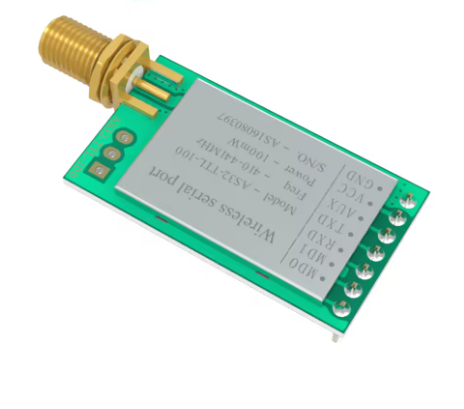
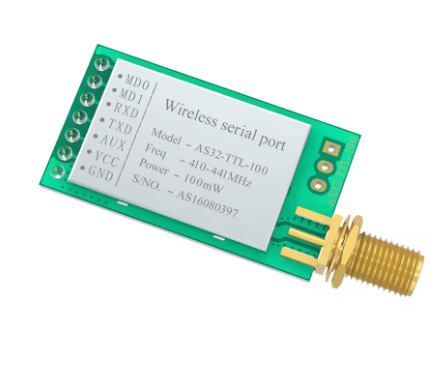
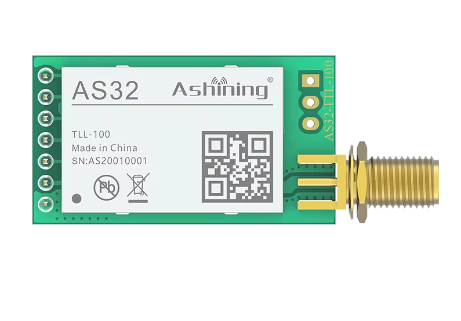
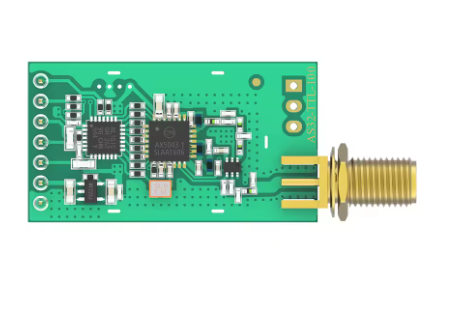
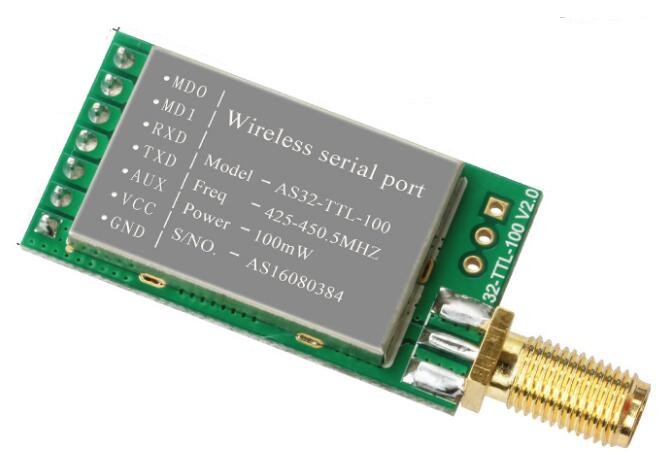
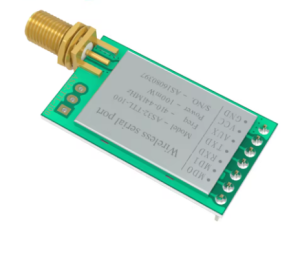
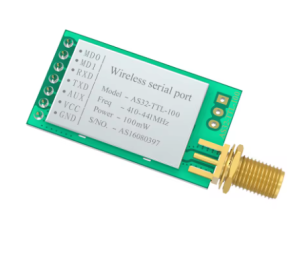
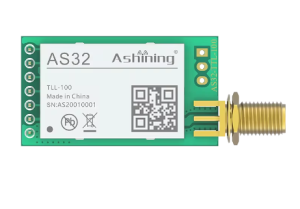
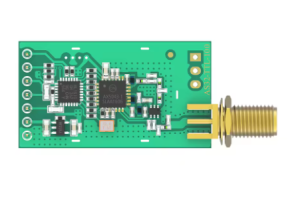
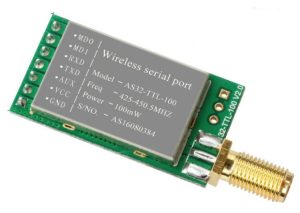
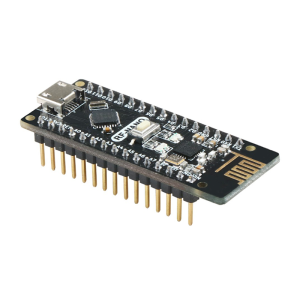
AS32-TTL-100 SX1278/SX1276 wireless module 433mhz

SKU: FA1067
RF Chip

Semtech SX1278 / SX1276

Operating Frequency

410MHz – 441MHz (Default: 433MHz)

Interface

UART (TTL Level)

Transmit Power

20dBm (approx. 100mW)

Communication Distance

3000m (Open air, max power, 2.4kbps)

Air Data Rate

0.3kbps – 19.2kbps

Operating Voltage

2.3V – 5.5V DC

Operating Current

110mA (TX), 15mA (RX), 5μA (Sleep)

The AS32-TTL-100 is an industrial-grade, high-stability wireless data transceiver module based on the Semtech SX1278/SX1276 RF chip. As of 2026, it remains a gold standard for long-range, low-power telemetry due to its LoRa spread spectrum technology and user-friendly UART interface. 
Long Product Description
The AS32-TTL-100 is designed to bridge the gap between complex RF engineering and simple MCU integration. By utilizing LoRa (Long Range) spread spectrum technology, the module achieves significantly higher penetration and interference immunity compared to traditional FSK or GFSK modules. It operates in the 433MHz ISM band and features a transparent transmission mode, meaning any data sent to the serial port is transmitted wirelessly and received exactly as-is by the target module. 
The module incorporates a high-efficiency error correction algorithm (FEC), which proactively corrects interfered data packets, drastically improving reliability in noisy industrial environments. With its small form factor and multiple sleep modes, it is perfectly suited for battery-operated remote sensors, smart meter reading, and industrial control systems. 
Key Features
  • LoRa Spread Spectrum: Provides ultra-long communication distances with high receiver sensitivity (-130dBm).
  • Transparent Transmission: Operates via a standard TTL UART interface, making it compatible with Arduino, STM32, Raspberry Pi, and PLCs without complex RF programming.
  • Forward Error Correction (FEC): Increases anti-interference capability by automatically repairing corrupted data packets.
  • Multi-Level Power Saving: Supports ultra-low power consumption modes (Deep Sleep and Wake-on-Radio), extending battery life for years.
  • Encrypted Transmission: Supports address-based transmission and point-to-point or broadcast modes for secure data handling
Usage Instructions
  1. Wiring: Connect the module to your MCU using the pins: VCC, GND, TXD, RXD.
  2. Mode Selection (M0, M1 Pins):
    • Mode 0 (M0=0, M1=0): Normal transparent transmission.
    • Mode 1 (M0=1, M1=0): Wake-up mode (adds a preamble to data).
    • Mode 2 (M0=0, M1=1): Power-saving mode.
    • Mode 3 (M0=1, M1=1): Sleep mode (used for parameter configuration).
  3. Configuration: To change frequency or baud rate, set pins to Mode 3 and use the Manufacturer Configuration Software via a USB-to-TTL adapter.
  4. Antenna: Always attach a 433MHz antenna before powering the device to prevent damage to the RF amplifier.
Q: Can the AS32-TTL-100 communicate with other LoRa modules?

It can communicate with other AS32 series modules and many standard SX1278 modules, provided they are configured with the same frequency, spreading factor, and air data rate

Q: Is this module suitable for business/industrial use?

Yes. Its industrial-grade components and high anti-interference making it ideal for large-scale deployments like smart agriculture, factory monitoring, and oil field telemetry. Bulk purchasing is available via Alibaba for enterprise clients

Q: Why is my range much shorter than 3km?

The 3km range is tested in “open-field” conditions. In urban areas, obstacles like walls and metal structures will reduce range. To maximize distance, mount the antenna as high as possible and lower the “Air Data Rate.”

Q: Does it require a specific library for Arduino?

No. Since it is a transparent serial module, you can use the standard Serial.print() and Serial.read() commands

Q: What power supply is recommended?

While it supports up to 5.5V, a stable 3.3V or 5V supply with at least 200mA current capacity is recommended to handle the peaks during transmission