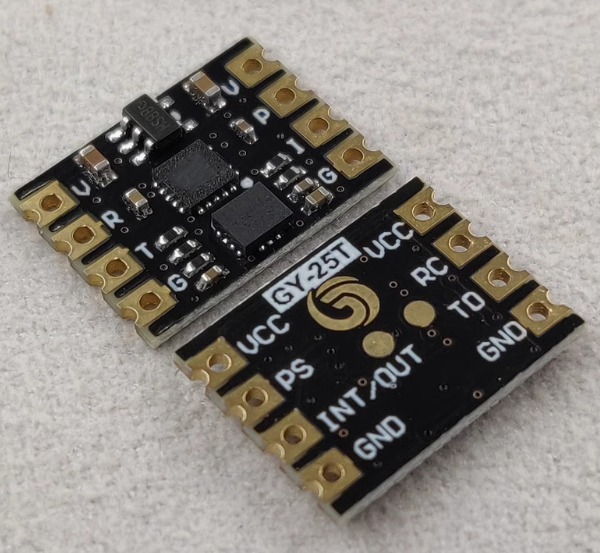
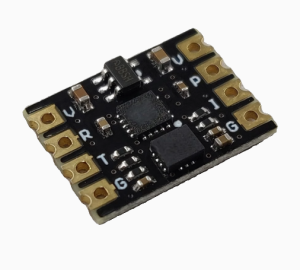
GY-25T 6DOF IMU Module – UART/I2C Tilt Sensor with Gyro + Accelerometer | Angle Detection for ROS Robotics (3.3-5V)

SKU: FA2012-2-2
Sensor Core

Integrated 6-Axis Motion Processor (MPU series compatible)

Output Data

Pitch Angle, Roll Angle

Output Format

Serial (UART TTL) & I2C

Supply Voltage

3.0V – 5.0V DC

Resolution

Approx. 0.01°

Baud Rate Options (UART)

9600 bps (default) / 115200 bps (configurable)

Data Update Rate

Up to 100 Hz

Module Dimensions

Approx. 24mm x 15mm

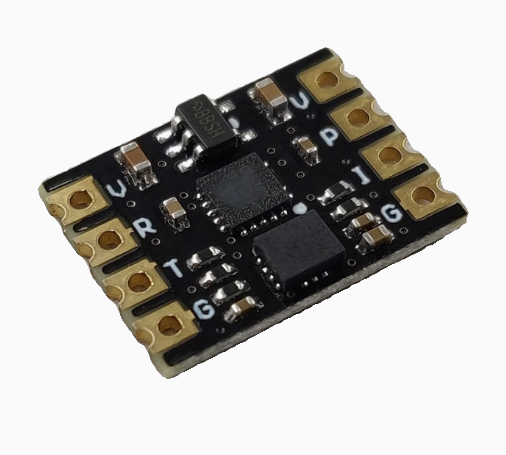
The GY-25T 6DOF IMU Module is a versatile 6-Degrees of Freedom Inertial Measurement Unit designed to provide pre-processed, stable tilt angle data via both UART (Serial) and I2C communication interfaces. This module is an excellent solution for robotics, specifically within the ROS (Robot Operating System) framework, requiring reliable pitch and roll measurements without the need for complex microcontroller-level sensor fusion algorithms.
Product Description
The GY-25T module offers a powerful integration of a 3-axis accelerometer and a 3-axis gyroscope within a single compact unit. What sets it apart is the onboard processing unit that executes sophisticated sensor fusion algorithms internally. This results in direct, reliable digital outputs of calculated pitch and roll angles in degrees, drastically simplifying development time for engineers and hobbyists alike.
With the GY-25T, you bypass the challenges of managing raw sensor data, calibration routines, and mathematical drift correction on your main control board. The module provides a plug-and-play experience, offering both a high-speed serial interface for rapid data polling (ideal for ROS integration) and a flexible I2C interface. It operates across a wide power supply range of 3.3V to 5V and features an onboard voltage regulator, ensuring compatibility with virtually any contemporary development platform, from Arduino to Raspberry Pi and specialized industrial controllers.
Key Features
  • Integrated 6DOF Sensing: Combines 3-axis acceleration and 3-axis gyroscope data acquisition.
  • Pre-Processed Angle Output: Delivers stable, filtered Pitch and Roll angles in degrees (not raw data).
  • Dual Communication Interfaces: Supports both UART (Serial TTL) and I2C protocols for versatile connectivity.
  • Wide Voltage Compatibility: Onboard regulator allows operation from 3.3V to 5V DC power supplies.
  • High Resolution: Provides detailed angle measurement with fine precision (typically 0.01° resolution).
  • Internal Sensor Fusion: Offloads computationally intensive algorithms from the main microcontroller.
  • ROS Ready: Ideal for use in Robot Operating System projects requiring reliable orientation data.
Usage
The GY-25T module is used to provide accurate orientation data for various applications:
  1. Robotics (ROS): Provides reliable orientation input for navigation stacks and balance algorithms.
  2. Platform Stabilization: Used in camera gimbals or leveling systems for industrial machinery.
  3. UAV/Drone Monitoring: For basic pitch and roll tracking in fixed-wing or entry-level drone systems.
  4. Automation: Ensuring components are correctly oriented in automated systems.
Wiring via UART:
  • Connect VCC to 5V/3.3V and GND to common ground.
  • Connect module’s TX to microcontroller’s RX.
  • Connect module’s RX to microcontroller’s TX (for configuration).
Wiring via I2C:
  • Connect VCC to 5V/3.3V and GND to common ground.
  • Connect module’s SCL/SDA pins to microcontroller’s I2C pins.
  • Note: Ensure the module is configured for I2C mode if required (check documentation for jumper settings).
Q: Do I need to program sensor fusion algorithms in my Arduino code?

No, the main benefit of the GY-25T is that these complex calculations are handled internally. Your microcontroller simply reads the final, stable angle data via serial or I2C.

Q: Can I use both UART and I2C interfaces simultaneously?

Generally, you configure the module to use one interface or the other (often via a solder jumper or startup command). Refer to the specific module documentation for switching instructions.

Q: Does this sensor measure Yaw (heading/compass direction)?

No, the integrated sensors only provide Pitch and Roll measurements relative to gravity. Yaw tracking requires an additional magnetometer (compass) sensor.

Q: Is the data noisy? Do I need external filtering?

The data is already internally filtered and stabilized using onboard algorithms. You should find the output significantly cleaner and more stable than raw IMU breakout boards.

Q: Can I use this for high-speed robotic applications?

The 100 Hz update rate is sufficient for most standard robotics projects, particularly within ROS environments that manage sensor data streams effectively.