Product Description
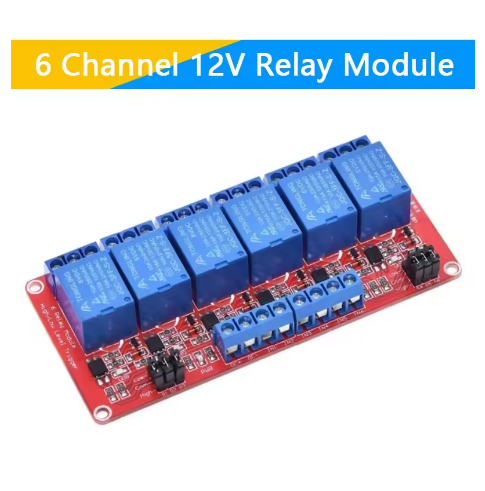
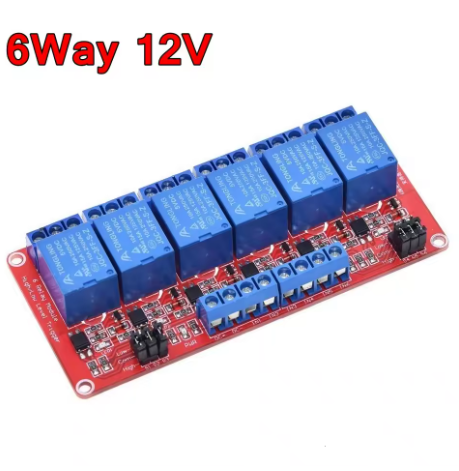
The 6 Channel 12V Relay Module with Optocoupler is a premium interface solution designed to provide reliable, isolated, and flexible control for 12V-based systems. It serves as a robust bridge between 12V control logic from PLCs, industrial controllers, or automotive systems and a wide range of high-power AC or DC loads. The core innovation lies in its integration of advanced optocouplers for all six channels, creating a critical 2500V electrical barrier that isolates your sensitive control circuitry from the potentially noisy and hazardous high-voltage/current load side. This ensures complete protection against damaging voltage spikes, ground loops, and electrical interference, guaranteeing the longevity and stability of your control equipment.
Engineered for versatility, the module features individually selectable high-level or low-level trigger logic for each channel via simple onboard jumpers. This allows seamless compatibility with any 12V sourcing (PNP) or sinking (NPN) control signals. With six industrial-grade relays capable of handling substantial currents, clear dual-LED status indicators per channel, and secure screw terminal connections, this module is the ideal choice for building sophisticated multi-zone control systems, industrial machine interfaces, and complex automation projects where safety, reliability, and flexible signal handling are paramount.
Key Features
-
Six-Channel Opto-Isolated Design: Each of the six independent channels is protected by a dedicated optocoupler, providing 2500Vrms of isolation to safeguard 12V control systems from load-side electrical noise and transients.
-
Dual Trigger Logic Selectable: Each channel can be individually configured for High-Level (active on +12V) or Low-Level (active on 0V/GND) trigger via a simple jumper, ensuring compatibility with all 12V PLCs and controllers.
-
Industrial 12V Compatibility: Designed for direct integration into standard 12V DC control environments, including factory automation, automotive applications, and control panels.
-
High-Current Relay Outputs: Features six robust electromagnetic relays with SPDT contacts, each rated to switch loads up to 10A at 250VAC or 30VDC.
-
Comprehensive Status Indicators: Dual LEDs per channel provide clear visual feedback: one indicates the opto-isolator input status, and the other confirms the physical relay coil activation and contact switching.
-
Secure & Professional Connections: All high-power load and DC power inputs utilize reliable screw terminals for safe, vibration-resistant wiring suitable for industrial and vehicular installations.
-
Integrated Protection: Includes flyback diodes across each relay coil to suppress inductive voltage spikes, protecting the driving circuitry and enhancing module longevity.
-
Compact, High-Density Layout: Efficient PCB design packs six fully isolated relay channels into a compact form factor, saving space in control cabinets and enclosures.
Main Parameters
-
Channels: 6 Independent Relays
-
Control & Logic Voltage: 12V DC
-
Trigger Mode: High or Low Level (Jumper Selectable per channel)
-
Isolation Voltage: 2500V RMS (Optocoupler)
-
Relay Contact Rating: 10A @ 250VAC / 10A @ 30VDC
-
Relay Type: Electromagnetic, SPDT (Single Pole Double Throw)
-
Input Current (per channel): ~5-10mA (to activate optocoupler)
-
Dimensions: Approx. 135mm x 85mm x 22mm
Typical Applications / Usage
-
Industrial Machine Control: Interface 12V PLC or microcontroller outputs to control multiple actuators, solenoid valves, motor contactors, and indicator lights on automated production equipment.
-
Automotive & Marine System Integration: Build centralized control units for vehicles or boats to manage lighting arrays, winches, pumps, fans, and audio systems from a 12V control head unit or ECU.
-
HVAC & Building Management: Control multiple zones of heating, ventilation, or lighting in commercial settings using a 12V building automation controller.
-
Agricultural Automation: Manage various equipment in large-scale setups, such as irrigation solenoid valves, greenhouse vent openers, and feeding systems, from a central 12V timer or controller.
-
Telecom/Data Rack Power Management: Control power distribution, sequencing, and cooling devices across multiple equipment racks in 12V-based infrastructure.
-
Prototyping Complex 12V Systems: The essential development tool for engineers creating prototypes for industrial controllers, test fixtures, or custom vehicular electronics.
Connection & Configuration Guide:
-
Trigger Configuration: For each channel, place the jumper cap over the pins labeled “H” for High-Level trigger (activates on +12V signal) or “L” for Low-Level trigger (activates on 0V signal).
-
Power & Control Wiring: Connect a stable 12V DC power supply to the module’s VCC and GND terminals. Connect the six signal input pins (IN1 to IN6) to the digital outputs of your 12V controller (PLC, microcontroller, etc.).
-
Load Wiring: For each channel, connect the power source (AC mains or DC supply) to the relay’s Common (COM) terminal. Connect the device to be controlled to the Normally Open (NO) terminal to be powered when the relay activates.
-
Critical Safety: Always disconnect all high-voltage AC mains or high-current DC power before making or changing any load-side connections. Install the module in a properly rated, insulated enclosure. Follow all applicable electrical safety codes.
Q: Why is a 12V relay module with an optocoupler better than one without?
The optocoupler provides critical electrical isolation. In 12V systems—especially in vehicles or industrial settings—switching high-power inductive loads (motors, solenoids) creates significant electrical noise and voltage spikes. The optocoupler prevents this noise from traveling back into your sensitive 12V controller, preventing malfunctions, resets, or permanent damage.
Q: My controller has 24V outputs. Can I use it with this 12V module?
No, not directly. Applying 24V to the control inputs or the VCC pin will damage the optocouplers and other components on the module. You need a module designed for 24V control or must use a voltage divider/regulator to step the 24V signal down to 12V for the control inputs.
Q: How do I know if I need High-Level or Low-Level trigger?
It depends on your controller’s output type.
-
Sourcing Output (PNP): Provides +12V when active. Use High-Level (H) trigger.
-
Sinking Output (NPN): Provides a path to ground (0V) when active. Use Low-Level (L) trigger.
Consult your controller’s manual to confirm its output configuration.
Q: What is the power requirement for this module?
The control side (opto-couplers) draws very little current (~5-10mA per active channel). The primary load is the relay coils. Each 12V coil draws approximately 80-100mA when activated. If all six relays are on simultaneously, ensure your 12V power supply can provide at least 500-600mA of current, plus additional capacity for your controller.
Q: Can I use this to directly switch a 3-phase motor or a high-wattage heater?
No, not directly for high-power devices. The relays are rated for 10A. A high-wattage heater may exceed this. More importantly, a 3-phase motor requires switching all three phases simultaneously. The correct method is to use one channel of this module to control the coil of a suitably rated 3-pole contactor, which then safely switches the high-power load.
Q: The opto-isolator LED lights up, but the relay status LED does not. What's wrong?
This indicates the control signal is being received (opto LED on), but the relay coil is not energizing. The most common cause is an insufficient 12V power supply for the relay coils. Ensure your 12V supply connected to VCC is powerful enough and that connections are secure. The relay coils and opto-couplers are often on separate power circuits internally.
Q: Are the six relay output channels electrically common or separate?
The load-side contacts (COM, NO, NC) for each relay are completely separate and isolated from each other. This allows you to switch circuits with different voltages and power sources on different channels without any cross-connection.
Q: Is this product suitable for business and OEM integration?
Yes, perfectly. Its industrial specifications (12V logic, optical isolation, high-current relays, and flexible triggering) make it an excellent, reliable component for integration into commercial machinery, vehicular control systems, custom control panels, and OEM products. We offer volume pricing and can discuss custom modifications for qualified business clients. Please contact our sales team for details.