Description
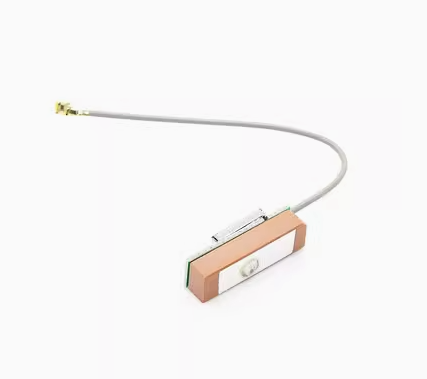
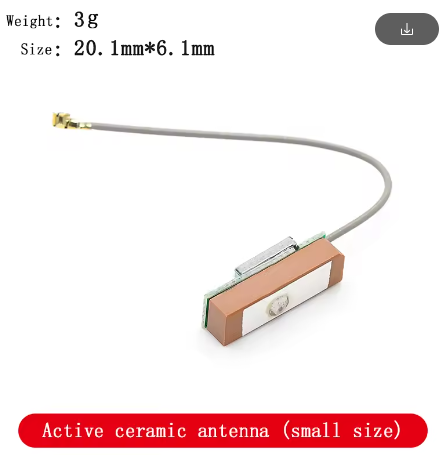
The 20.1×6.1mm Mini Active Ceramic Antenna is a compact, high-performance external GPS antenna designed specifically for space-constrained applications where traditional square patch antennas are too large. With its slim rectangular form factor measuring just 20.1mm in length and 6.1mm in width, this antenna fits easily into narrow enclosures, drone arms, vehicle mirror housings, wearable devices, and other tight spaces where a standard 25×25mm antenna cannot be accommodated.
Despite its miniature size, this is a fully active antenna featuring a built-in Low Noise Amplifier (LNA). The integrated amplifier boosts weak GPS satellite signals before transmitting them down the cable to your GPS module, compensating for signal loss and enabling reliable reception even in challenging environments. The antenna is precision-tuned to the GPS L1 frequency band (1575.42 MHz) with Right-Hand Circular Polarization (RHCP), matching the signal characteristics of GPS satellites for optimal energy transfer.
The antenna is terminated with a u.FL / IPEX connector on a short pigtail cable (approximately 5cm to 14cm), making it directly compatible with GY-NEO-6M, GY-NEO-7M, and GY-NEO-8M V2 modules that feature an external antenna port. For installations requiring SMA connectors, a u.FL-to-SMA adapter cable can be used.
Housed in a durable, lightweight casing, this mini antenna is suitable for both indoor and outdoor use within its specified temperature range (-40°C to +85°C). Whether you are building a mini drone where every gram and millimeter counts, designing a compact vehicle tracker, or integrating GPS into a portable IoT device, this mini active ceramic antenna delivers reliable GPS signal reception without sacrificing valuable board or enclosure space.
Key Features
-
Ultra-Compact Size – Slim 20.1mm × 6.1mm rectangular form factor fits into tight spaces where standard antennas cannot be used
-
Active Amplification (LNA) – Built-in Low Noise Amplifier boosts weak GPS signals, improving sensitivity and reducing Time-To-First-Fix (TTFF)
-
High Gain (26dB typical) – Provides strong signal output to overcome cable losses, ideal for installations requiring longer cable runs
-
GPS L1 Band Tuned – Precision-tuned to 1575.42 MHz ± 3 MHz for optimal GPS satellite reception
-
Right-Hand Circular Polarization (RHCP) – Matches GNSS satellite signal polarization for maximum energy transfer and signal integrity
-
Integrated Ceramic Element – High-performance rectangular ceramic patch for reliable satellite tracking in a compact footprint
-
u.FL / IPEX Connector – Standard connector directly compatible with GY-NEO series GPS modules; no soldering required
-
Low Noise Figure (1.5dB typical) – Minimizes signal degradation introduced by the amplifier itself
-
Wide Operating Temperature – -40°C to +85°C suitable for automotive, drone, and outdoor applications
-
Lightweight Design – Approximate weight of 5g – 8g, ideal for weight-sensitive applications like drones and portable devices
Technical Specifications
Q: How is this mini antenna different from the standard 25×25mm active ceramic antenna?
The primary difference is size and gain. This mini antenna measures only 20.1mm × 6.1mm, making it suitable for tight spaces. It has a slightly lower typical gain (26dB vs 28dB), but this difference is negligible for most applications. The mini version is ideal when space is the constraint; the standard version offers marginally better performance in wide-open installations.
Q: Will this antenna work with my GY-NEO-6M/7M/8M V2 module?
Yes, provided your GY-NEO module has the external antenna connector variant (featuring a u.FL/IPEX port). This antenna’s u.FL connector plugs directly into these modules. If your module has an SMA connector, you will need a u.FL-to-SMA adapter cable.
Q: Do I need to provide external power to this antenna?
No. Like all active GPS antennas, this antenna receives its operating power (typically 3V–5V DC) directly from your GPS module through the same coaxial cable. The GY-NEO series modules provide this “antenna bias” voltage automatically.
Q: Can I use this antenna for multi-GNSS (GPS + GLONASS + BeiDou + Galileo)?
This antenna is optimized for GPS L1 (1575.42 MHz). While GLONASS L1 (1602 MHz) and BeiDou B1 (1561 MHz) are relatively close, performance may be reduced compared to a dedicated wideband antenna. For true multi-GNSS performance across all constellations, we recommend a wideband antenna covering 1559–1610 MHz (sold separately).
Q: What is the maximum cable length I can use with this mini antenna?
With 26dB gain, you can typically use cables up to 3–5 meters using quality RG174 coax. Cable loss for RG174 is approximately 1.2dB per meter at GPS frequencies. Your total system gain (26dB minus cable loss) should remain above 20dB for reliable operation. For longer runs, consider the standard 28dB antenna or a lower-loss cable (e.g., RG58 or LMR-200).
Q: Why is my GPS module not getting a fix after connecting this antenna?
Check the following: (1) Ensure the antenna has a clear, unobstructed view of the sky — not under metal roofs or behind metallic window tint. (2) Verify the u.FL connector is fully seated (it should click into place). (3) Allow 5–15 minutes for the first “cold start” acquisition, especially if the module has been powered off for a long time. (4) Ensure your GPS module is configured to use an external antenna (most auto-detect, but some require a setting change).
Q: Can this antenna be mounted outdoors in rain or snow?
Yes. The antenna is housed in a weather-resistant casing and rated for operation from -40°C to +85°C, making it suitable for outdoor use. For permanent marine or exposed installations, we recommend adding a layer of dielectric grease to the u.FL connector and using heat shrink or weather-sealing tape for additional protection.
Q: Is this antenna suitable for drone use?
Absolutely. The compact size (20.1×6.1mm) and light weight (5–8g) make it ideal for mini drones and micro UAVs where space and weight are critical. Mount the antenna on the drone’s top plate or along an arm, ensuring it is not shielded by carbon fiber or metal components. For best results, keep the antenna oriented flat (ceramic element facing upward toward the sky).
Q: What is the difference between an active and passive antenna, and why does this matter?
An active antenna includes a built-in Low Noise Amplifier (LNA) that boosts weak satellite signals, allowing longer cable runs and better performance in weak signal environments. A passive antenna has no amplifier and requires very short cables. This product is an active antenna, which is required for any installation with a cable longer than 30cm or where the GPS module is inside an enclosure.
Q: What does VSWR ≤ 1.5 mean and why is it important?
VSWR (Voltage Standing Wave Ratio) measures how efficiently the antenna transfers RF energy to the receiver. A VSWR of 1.5 means approximately 96% of the received signal power reaches the receiver, with only 4% reflected back. Lower VSWR is better. A VSWR of 1.5 or less is considered excellent for GPS antennas and indicates proper impedance matching to the 50Ω standard.