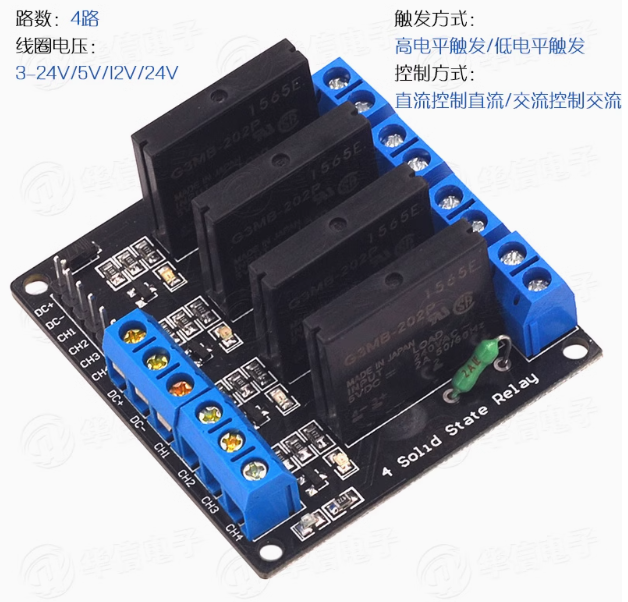
Product Description
The 4-Channel Solid State Relay (SSR) Module is a sophisticated, fully-isolated switching solution designed for silent, reliable, and long-lasting control of AC loads using low-voltage DC signals. Engineered to offer maximum flexibility, it supports a wide 5V/12V/24V DC control voltage range and features selectable high/low-level trigger logic, making it universally compatible with virtually any microcontroller, PLC, or digital controller on the market. This module is the modern, solid-state alternative to traditional electromagnetic relays, eliminating moving parts for completely silent operation, faster switching, and exceptional longevity—ideal for noise-sensitive environments and high-cycle applications.
Each channel provides robust 2500V optical isolation, ensuring your sensitive control electronics are completely protected from high-voltage AC transients and noise. The integrated zero-crossing detection circuit switches the load precisely as the AC waveform crosses zero volts, dramatically reducing electromagnetic interference (EMI) and inrush current to protect both the relay and connected devices like motors, heaters, and lamps. With its clear status LEDs, versatile control options, and reliable screw terminal connections, this module is the perfect choice for advanced home automation, professional industrial control systems, and robust IoT applications requiring safe and precise AC power management.
Key Features
-
Universal Control Voltage: Jumper-selectable 5V, 12V, or 24V DC input makes it compatible with Arduino, Raspberry Pi, PLCs, and 12V/24V industrial systems without modification.
-
Selectable Trigger Logic: Choose between High-Level or Low-Level trigger for each channel via onboard jumpers, offering perfect compatibility with any control logic (sourcing or sinking).
-
Full Optical Isolation: Advanced optocoupler isolation (2500Vrms) on each channel provides complete electrical separation between your low-voltage DC control circuit and the high-voltage AC load, ensuring safety and noise immunity.
-
Zero-Crossing Switching: Built-in zero-crossing circuitry minimizes EMI/RFI noise and prevents high inrush current, protecting both the SSR and connected devices for extended operational life.
-
Four Independent AC Outputs: Control up to four separate AC appliances or circuits independently with a single, compact module.
-
Silent & Maintenance-Free Operation: Solid-state design with no moving parts or contacts to wear out, ensuring silent switching and a vastly longer lifespan than mechanical relays.
-
Clear Visual Status: Bright LED indicators for each channel provide instant visual feedback of the switching state.
-
Secure & Safe Connections: High-quality screw terminals for both control and load wiring ensure reliable, vibration-resistant connections for safety and performance.
Main Parameters
-
Channels: 4
-
Control Voltage (Input): 5V / 12V / 24V DC (Jumper Selectable)
-
Trigger Mode: High-Level or Low-Level (Jumper Selectable)
-
Load Voltage (Output): 24 ~ 240V AC
-
Maximum Load Current: 2A per channel
-
Isolation Voltage: 2500V RMS
-
Switching Function: Zero-Crossing
-
On-state Resistance: < 30mΩ
-
Dimensions: Approx. 100mm x 80mm x 25mm