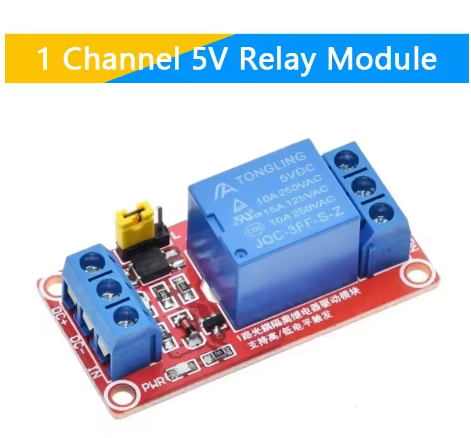
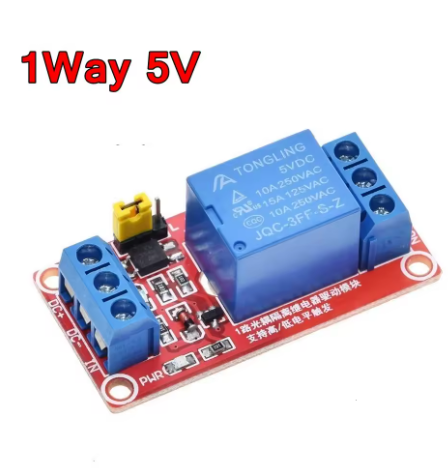
Product Description
The 5V Opto-Isolated Single Channel Relay Module is a fundamental yet critical building block for any project requiring safe and reliable control of a high-power electrical device from a low-voltage microcontroller. This module provides a single, robust interface that perfectly balances simplicity with professional-grade protection. At its core is a high-quality electromagnetic relay, but its defining feature is the integrated optocoupler that creates a complete 2500V electrical barrier between your sensitive control circuitry (like an Arduino or Raspberry Pi) and the potentially noisy or hazardous load circuit. This isolation ensures voltage spikes, ground loops, and electrical interference from motors or appliances cannot damage your valuable controller.
Designed for ultimate flexibility, the module includes a simple jumper to select between high-level or low-level trigger logic, making it compatible with virtually any digital output. Clear dual LED indicators provide immediate feedback on both the input command and the relay’s physical state. With its compact size, secure screw terminals, and straightforward three-pin control interface, this single-channel module is the ideal, reliable solution for individual switching tasks, educational purposes, or as a modular component in larger, customized control systems.
Key Features
-
Critical Optical Isolation: Integrated optocoupler provides 2500Vrms of isolation, creating a safe electrical barrier that protects your microcontroller from damaging high-voltage transients and electrical noise from the load side.
-
Selectable Trigger Logic: A simple jumper allows you to configure the module for either High-Level (active-HIGH) or Low-Level (active-LOW) trigger operation, ensuring compatibility with any control logic or microcontroller.
-
High-Capacity Relay: Features a durable electromagnetic relay with SPDT (Single Pole Double Throw) contacts, capable of switching loads up to 10A at 250VAC or 30VDC.
-
Dual Status Indication: Two independent LEDs provide clear visual feedback: one lights when the opto-isolator receives a valid input signal, and the other lights when the relay coil is energized and the contacts have physically switched.
-
Integrated Flyback Diode: Includes a protection diode across the relay coil to suppress voltage spikes generated when the coil is de-energized, safeguarding the driving transistor and ensuring circuit longevity.
-
5V TTL Logic Compatible: Designed for direct and easy interfacing with 5V microcontrollers like Arduino, requiring only minimal current (5-10mA) to activate the opto-isolator.
-
Secure & Professional Connections: High-current load connections use reliable screw terminals (COM, NO, NC), while control is via a standard 3-pin header (VCC, GND, IN) for a clean and safe setup.
-
Compact & Versatile Design: A small, self-contained module that is easy to mount and integrate into a wide variety of projects, from simple prototypes to final products.
Main Parameters
-
Channels: 1
-
Control Logic Level: 5V TTL
-
Trigger Mode: High or Low Level (Jumper Selectable)
-
Isolation Rating: 2500V RMS (Optocoupler)
-
Relay Contact Rating: 10A @ 250VAC / 10A @ 30VDC
-
Relay Type: Electromagnetic, SPDT (Single Pole Double Throw)
-
Input Current: ~5-10mA (to activate optocoupler)
-
Dimensions: Approx. 50mm x 40mm x 18mm
Typical Applications / Usage
-
Safe Appliance Control: The perfect, protected interface for a smart home project to control a single lamp, fan, coffee maker, or other appliance with an Arduino or ESP8266/32.
-
Industrial Sensor Interface: Connect a single PLC digital output or sensor to safely control an alarm, indicator light, or small actuator in an industrial setting with electrical noise.
-
Audio/Video Switching: Use as a noise-free, ground loop-breaking switch to control power to an amplifier, projector, or other A/V equipment.
-
Educational Demonstrations: An excellent tool for teaching electronics, relay operation, and the critical importance of optical isolation in control systems.
-
Prototyping & Modular Design: Use as a discrete, reliable switching module that can be easily replicated and integrated into larger custom control panels or prototypes.
-
Safety Interlock: Implement a simple, isolated safety circuit where one device (e.g., a guard door switch) must reliably enable or disable another.
Connection & Configuration Guide:
-
Trigger Configuration: Place the jumper cap over the two pins labeled “H” for High-Level trigger (relay activates on a 5V signal) or “L” for Low-Level trigger (relay activates on a 0V signal).
-
Power & Control Wiring: Connect the module’s VCC and GND to a 5V DC power source. Connect the signal pin (IN) to a digital output pin on your microcontroller.
-
Load Wiring: Connect the power source (e.g., 120V AC line) for your device to the relay’s Common (COM) terminal. Connect the device to be controlled to the Normally Open (NO) terminal to power it when the relay activates, or to the Normally Closed (NC) terminal for the opposite logic.
-
Safety Notice: Always disconnect all high-voltage power before making or changing any load-side connections. Install the module in a properly rated insulated enclosure for safety.
Q: What is the main benefit of the opto-isolator in this module?
The opto-isolator provides electrical safety and noise immunity. It prevents any high-voltage spikes, electrical noise, or ground potential differences from the load circuit (e.g., a motor or appliance) from traveling back to and damaging your sensitive and expensive microcontroller or computer.
Q: When should I use High-Level trigger vs. Low-Level trigger?
-
High-Level (H): Use this when you want the relay to activate when your microcontroller pin goes HIGH (5V). This is the standard for most Arduino sketches (digitalWrite(pin, HIGH)to turn ON).
-
Low-Level (L): Use this when you want the relay to activate when the pin goes LOW (0V). This is common in industrial “sinking” logic and can be a “fail-safe” design, as a broken control wire often defaults to a HIGH state, turning the relay OFF.
Q: Can I use this with a 3.3V microcontroller like a Raspberry Pi or ESP32?
Yes, typically in High-Level trigger mode. While the module’s VCC should be 5V, a 3.3V HIGH signal is often sufficient to weakly activate the optocoupler’s internal LED. For guaranteed and reliable operation, it is best to use a simple logic level converter to shift the 3.3V signal to 5V, or use a module specifically designed for 3.3V logic.
Q: I see a "JD-VCC" pin or jumper. What is it for?
This allows you to power the relay coil from a separate 5V power supply. This is highly recommended! The relay coil can draw 70-80mA when on, which can cause a voltage drop on your microcontroller’s 5V line. Using a separate supply (connected to JD-VCC and GND) keeps the power for your microcontroller clean and stable.
Q: What is the difference between the two LEDs?
-
OPTO LED (often green or smaller): Lights up when the optocoupler receives a valid trigger signal from your microcontroller. It indicates the command has been received.
-
RELAY LED (often red or larger): Lights up when the relay coil is energized and the physical switch contacts have closed. It indicates the output has actually switched.
Q: Can I use this to switch a DC load, like a 12V LED strip?
Yes. The relay contacts are rated for both AC and DC. You can switch a 12V DC LED strip by connecting your 12V power supply to COM and the LED strip to NO. Do not exceed the 10A, 30VDC rating.
Q: The relay clicks but my device doesn't turn on. What should I check?
First, check your load-side wiring. Ensure the device is connected between COM and NO. Verify the device works by connecting it directly to its power source. Finally, ensure the screw terminals are tightened securely on bare wire ends. The click confirms the coil is working, so the issue is almost certainly in the load circuit.
Q: Is this a suitable product for small business or OEM use?
Absolutely. Its professional features—optical isolation, robust relay, flexible triggering, and secure terminals—make it an excellent, reliable component for low-volume product integration, kiosks, custom control boxes, and educational kits. We offer bulk pricing for business and reseller customers. Please contact our sales team for quotes.