Description
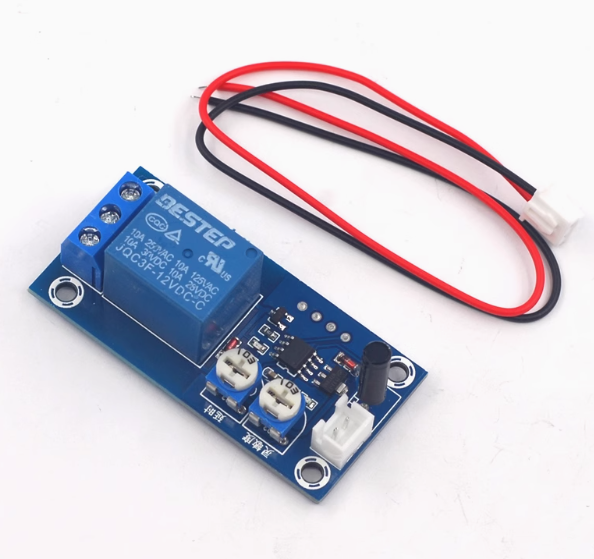
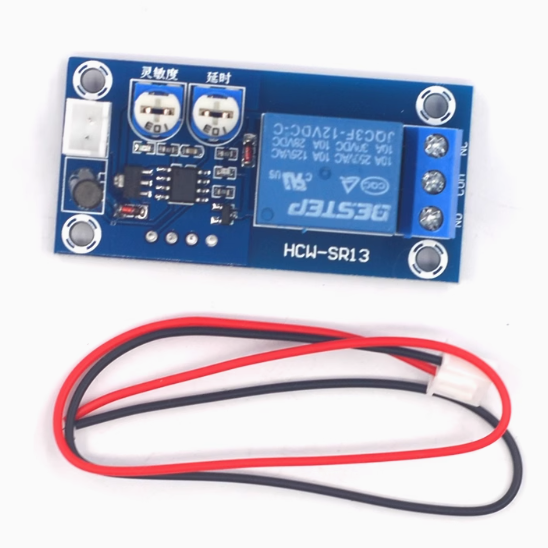
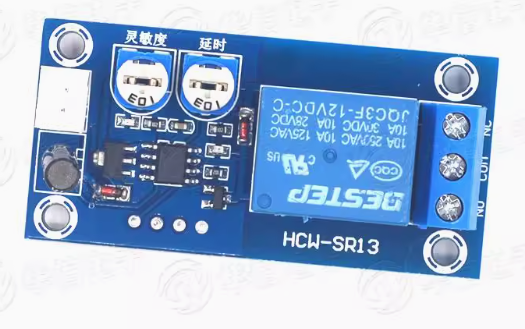
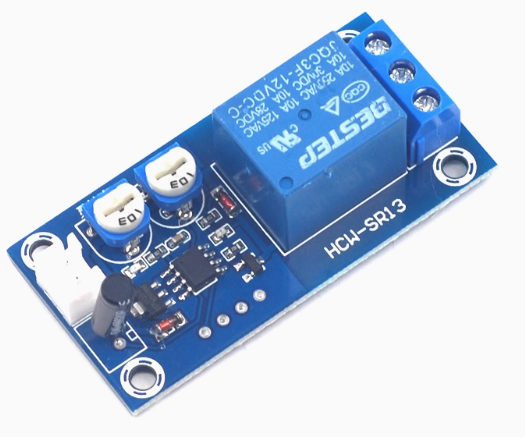
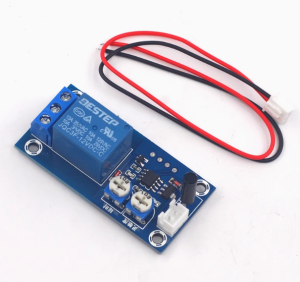
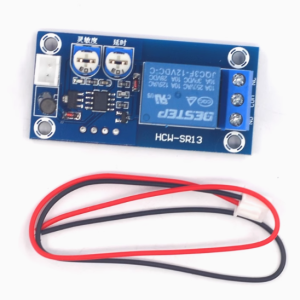
The Adjustable Sensitivity Vibration Sensor Switch Module – High Precision with Delay Control is a sophisticated, intelligent vibration detection and control device designed for industrial equipment protection, security systems, and automation applications. This advanced module combines a highly sensitive piezoelectric or spring-based vibration sensor with a built-in relay, adjustable sensitivity threshold, and programmable delay timer – all in a compact, easy-to-use package.
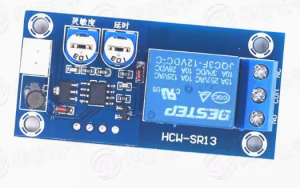
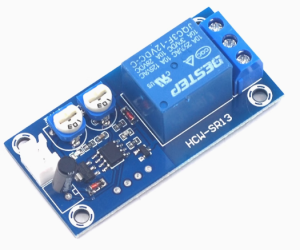
What sets this module apart from basic vibration sensors is its dual adjustment capability. First, the onboard potentiometer allows you to fine-tune the sensitivity from light touch detection to heavy impact only, ensuring you can dial in exactly the response your application requires. Second, the independent delay control circuit lets you set how long the relay remains activated after vibration stops – from as short as 1 second up to 240 seconds or more, depending on the model .
The module operates on 5V or 12V DC (selectable by model) and features a built-in SPDT relay rated for 10A at 250V AC or 30V DC, capable of controlling fans, alarms, motors, lights, or shutting down equipment directly. An LED indicator provides clear visual confirmation of relay status, and the module can be configured for either latching or non-latching operation.
Whether you need to trigger an alarm when a safe is tampered with, shut down a washing machine when it becomes unbalanced, detect conveyor belt jams, protect industrial pumps from excessive vibration, or create a smart anti-theft system for vehicles or equipment, this adjustable sensitivity vibration switch module delivers precision control in a plug-and-play format – no microcontroller programming required.
Key Features
-
Dual Adjustable Parameters – Independent sensitivity adjustment (via potentiometer) and delay time adjustment (via potentiometer or digital buttons) for complete application customization .
-
Wide Delay Time Range – Adjustable delay from 1 second to 240 seconds (or up to 999 seconds on advanced models), allowing the relay to stay activated after vibration stops .
-
High Sensitivity Detection – Capable of detecting subtle vibrations (as low as 0.5g to 1g threshold) while allowing adjustment to ignore minor noise .
-
Built-in SPDT Relay – Controls external devices up to 10A / 250V AC or 10A / 30V DC, suitable for alarms, fans, motors, and equipment shutdown.
-
Dual Voltage Options – Available in 5V DC (USB/Arduino compatible) or 12V DC (automotive/industrial standard) configurations.
-
Real-Time LED Indicators – Power LED shows module status; relay LED indicates when output is activated.
-
Fail-Safe Capable – NC (Normally Closed) output option available for equipment protection applications where power loss should trigger a safe state.
-
Standalone Operation – No microcontroller, programming, or software required – works immediately after wiring and adjustment.
-
Compact Form Factor – Small footprint (approx. 60mm x 40mm) fits easily into control panels, equipment enclosures, or security housings .
-
Low Standby Current – Consumes less than 1mA in standby mode, making it suitable for battery-powered applications .
Technical Parameters
Usage Guide
How It Works
The module continuously monitors for vibration through its sensor element. When vibration is detected above the sensitivity threshold, the relay activates (closes the NO contact) and remains activated for the duration of the vibration plus the programmed delay time. Once vibration stops and the delay timer expires, the relay deactivates (returns to NO open state). This delay feature prevents rapid on/off cycling and ensures connected devices stay active long enough to be effective (e.g., an alarm sounding long enough to be heard).
Wiring Instructions
Step 1 – Power Connection
-
Connect the appropriate DC power supply to the VCC (+) and GND (-) terminals.
-
5V model: Use USB charger, 5V adapter, Arduino 5V pin, or regulated 5V battery
-
12V model: Use 12V battery, automotive system, 12V industrial power supply, or solar system
Step 2 – Load (Device) Connection
Wiring Example (Alarm System – Activates on vibration):
-
Connect alarm siren positive → NO terminal
-
Connect power supply positive → COM terminal
-
Connect alarm siren negative → power supply negative directly
Wiring Example (Equipment Protection – Shuts down on vibration):
⚠️ Safety Warning: For AC loads (110V/220V), ensure all connections are properly insulated. Use appropriate gauge wire and mount the module in an enclosure.
Sensitivity Adjustment
-
Power on the module and place the sensor in the target location.
-
Locate the sensitivity potentiometer (usually labeled “SENS” or “ADJ”).
-
Use a small screwdriver to adjust:
-
Test by creating controlled vibration (tap near the sensor) and observe the relay LED.
-
Repeat adjustment until the desired sensitivity is achieved.
Tip: Start with the potentiometer at mid-position (50%), then fine-tune up or down based on your testing.
Delay Time Adjustment
Analog Potentiometer Models:
-
Locate the delay potentiometer (usually labeled “DELAY” or “TIME”)
-
Turn clockwise to increase delay time (longer relay activation after vibration stops)
-
Turn counter-clockwise to decrease delay time (shorter activation)
Digital Button Models (Advanced):
-
Use S2 (UP) button to increase delay time
-
Use S3 (DOWN) button to decrease delay time
-
Digital display shows the current delay setting in seconds
-
Settings are saved to non-volatile memory and persist after power loss
Delay Time Guidelines:
Sensor Placement Tips
-
Mount the sensor firmly to the equipment or surface being monitored – loose mounting reduces sensitivity.
-
For best results, mount on a rigid, flat surface using screws or strong double-sided tape.
-
The sensor can be mounted remotely using the included cable (typically 1 meter, extendable up to 5 meters) .
-
Avoid mounting near sources of constant vibration (e.g., running motors) unless intentional.
-
For outdoor or wet environments, protect the module in an IP-rated enclosure.
Testing the Module
-
Apply power – the power LED should illuminate.
-
Set sensitivity to mid-range and delay to 5 seconds.
-
Tap the sensor or the surface it’s mounted on.
-
The relay LED should illuminate, and the relay should click.
-
Stop tapping – the relay should remain active for the programmed delay time, then deactivate.
-
Adjust sensitivity and delay as needed for your application.
Q: What is the difference between this module and a basic vibration sensor?
| Feature |
This Module |
Basic Vibration Sensor |
| Built-in Relay |
Yes (10A) |
No (digital output only) |
| Delay Control |
Yes (1-240 seconds adjustable) |
No |
| Sensitivity Adjustment |
Yes (potentiometer) |
Limited or none |
| Standalone Operation |
Yes (no microcontroller needed) |
Often requires Arduino |
| Direct Load Control |
Yes (lights, alarms, motors) |
No |
Q: What voltage versions are available?
This module is available in both 5V DC and 12V DC versions. The 5V version is ideal for USB power, Arduino projects, and low-voltage hobbyist applications. The 12V version is designed for automotive systems, industrial control panels, and battery-powered equipment. Please verify your required voltage before ordering.
Q: How does the delay control work?
When vibration is detected, the relay activates immediately. After vibration stops, the relay remains active for the programmed delay time (e.g., 10 seconds), then deactivates automatically. This prevents rapid on/off cycling and ensures connected devices (like alarms or shutdown circuits) stay active long enough to be effective
Q: What is the maximum delay time available?
Standard models offer adjustable delay from 1 second to 240 seconds (4 minutes) . Advanced digital models can support delays up to 999 seconds (16.6 minutes) . The delay setting is saved to memory and persists after power loss.
Q: Can I use this module for both home and business applications?
Home users: Washing machine imbalance shutdown, garage door tamper alarm, sump pump vibration monitoring, aquarium pump protection, DIY anti-theft systems, workshop tool vibration cutoff.
Business users: CNC machine vibration shutdown, conveyor belt jam detection, industrial pump cavitation protection, compressor monitoring, HVAC equipment protection, security system integration, packaging line jam detection, rotating machinery monitoring.
Q: Can I use this module in a vehicle (12V car system)?
Yes – the 12V version is specifically designed for automotive applications . It can be used for anti-theft systems, detecting vehicle towing or impact, monitoring engine vibration, or triggering dashcam recording. Connect to a switched 12V source (fuse box, accessory power) or directly to the battery with an inline fuse (1A recommended).
Q: What is the standby current consumption?
The module consumes less than 1mA in standby mode (relay idle, no vibration detected) . This makes it suitable for battery-powered applications and always-on security systems where long-term power efficiency is important.
Q: How sensitive is this module? Can it detect light taps?
Yes. With the sensitivity potentiometer adjusted to maximum (fully counter-clockwise), the module can detect very light vibrations – as subtle as a finger tap on the mounting surface or even footsteps on the floor . For heavy industrial applications, sensitivity can be reduced to ignore minor background vibration.
Q: Does the module remember delay and sensitivity settings after power loss?
-
Sensitivity: The potentiometer is a mechanical component – its position does not change when power is removed. Sensitivity settings are effectively permanent.
-
Delay (Analog models) : Potentiometer-based delay settings are also mechanical and persist after power loss.
-
Delay (Digital models) : Settings are stored in non-volatile EEPROM memory and retained after power loss .