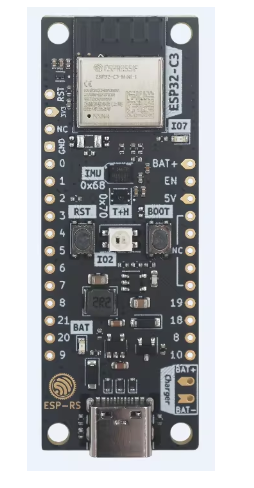
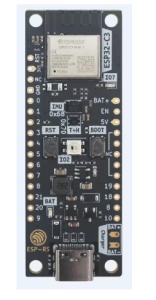
ESP32-C3-DevKit-Rust-1 Development Board – Official Training Kit by Espressif

SKU: FA1054-3
Microcontroller

ESP32-C3 (32-bit RISC-V Core)

Clock Speed

160 MHz

Memory

4MB SPI Flash, 400KB SRAM

Onboard Sensors

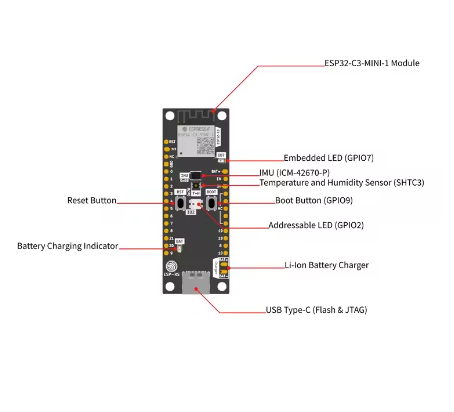
Temperature and Humidity (SHT4x or similar)

Visual Indicators

1x User-programmable RGB LED

Connectivity

Wi-Fi 4 (802.11 b/g/n) & Bluetooth 5.0 (LE)

Power Supply

5V via USB Type-C

USB-to-Serial

Integrated USB-Serial/JTAG Controller

Expansion

Dual-row pin headers for all I/O

The ESP32-C3-DevKit-Rust-1 is the official training and development hardware specifically designed by Espressif to support the growing Rust programming language ecosystem. Optimized for the 2026 developer environment, it provides a “bare-metal” or “std” approach to writing memory-safe, high-performance IoT applications on a RISC-V architecture.
Long Description
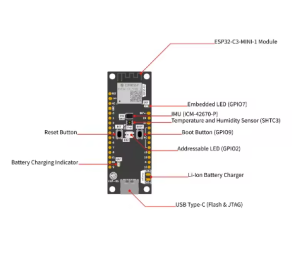
The ESP32-C3-DevKit-Rust-1 is a specialized version of the C3 series designed to lower the barrier for Rust developers entering the embedded space. It features the ESP32-C3-WROOM-02 module with 4MB of Flash and integrates several onboard peripherals—such as a sensirion humidity/temperature sensor and an analog joystick (depending on the specific revision)—to allow for immediate experimentation with Rust drivers and HALs (Hardware Abstraction Layers).
For business purchasers, this kit is an essential investment for teams transitioning to Rust to leverage its memory safety features, which drastically reduce firmware vulnerabilities and “null pointer” bugs in commercial IoT products. For individual makers, it serves as the primary hardware for the official Espressif “Rust on ESP” Training, ensuring you have the exact hardware mentioned in all current 2026 documentation and tutorials.
Key Features
  • Official Rust Support: The primary target for the esp-rs community, ensuring 100% compatibility with the latest Rust toolchains.
  • RISC-V Architecture: Powered by a 32-bit single-core RISC-V processor (160MHz), offering modern efficiency and an open instruction set.
  • Onboard Peripherals: Includes an I2C Temperature & Humidity sensor and an RGB LED, allowing for sensor-to-cloud testing without external wiring.
  • Advanced Security: Features Secure Boot, Flash Encryption, and hardware cryptographic accelerators—essential for professional-grade Rust deployments.
  • Dual Wireless Stack: Full support for 2.4GHz Wi-Fi and Bluetooth 5 (LE) with Long Range capabilities.
Usage Instructions
  1. Environment Setup: Install the Rust toolchain (via rustup) and the esp-idf-template or esp-generate tools as per the Espressif Rust Book.
  2. Hardware Connection: Connect to your PC using a USB Type-C data cable. No external USB-to-Serial drivers are typically needed for modern OSs as it uses the chip’s internal JTAG/Serial controller.
  3. Compiling & Flashing:
    • Use the command cargo espflash flash --monitor to compile your Rust code and upload it to the board.
  4. Debugging: Utilize the built-in JTAG functionality for real-time debugging within VS Code or other Rust-supported IDEs.
Q: Can I use this board with the Arduino IDE?

Yes. While it is optimized for Rust, it is still a standard ESP32-C3 board. You can use it with Arduino or ESP-IDF as you would any other C3-DevKit.

Q: Why should I use Rust instead of C++ for my IoT business?

Rust’s “ownership” model prevents common memory errors (like buffer overflows) that account for the majority of security vulnerabilities in C++ firmware. In 2026, this is a major factor in reducing long-term maintenance costs and improving device security.

Q: Does this board require a special programmer?

No. The ESP32-C3 features an integrated USB-Serial/JTAG controller. You can flash and debug the board directly through the USB Type-C port without an external J-Link or ESP-Prog.

Q: How do I access the onboard sensors in Rust?

You can use the embedded-hal ecosystem. There are pre-existing “crates” (libraries) for the onboard I2C sensors available on crates.io.

Q: Does it support Wi-Fi 6?

No. The ESP32-C3 supports Wi-Fi 4 (802.11 b/g/n). For Wi-Fi 6 support in the RISC-V line, we recommend the ESP32-C6 series.

Q: Is the antenna built-in?

Yes, this board uses a high-efficiency onboard PCB antenna, which is sufficient for most indoor and laboratory training environments.