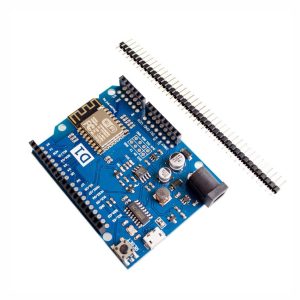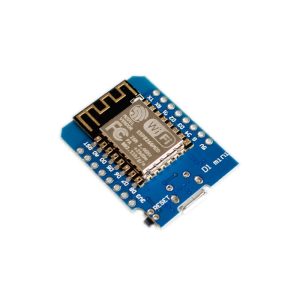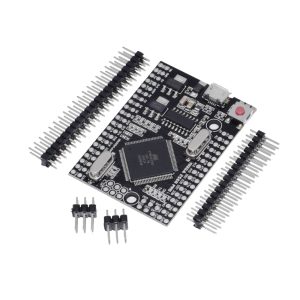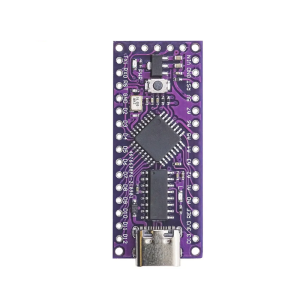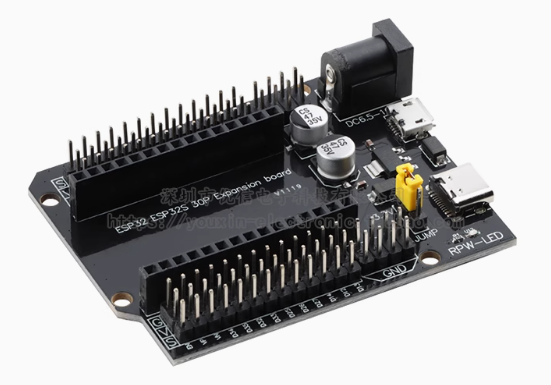
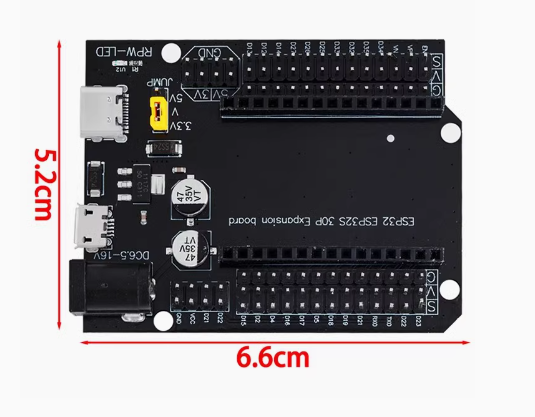
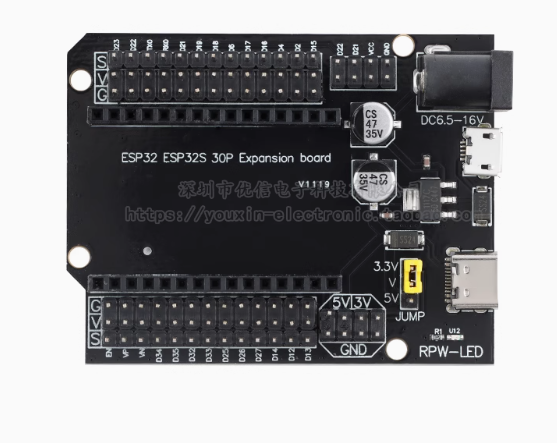
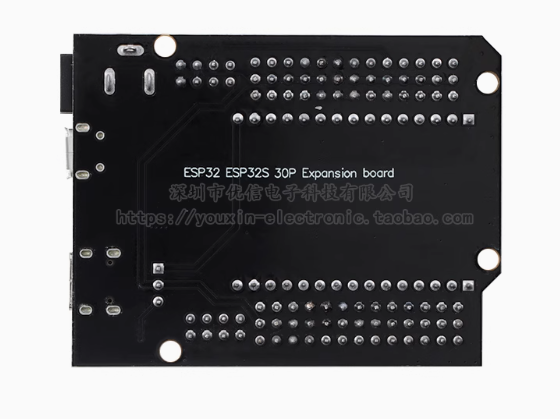
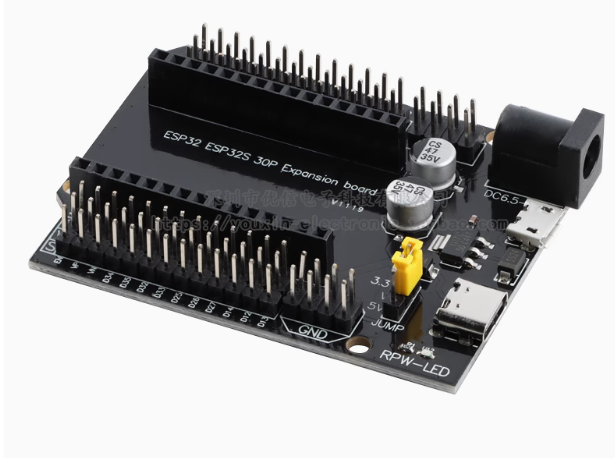
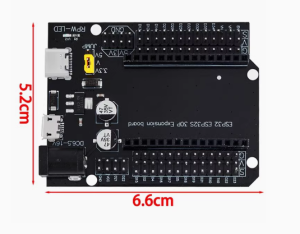
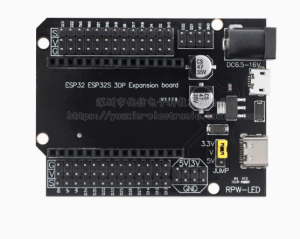
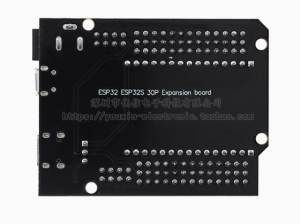
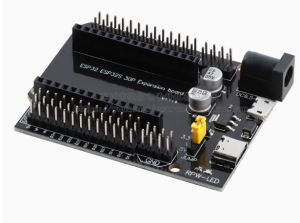
This 30-Pin ESP32 Development Board and Expansion Baseboard Kit is a versatile, industrial-grade prototyping solution. By pairing the classic ESP32-WROOM-32 module with a dedicated power-management shield, this kit solves the most common issues in IoT development: unstable power and messy wiring.
Product Description
The ESP32-DevKitC 30-Pin Kit is an all-in-one platform for high-performance wireless applications. The core development board features the powerful dual-core ESP32 chip, integrated Wi-Fi, and dual-mode Bluetooth.
The accompanying Baseboard (Expansion Shield) is designed to simplify hardware integration. It breaks out every GPIO pin into “GVS” headers (Ground-Voltage-Signal), allowing you to plug in sensors and servos directly. Crucially, the baseboard includes a DC Barrel Jack and onboard voltage regulation, providing the high-current 5V and 3.3V rails necessary to drive motors, relays, and large displays that standard USB ports cannot support. This combination is highly recommended for B2B rapid prototyping and educational labs where durability and clean wiring are priorities.
Key Features
- Dual-Core Performance: Powered by the Xtensa® 32-bit LX6 processor (up to 240MHz) for multitasking and low-power operations.
- Robust Power Management: The baseboard accepts 6.5V to 12V DC input, regulating it into stable power for the ESP32 and all connected peripherals.
- “GVS” Header Layout: Every GPIO pin is grouped with a dedicated Power (V) and Ground (G) pin, enabling “one-cable” sensor connectivity.
- Breadboard-Free Design: The baseboard features four 3.2mm mounting holes for secure, permanent installation in enclosures or control panels.
- Hybrid Connectivity: Supports Wi-Fi 802.11 b/g/n and Bluetooth (Classic + BLE) simultaneously.
- Standard 30-Pin Layout: Uses the most widely supported ESP32 footprint, ensuring compatibility with thousands of open-source libraries and tutorials.