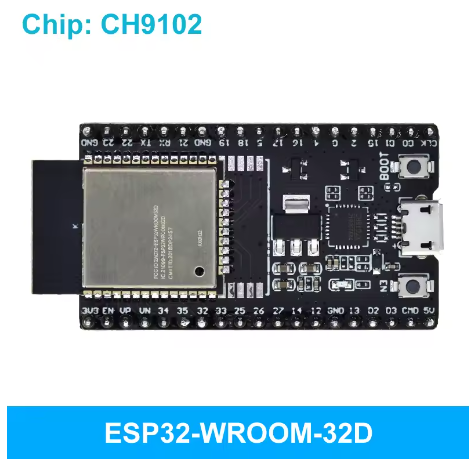
The ESP32-DevKitC Development Board with WROOM-32D module and CH9102X chip is a powerful, entry-level platform for Internet of Things (IoT) and embedded system development. It combines Wi-Fi and Bluetooth connectivity with a dual-core processor, offering a versatile solution for hobbyists and professionals alike.
Description
The ESP32-DevKitC is a compact and feature-rich development board designed to evaluate the capabilities of the ESP32-WROOM-32D module. At its core is the ESP32-D0WDQ6 chip, featuring a low-power dual-core 32-bit Tensilica LX6 microprocessor with an adjustable clock frequency up to 240 MHz.
This board is engineered for rapid prototyping, integrating all necessary support circuitry including a reliable CH9102X USB-to-UART bridge chip for stable serial communication and easy programming via the Micro USB interface. The pin headers on both sides break out nearly all GPIO pins, making it breadboard-friendly and adaptable to various peripherals and sensors.
With its robust connectivity options (802.11 b/g/n Wi-Fi and Bluetooth 4.2 BR/EDR and BLE), hardware encryption, and support for multiple development environments like Arduino IDE and ESP-IDF, the ESP32-DevKitC is ideal for a wide range of applications, from smart home devices and industrial automation to wearable electronics and low-power sensor networks.
Key Features
- Integrated Connectivity: Onboard 2.4 GHz Wi-Fi (802.11 b/g/n) and dual-mode Bluetooth (Classic and BLE) capabilities.
- Powerful Processing: Features a dual-core 32-bit CPU with up to 600 DMIPS of computing power.
- Stable Serial Communication: Utilizes the reliable CH9102X USB-to-TTL serial chip, ensuring stable data transmission and supporting automatic download mode.
- Rich Peripherals: Exposes numerous interfaces including UART, SPI, I²C, I²S, PWM, ADC, DAC, SD card interface, and capacitive touch sensors.
- Flexible Power Management: Can be powered via the Micro USB port or external 5V/3.3V supply pins, with ultra-low power consumption modes for battery-powered applications.
- Ease of Use: Breadboard-friendly design with clearly labeled pinouts, reset and boot buttons for easy operation and firmware flashing.
- Broad Compatibility: Supports multiple development environments including the Arduino IDE, Espressif IoT Development Framework (ESP-IDF), and MicroPython.
- Robust Security: Includes hardware encryption (WPA/WPA2/WPA2 Enterprise/WPS) and secure Over-The-Air (OTA) updates.
Technical Specifications (Parameters)
| Feature | Detail |
|---|---|
| Main Module | ESP32-WROOM-32D |
| Microcontroller | Tensilica LX6 Dual-Core 32-bit |
| Clock Frequency | 80 MHz to 240 MHz (adjustable) |
| SRAM | 520 KB |
| Flash Memory | 4 MB (32 Mbit) QSPI flash |
| USB-to-UART Chip | WCH CH9102X |
| USB Interface | Micro USB |
| Input Voltage (USB) | 5V DC |
| Operating Voltage (I/O) | 3.3V DC |
| Wireless | Wi-Fi 802.11 b/g/n (2.4 GHz), Bluetooth 4.2 BR/EDR & BLE |
| Interfaces | UART, SPI, I²C, I²S, PWM, ADC (12-bit), DAC (12-bit), GPIO, Hall sensor, capacitive touch |
| Operating Temperature | -40°C to +85°C |
| Dimensions | Approx. 55.5mm x 28.3mm (breadboard compatible) |