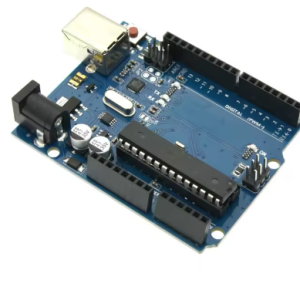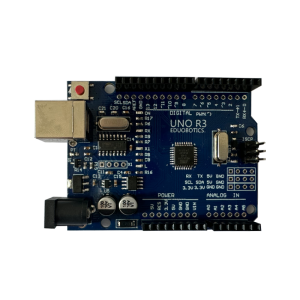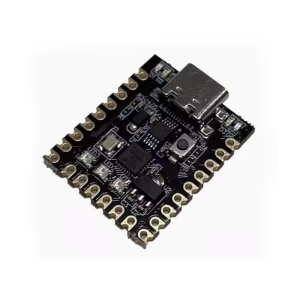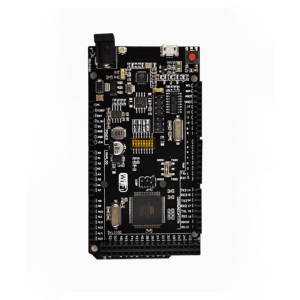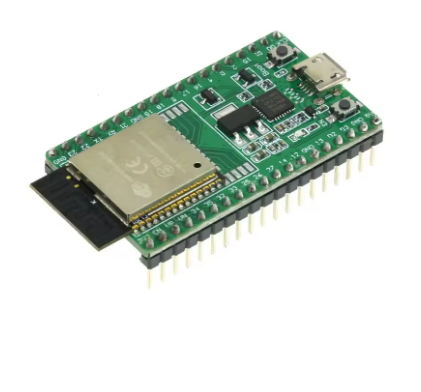
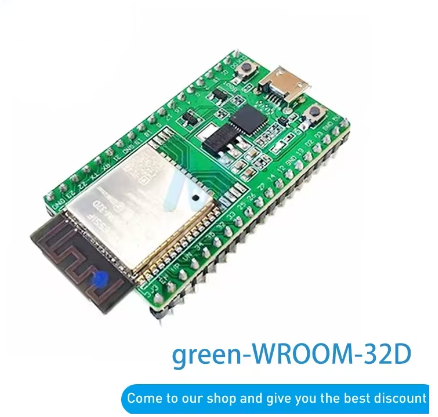
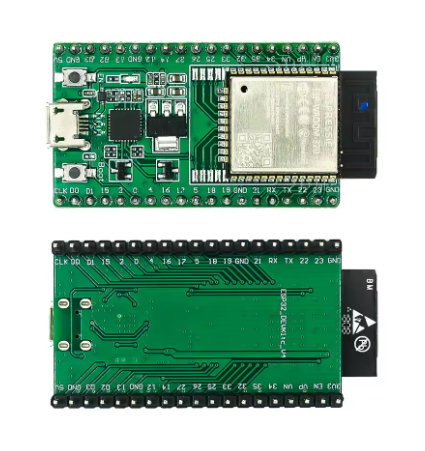
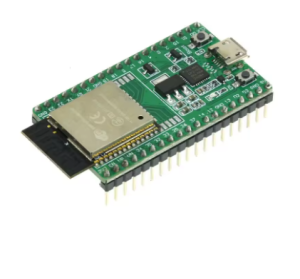
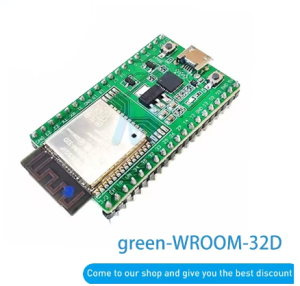
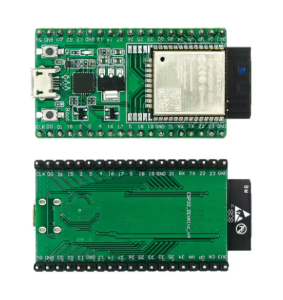
The ESP32-DevKitC Development Board with WROOM-32D module and CP2102 chip is a versatile and widely used platform for Internet of Things (IoT) and embedded system development. It provides robust Wi-Fi and Bluetooth connectivity, making it a powerful solution for hobbyists, educators, and professional engineers alike.
Description
The ESP32-DevKitC (Green Version) is a compact, entry-level development board designed to leverage the powerful features of the ESP32-WROOM-32D module. This board integrates the essential components required for rapid prototyping and project development. At its core is the ESP32-D0WDQ6 chip, which boasts a low-power, dual-core 32-bit Tensilica LX6 microprocessor with an adjustable clock frequency up to 240 MHz.
A defining feature of this specific variant is the inclusion of the reliable Silicon Labs CP2102 USB-to-UART bridge chip. This component ensures stable and efficient serial communication between the development board and a host PC, facilitating easy firmware uploading via the Micro USB interface.
Designed for maximum compatibility and ease of use, the board features standard pin headers that break out nearly all General Purpose Input/Output (GPIO) pins, making it perfectly compatible with standard breadboards. It supports various development environments, including the Arduino IDE, the official Espressif IoT Development Framework (ESP-IDF), and MicroPython. Whether you are building a smart lighting system, a complex sensor network, or an industrial control interface, the ESP32-DevKitC provides the connectivity and processing power required.
Key Features
- Dual-Mode Connectivity: Built-in 2.4 GHz Wi-Fi (802.11 b/g/n) and Bluetooth 4.2 (BR/EDR and BLE) capabilities.
- High-Performance Processing: Features a dual-core 32-bit CPU capable of up to 600 DMIPS of computing performance.
- Reliable USB Interface: Utilizes the robust CP2102 USB-to-TTL serial converter chip for stable data links and effortless programming.
- Extensive Peripherals: Exposes a wide array of interfaces, including UART, SPI, I²C, I²S, PWM, ADC, DAC, SD card interface, and capacitive touch sensors.
- Flexible Power Input: Can be powered conveniently via the Micro USB port or external 5V/3.3V supply pins.
- User-Friendly Design: Features a breadboard-compatible layout, along with integrated Boot and EN (Reset) buttons for simple operation and manual firmware flashing when needed.
- Security Features: Supports WPA/WPA2/WPA2 Enterprise/WPS encryption and secure Over-The-Air (OTA) updates.
- Wide Software Support: Compatible with popular development ecosystems including the Arduino IDE and Espressif IDF.
Technical Specifications (Parameters)
| Feature | Detail |
|---|---|
| Main Module | ESP32-WROOM-32D |
| Microcontroller | Tensilica LX6 Dual-Core 32-bit |
| Clock Frequency | 80 MHz to 240 MHz (adjustable) |
| SRAM | 520 KB |
| Flash Memory | 4 MB (32 Mbit) QSPI flash |
| USB-to-UART Chip | Silicon Labs CP2102 |
| USB Interface | Micro USB |
| Input Voltage (USB) | 5V DC |
| Operating Voltage (I/O) | 3.3V DC |
| Wireless Protocols | Wi-Fi 802.11 b/g/n (2.4 GHz), Bluetooth 4.2 BR/EDR & BLE |
| Interfaces | UART, SPI, I²C, I²S, PWM, ADC (12-bit), DAC (12-bit), GPIO, Hall sensor, touch sensors |
| Operating Temperature | -40°C to +85°C |
| PCB Color | Green |
| Dimensions | Approx. 55.5mm x 28.3mm |