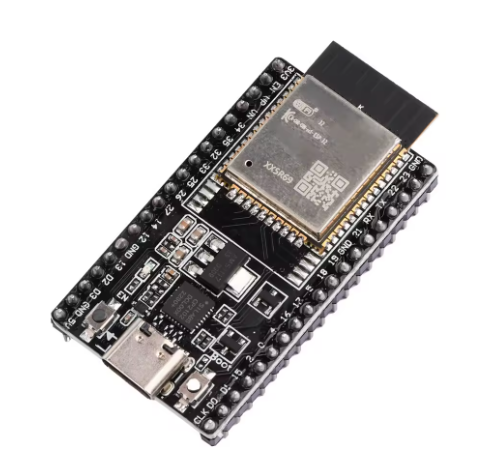
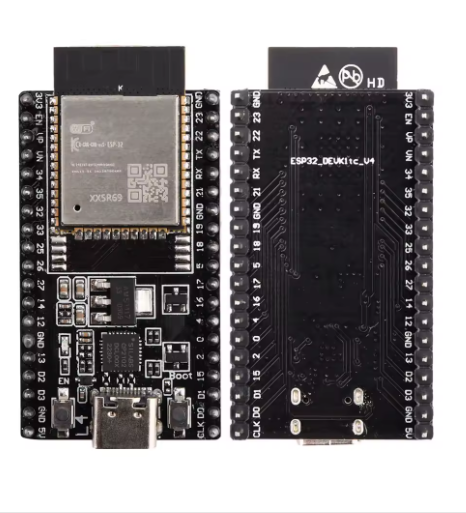
The Espressif ESP32 DevKitC development board, featuring the robust ESP-WROOM-32D module, reliable CP2102 USB interface, and a modern Type-C port, is a standard evaluation platform for the powerful ESP32 microcontroller. This board combines industry-standard components with modern connectivity, offering dual-core processing, ultra-low power consumption, and integrated Wi-Fi and Bluetooth capabilities, making it ideal for rapid prototyping in both individual and business environments.
Description
The ESP32 DevKitC is an official Espressif development board designed for maximum ease of use and versatility. It is built around the ESP-WROOM-32D module, which contains the high-performance Xtensa® 32-bit LX6 dual-core microprocessor capable of operating at up to 240 MHz. This power enables the board to handle demanding tasks such as real-time data processing, voice encoding, and managing complex sensor networks efficiently.
This board provides comprehensive connectivity options with integrated 2.4 GHz dual-mode Wi-Fi (802.11b/g/n) and Bluetooth (v4.2 BR/EDR and BLE). These features allow for a vast range of applications, from connecting simple sensors to the cloud to building complex mesh networks or interfacing with mobile devices.
A key modern feature of this variant is the inclusion of a Type-C USB interface. The Type-C port offers superior physical durability, is reversible for ease of use, and generally provides better power stability. This port interfaces with the widely recognized CP2102 USB-to-UART bridge, ensuring a stable and consistent connection with your PC for programming and debugging. The board’s pin layout is designed to be highly breadboard-friendly, facilitating rapid prototyping by keeping standard 0.1-inch (2.54 mm) pin spacing.
Manufactured with 40nm ultra-low-power technology, the ESP32 chip incorporates advanced power management features, including a deep sleep mode drawing less than 5 µA, which is critical for extending battery life in portable and IoT applications. It supports various development environments, including the official Espressif IDF, the popular Arduino IDE, and MicroPython, catering to diverse programming preferences.
Features
- Modern Type-C USB Interface: Durable, reversible, and power-stable connection for modern development environments.
- Official Espressif Design: Standard DevKitC reference design ensures reliability and full compatibility with official documentation and firmware.
- Powerful Dual-Core Processing: Xtensa® 32-bit LX6 dual-core CPU, running at up to 240 MHz.
- Integrated Wi-Fi & Bluetooth: Supports 802.11 b/g/n Wi-Fi and Bluetooth 4.2 BR/EDR and BLE specifications.
- Reliable USB Interface: Uses the robust CP2102 USB-to-UART bridge for stable communication.
- Ultra-Low Power Consumption: Multiple power modes, including a deep sleep mode drawing less than 5 µA.
- Rich Peripheral Interfaces: Includes support for UART, SPI, I²C, I²S, PWM, ADC (18 channels), DAC (2 channels), touch sensors (10), and a Hall sensor.
- Robust Security: Built-in hardware accelerators for security features like secure boot, flash encryption, and TLS 1.2 support.
Parameters
| Feature | Detail |
|---|---|
| Module Used | ESP-WROOM-32D |
| Microcontroller | ESP32-D0WDQ6 |
| Processor Cores | Xtensa dual-core 32-bit LX6 |
| Clock Speed | Adjustable from 80 MHz to 240 MHz |
| SRAM | 520 KB |
| Flash Memory | 4 MB SPI Flash |
| Operating Voltage | 3.3V (Logic level) |
| Input Voltage (via USB Type-C) | 5V DC |
| Connectivity | Wi-Fi (802.11b/g/n), Bluetooth 4.2 BR/EDR & BLE |
| USB Interface Chip | CP2102 |
| USB Interface Type | Type-C |