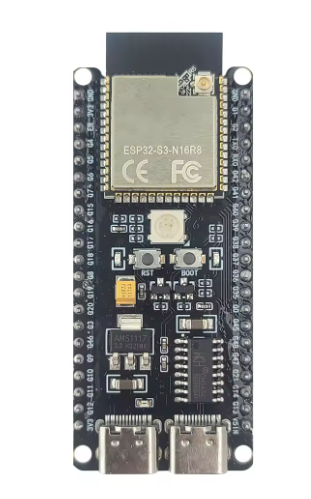
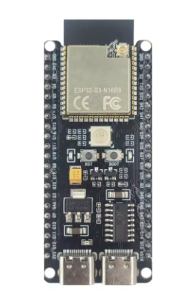
This high-performance Goouuu ESP32-S3-N16R8 development board is a professional-grade platform featuring the ESP32-S3-WROOM-1 module. In 2025, this 42-pin variant has become a favorite for engineers and makers due to its maximized I/O access and high-speed memory configuration. It is equipped with dual Type-C interfaces for versatile power and data management.
Product Description
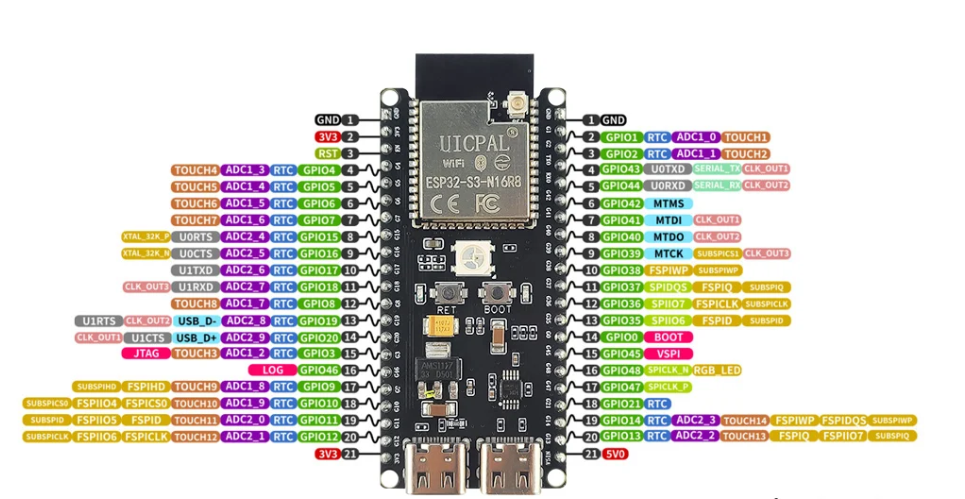
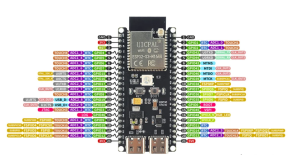
The Goouuu ESP32-S3-N16R8 is built for power users who require the full potential of the ESP32-S3 silicon. Featuring an expanded 42-pin layout, this board breaks out more GPIOs than standard DevKitC models, allowing for complex multi-sensor integrations.
With 16MB of Flash and 8MB of Octal PSRAM, this board is specifically optimized for “Edge AI” tasks, including voice recognition and real-time image processing. The dual Type-C design provides ultimate flexibility: one port is dedicated to the USB-to-Serial bridge for easy programming, while the second port provides a direct Native USB connection to the S3 chip, enabling it to act as a high-speed USB device (HID, MIDI, or Disk Drive).
Key Features
- Expanded 42-Pin Header: Provides additional GPIOs, including specialized pins for JTAG debugging or high-speed peripherals.
- Dual Type-C Connectors:
- UART Port: For stable firmware flashing and serial monitoring.
- Native USB Port: Supports USB OTG, allowing the board to simulate keyboards, mice, or UVC cameras.
- AI Acceleration: The Xtensa® LX7 core includes specialized vector instructions to speed up neural network inference.
- Max Memory Spec (N16R8): 16MB Flash and 8MB Octal PSRAM handle large firmware and data-heavy applications with ease.
- Goouuu Reliability: Known for high-quality PCB fabrication with excellent thermal dissipation and clear pin labeling.