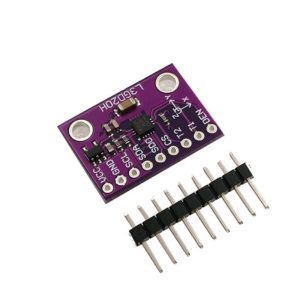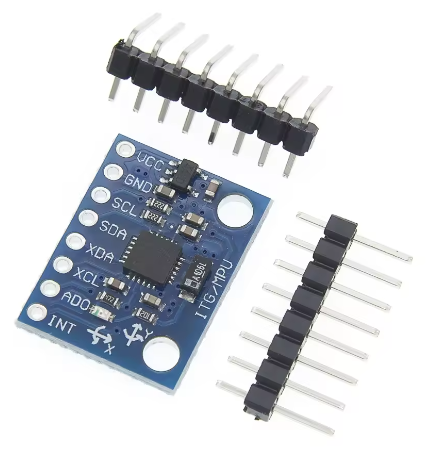
GY-521 MPU-6050 Module GY- 3 Axis Acceleration Gyroscope 6 DOF Module (CHN chip)-Black Tantalum Capacitor

SKU: FA2012-0-1
Microcontroller Chip

MPU-6050 (CHN Variant)

Power Supply

3.0V – 5.0V DC

Communication Mode

Standard I2C Protocol

Gyroscope Range

±250, 500, 1000, 2000 °/s

Accelerometer Range

±2, ±4, ±8, ±16g

ADC Resolution

16-bit

Power Filtering

Black Tantalum Capacitor

Pin Pitch

2.54mm (Standard Header)

Module Size

20.3mm x 15.6mm

The GY-521 MPU-6050 (CHN Chip Edition) is a cost-effective 6-axis MotionTracking module designed for high-volume production and budget-conscious DIY projects. Featuring a black tantalum capacitor for enhanced power stability, this module provides reliable 3-axis acceleration and 3-axis gyroscope data for various motion-sensing applications.
Product Description
The GY-521 CHN Edition is a versatile 6-Degree of Freedom (6-DOF) sensor module built around a high-quality localized MPU-6050 chipset. This version is specifically optimized for efficiency and value, making it a preferred choice for educational kits, consumer electronics, and large-scale prototyping.
Despite its competitive price point, the module does not compromise on stability. It is equipped with a black tantalum capacitor, which offers superior ripple current handling and lower Equivalent Series Resistance (ESR) compared to standard ceramic capacitors. This ensures the digital sensors receive clean, noise-free power, which is critical for accurate motion data. The board integrates 16-bit ADCs for every channel, capturing simultaneous X, Y, and Z motion for both linear acceleration and angular velocity. It communicates via a standard I2C interface, making it universally compatible with microcontrollers like Arduino, STM32, and Raspberry Pi.
Key Features
  • Cost-Optimized CHN Chipset: Delivers reliable 6-axis performance at a price point suitable for mass-market integration.
  • Black Tantalum Capacitance: Provides advanced power filtering to minimize sensor drift and signal noise.
  • Integrated 6-Axis Sensing: Combines a 3-axis gyroscope and a 3-axis accelerometer on a single compact PCB.
  • Onboard Voltage Regulator: Includes an LDO regulator, allowing the module to be powered by a wide range of 3V to 5V inputs.
  • Digital Motion Processor (DMP): Supports onboard processing of complex MotionFusion algorithms to reduce the load on the host CPU.
  • Standard I2C Protocol: Features a simple two-wire interface with a programmable I2C address.
Common Usage
  • Educational Robotics: Perfect for student projects involving balance bots and gesture control.
  • Consumer Electronics: Ideal for screen rotation sensors, step counting (pedometer), and sleep monitoring devices.
  • RC Vehicles: Provides stabilization data for entry-level drones, cars, and boats.
  • IoT Prototypes: Used in vibration monitoring for industrial machinery or movement detection for security systems.
Q: What is the benefit of the black tantalum capacitor on this module?

Black tantalum capacitors offer better stability and longevity than standard capacitors. They help “smooth out” the power supply, which reduces the electrical jitter in the gyroscope and accelerometer readings.

Q: How does the "CHN" chip version differ from the "Original" version?

The CHN version uses a localized chipset compatible with the MPU-6050 architecture. It offers a more competitive price for high-volume buyers while maintaining full compatibility with standard Arduino MPU-6050 libraries.

Q: Can I use this for professional drone flight controllers?

While suitable for entry-level and toy-grade drones, professional or high-performance racing drones typically prefer the “Original Chip” version for extreme precision. This version is excellent for general motion sensing and standard robotics.

Q: Does it come with the header pins soldered?

Typically, these modules are supplied with the 8-pin headers un-soldered to give users the flexibility to mount them directly to a PCB or use jumper wires.

Q: What is the default I2C address?

The default address is 0x68. If you connect the AD0 pin to high (VCC), the address will change to 0x69, allowing you to use two sensors on the same bus.