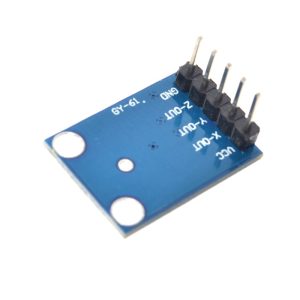
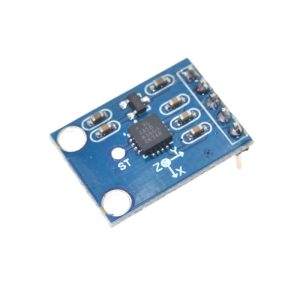
Description
Product Overview
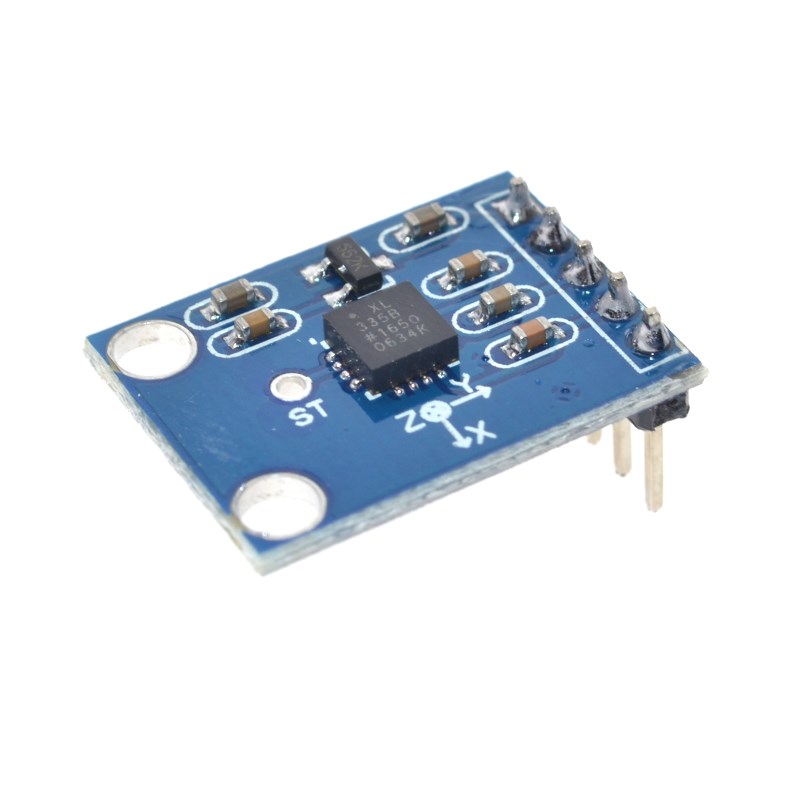
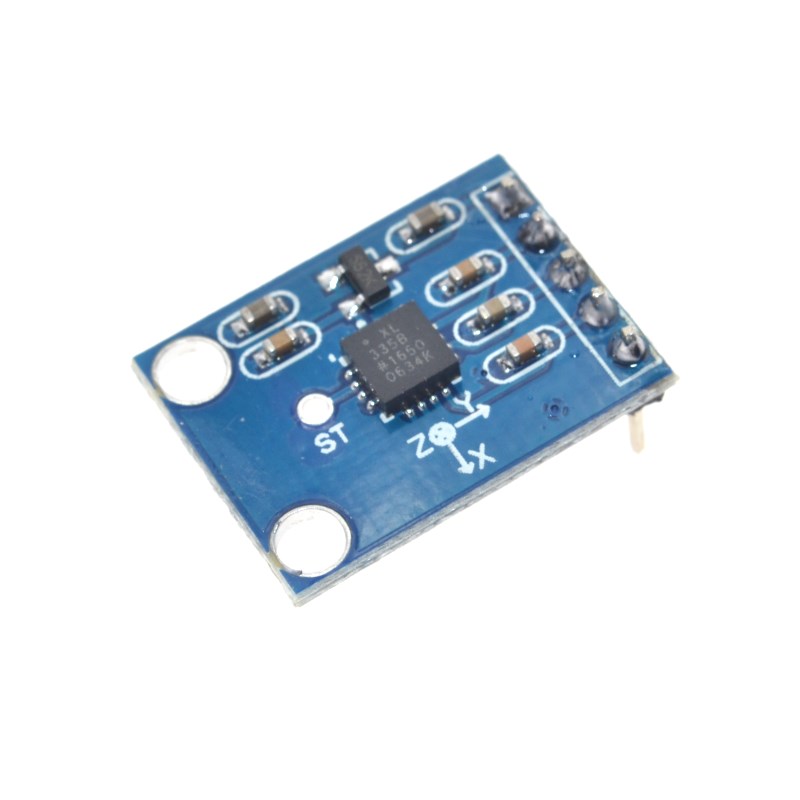
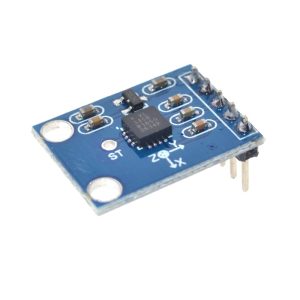
The GY-61 ADXL335 3-axis Accelerometer Module is a complete, low-power, analog output accelerometer designed for precise measurement of acceleration, tilt, and vibration across three axes (X, Y, and Z). Based on the industry-standard Analog Devices ADXL335 MEMS accelerometer, this module provides simple, noise-free analog voltage outputs that are directly proportional to the acceleration experienced on each axis .
The ADXL335 measures acceleration with a selectable full-scale range of ±3g (minimum) . It can measure both static acceleration—the constant force of gravity used for tilt sensing—and dynamic acceleration caused by motion, shock, or vibration . The output signals are analog voltages with a typical sensitivity of 300 mV/g (at 3V supply).
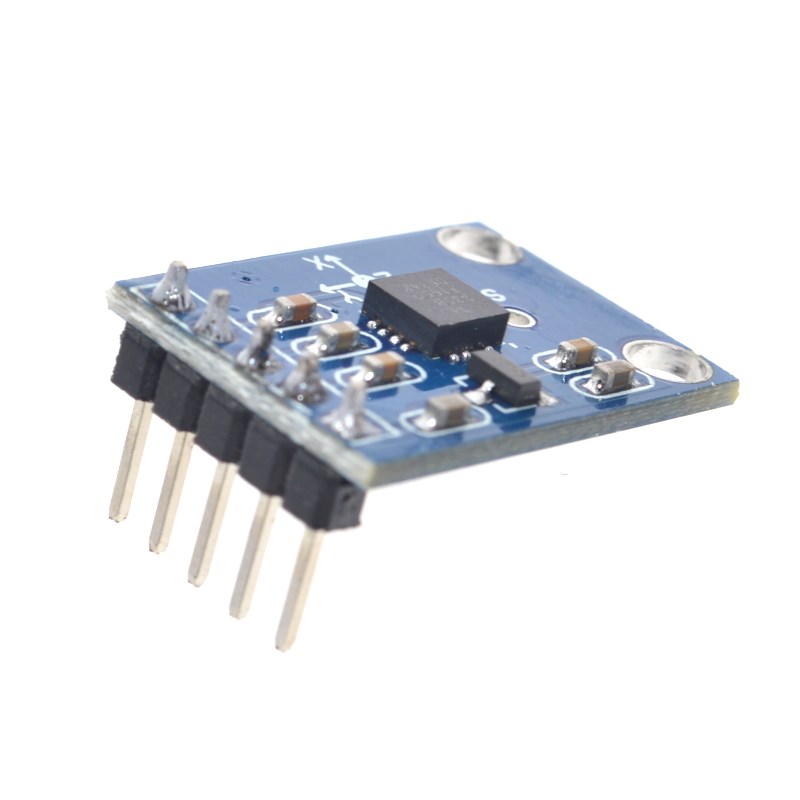
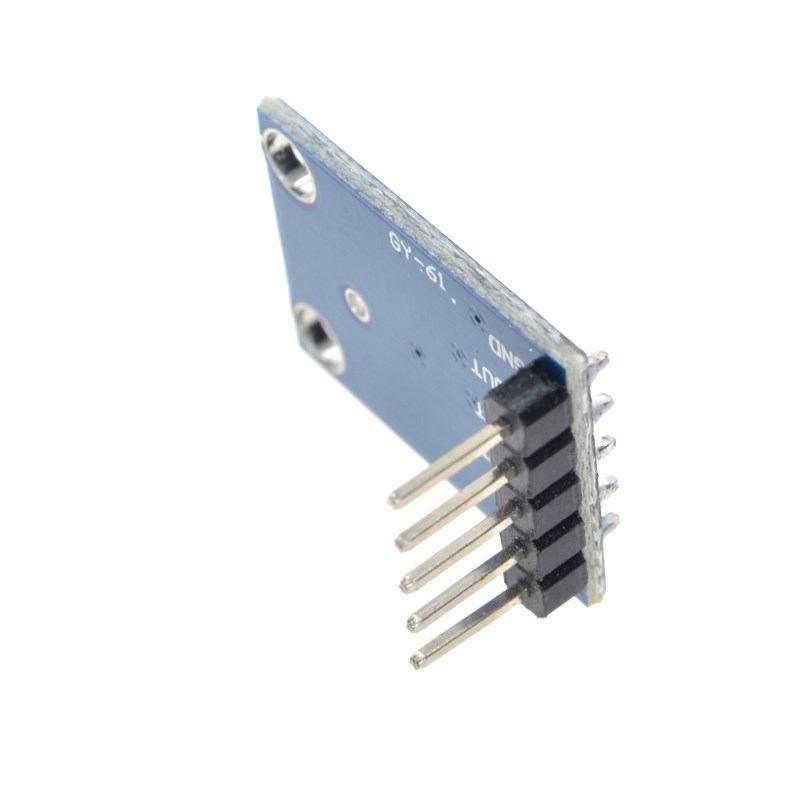
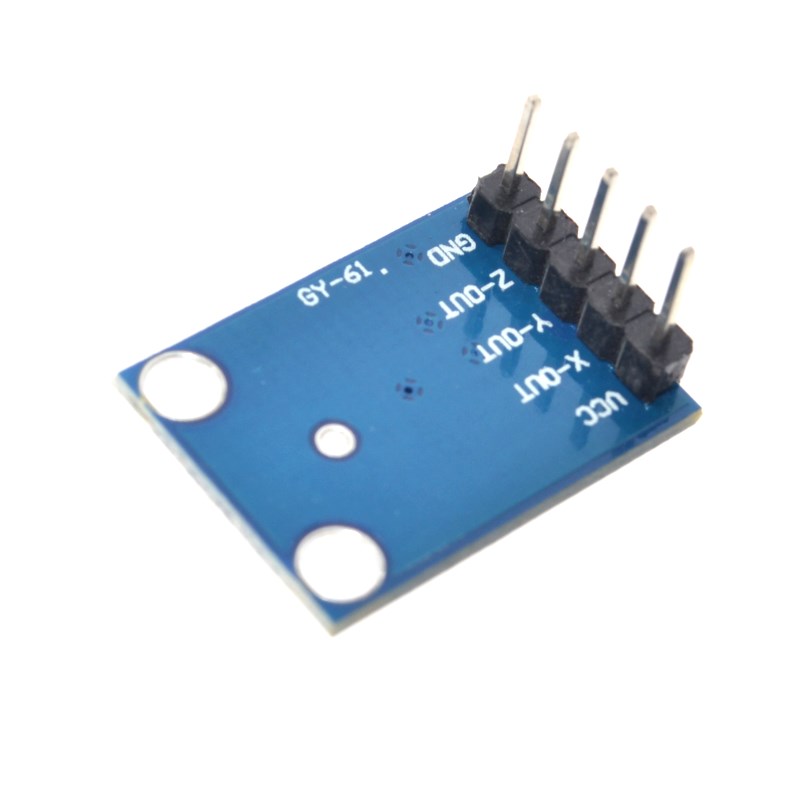
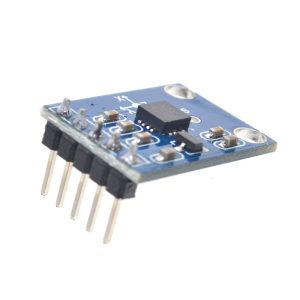
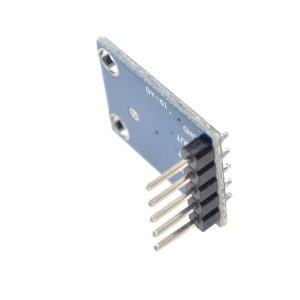
The GY-61 module breaks out all the essential pins onto a compact, easy-to-use board. Crucially, it often includes an onboard 3.3V voltage regulator, allowing you to power it directly from a 5V supply (like an Arduino) while ensuring the ADXL335 chip receives the correct 3.3V operating voltage . The analog outputs are ratiometric, meaning the output voltage scales proportionally with the supply voltage. This characteristic makes interfacing with microcontrollers straightforward, as the 0g offset point remains at VCC/2 regardless of the supply voltage .
Whether you need to measure the tilt of a robotic arm, detect the orientation of a handheld game controller, log vehicle vibration, or simply determine which way is “up” in your DIY project, this module offers a reliable, cost-effective solution with no complex programming or digital communication protocols to manage .
Key Features
-
3-Axis Sensing: Measures acceleration simultaneously on X, Y, and Z axes, providing complete orientation information .
-
±3g Measurement Range: Full-scale range of at least ±3g, suitable for tilt sensing and moderate motion detection .
-
Analog Voltage Output: Simple, noise-free analog outputs eliminate the need for complex digital libraries .
-
High Sensitivity: Typical sensitivity of 300 mV/g (at 3V supply), providing good resolution for tilt detection .
-
Low Power Consumption: Operates on just 350 µA (typical) , making it ideal for battery-powered applications .
-
Signal-Conditioned Outputs: On-chip signal conditioning provides stable, low-impedance outputs ready for direct connection to a microcontroller’s ADC .
-
Selectable Bandwidth: User-selectable bandwidth via external capacitors (X,Y axes: up to 1600 Hz, Z axis: up to 550 Hz) for noise reduction .
-
Ratiometric Outputs: Output voltage scales proportionally with supply voltage, simplifying ADC interfacing .
-
Onboard 3.3V Regulator: Most GY-61 boards include a voltage regulator, allowing 5V power input while supplying 3.3V to the sensor chip .
-
Ultra-Compact Package: Small module size (approx. 4mm × 4mm × 1.45mm chip on breakout board) fits easily into portable and space-constrained projects .
Technical Specifications
| Parameter | Operating Value |
|---|---|
| Sensor Chip | Analog Devices ADXL335 |
| Supply Voltage (VCC) | 3.3V – 5V DC (3.3V typical for chip) |
| Current Consumption (Active) | 350 µA (typical) |
| Measurement Range | ±3 g (minimum) |
| Sensitivity (at 3V) | 300 mV/g (typical) |
| Sensitivity (at 3.3V) | 330 mV/g (typical) |
| 0g Bias Voltage (at 3V) | 1.5V (typical) |
| 0g Bias Voltage (at 3.3V) | 1.65V (typical) |
| Output Type | Analog Voltage (0V – VCC) |
| Bandwidth (X, Y axes) | 0.5 Hz – 1600 Hz (user-selectable with capacitor) |
| Bandwidth (Z axis) | 0.5 Hz – 550 Hz (user-selectable with capacitor) |
| Shock Survival | 10,000 g |
| Operating Temperature | -40°C to +85°C |
| Module Dimensions | Approx. 15mm × 15mm (GY-61 breakout board) |
| Weight | Approx. 2g – 3g |
Reviews
There are no reviews yet.