GY-NEO-6M V2 Flight Controller GPS Module with EEPROM – Compatible with MWC & APM2.5, External Antenna

SKU: FA2172-3
GPS Chipset

u-blox NEO-6M (50-channel)

Operating Voltage

3V – 5V DC

Default Baud Rate

9600 bps (configurable: 4800 – 115200 bps)

Communication Interface

UART TTL (TX/RX)

Position Accuracy

<2.5 meters CEP (with SBAS)

Tracking Sensitivity

-162 dBm (SuperSense technology)

Update Rate

Up to 5Hz (configurable)

Cold Start Time

<27 seconds (typical)

Warm Start Time

<28 seconds (typical)

Hot Start Time

<1 second (typical)

Antenna Connector

u.FL / IPEX (for external active antenna)

Antenna Requirement

Active GPS antenna, 3V–5V, gain 15dB–28dB (not included)

Module Dimensions

25mm × 35mm (approx.)

Mounting Holes

3mm diameter

Operating Temperature

-40°C to +85°C

Description

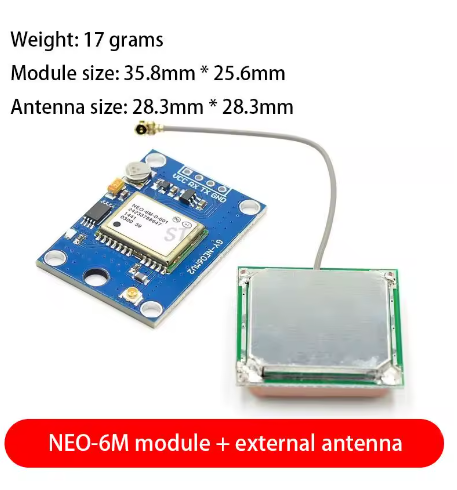
The GY-NEO-6M V2 is a high-performance GPS module specifically designed for flight controllers, drones, UAVs, and other embedded navigation systems requiring flexible antenna placement. Built around the industry-proven u-blox NEO-6M chipset, this module delivers reliable positioning data with fast satellite acquisition and stable signal tracking.

Unlike the onboard-ceramic-antenna version, this variant is designed for use with an external active GPS antenna (not included, sold separately). This design offers significant advantages for applications where the GPS module must be mounted inside an enclosure, behind a display, or in a location with limited sky visibility. By placing the external antenna in a location with a clear view of the sky — such as on a vehicle roof, drone top plate, or outdoor enclosure — you can achieve superior signal reception and faster satellite locks.

The module features a u.FL / IPEX connector for connecting a wide range of external active GPS antennas (3V to 5V active antennas, typical gain 15dB to 28dB). For users requiring even greater flexibility, the SMA adapter cable allows conversion to standard SMA connectors.

Key onboard features include EEPROM memory that permanently stores all configuration parameters (baud rate, update rate, NMEA message settings) even after power loss, and a rechargeable backup battery that maintains the real-time clock and ephemeris data for hot starts with a time-to-first-fix as low as 1 second.

Operating from a wide 3V to 5V DC input with onboard voltage regulation, the GY-NEO-6M V2 is compatible with both 3.3V and 5V logic systems. It provides UART TTL serial communication at a configurable baud rate (default 9600bps), making it plug-and-play compatible with Arduino, ESP32, STM32, Raspberry Pi, and popular flight controllers including MWC (MultiWii) and APM 2.5/2.6.

The bright LED signal indicator provides immediate visual feedback of GPS fix status — regular blinking confirms a successful 3D satellite lock. For advanced users, the module can be configured using u-blox u-center software via a USB-to-TTL adapter, allowing detailed performance monitoring and parameter customization.

Whether you are building a drone that requires a low-profile GPS installation, a vehicle tracking system where the module is hidden inside a metal dashboard, or an IoT device with remote antenna placement, the GY-NEO-6M V2 with external antenna support offers the flexibility and reliability required for both hobbyist and professional applications.

Key Features

  • External Active Antenna Support – u.FL/IPEX connector allows flexible antenna placement for optimal signal reception

  • High-Performance u-blox NEO-6M Chipset – Reliable GPS engine with up to 5Hz position update rate

  • High Tracking Sensitivity – SuperSense technology provides -162dBm tracking sensitivity for weak signal environments

  • Onboard EEPROM – Saves configuration parameters permanently; settings persist after power loss

  • Rechargeable Backup Battery – MS621FE battery maintains RTC and ephemeris data for hot starts (1s TTFF)

  • LED Signal Indicator – Real-time visual confirmation of GPS fix status

  • Wide Voltage Compatibility – Operates from 3V to 5V DC with onboard voltage regulation

  • UART TTL Interface – Simple 4-wire connection (VCC, GND, TX, RX) with default 9600 baud rate

  • SBAS Support – Compatible with WAAS, EGNOS, MSAS, and GAGAN for improved accuracy (2.5m typical)

  • Compact Design – Small module footprint for easy integration into space-constrained projects

  • Wide Operating Temperature – -40°C to +85°C suitable for outdoor and industrial applications

Technical Specifications 

Specification Value
GPS Chipset u-blox NEO-6M (50-channel)
Operating Voltage 3V – 5V DC
Default Baud Rate 9600 bps (configurable: 4800 – 115200 bps)
Communication Interface UART TTL (TX/RX)
Position Accuracy <2.5 meters CEP (with SBAS)
Tracking Sensitivity -162 dBm (SuperSense technology)
Update Rate Up to 5Hz (configurable)
Cold Start Time <27 seconds (typical)
Warm Start Time <28 seconds (typical)
Hot Start Time <1 second (typical)
Antenna Connector u.FL / IPEX (for external active antenna)
Antenna Requirement Active GPS antenna, 3V–5V, gain 15dB–28dB (not included)
Module Dimensions 25mm × 35mm (approx.)
Mounting Holes 3mm diameter
Operating Temperature -40°C to +85°C

Pinout Description

Pin Function
VCC Power input (3V – 5V DC)
GND Ground connection
TX Serial data output (connect to RX of microcontroller)
RX Serial data input (connect to TX of microcontroller)

Typical Usage

  • Drone & UAV Navigation – Provides position data for GPS hold, waypoint navigation, return-to-home, and autonomous flight modes — ideal when the module must be mounted inside the drone frame with antenna on top plate

  • Flight Controller Integration – Directly compatible with MWC (MultiWii), APM 2.5/2.6, Pixhawk, and ArduPilot systems

  • Vehicle Tracking Systems – Real-time GPS tracking for cars, fleet management, and asset tracking (module hidden inside dashboard, antenna on roof)

  • IoT Location-Aware Devices – Add positioning capabilities to weather stations, environmental monitors, and remote sensors with remote antenna placement

  • Robotics Navigation – Enable autonomous navigation for outdoor robots and rovers where the GPS module must be protected inside a sealed enclosure

  • Marine Navigation – Boats and yachts where the GPS module is mounted in a dry compartment and antenna is placed on deck

  • Data Logging – Record position, speed, and altitude data for analysis

  • Tolling & Telematics – Vehicle toll collection systems and telematics devices requiring hidden installation

Recommended External Antenna Specifications

Parameter Recommendation
Antenna Type Active GPS antenna (with built-in LNA)
Frequency 1575.42 MHz (GPS L1)
Operating Voltage 3V – 5V DC (powered by module)
Gain 15dB – 28dB
Connector u.FL / IPEX or SMA (via adapter cable)
Impedance 50Ω

Note: An external active GPS antenna is required for this module. The module provides DC power (typically 3.3V) to the active antenna through the same coaxial cable. Do not use passive antennas.

Basic Wiring Example (Arduino)

GY-NEO-6M V2 Pin Arduino Connection
VCC 5V
GND GND
TX Digital Pin 4 (RX)
RX Digital Pin 3 (TX)
Antenna Connect external active GPS antenna to u.FL/IPEX connector
Q: Is an antenna included with this module?

No. This version of the GY-NEO-6M V2 is designed for use with an external active GPS antenna (sold separately). It does not include a built-in ceramic antenna. An external antenna is required for operation. We offer compatible active GPS antennas in our store.

Q: Why would I choose the external antenna version over the built-in antenna version?

The external antenna version offers flexible antenna placement. If your GPS module must be mounted inside an enclosure (metal, carbon fiber, or thick plastic), inside a vehicle dashboard, or behind a display, the built-in antenna would have poor sky visibility. With an external antenna, you can place the antenna in a location with a clear view of the sky while keeping the module hidden or protected.

Q: What type of antenna do I need?

You need an active GPS antenna (with a built-in low-noise amplifier, LNA) operating at 1575.42 MHz (GPS L1 frequency). The antenna must accept 3V–5V DC power (provided by the module through the coaxial cable). Typical gain should be 15dB to 28dB. The module uses a u.FL / IPEX connector. If your antenna has an SMA connector, you can use a u.FL-to-SMA adapter cable.

Q: Can I use a passive antenna (without amplifier)?

No. The module is designed to power an active antenna through the coaxial cable. Passive antennas (without an LNA) will not work reliably with this module as they provide insufficient signal gain.

Q: What is the maximum cable length between module and antenna?

Using quality RG174 or similar low-loss coaxial cable, lengths of 3 to 5 meters are typically acceptable. For longer runs (up to 10 meters), use a higher-gain antenna (≥25dB) to compensate for cable losses. Avoid sharp bends and keep the cable away from sources of electromagnetic interference.

Q: Can I use this module with ESP32?

Yes. The module operates on 3V to 5V, so you can power it directly from the ESP32’s 3.3V or 5V pin. For best results, use the ESP32’s hardware serial ports (UART1 or UART2) rather than SoftwareSerial for reliable data reception at higher baud rates.

Q: What is the EEPROM used for?

The built-in EEPROM stores your configuration settings (such as baud rate, update rate, and NMEA message configuration). These settings are retained even after power loss, so you don’t need to reconfigure the module every time you power it on.

Q: How long does the backup battery last?

The rechargeable backup battery maintains the RTC and ephemeris data for several weeks when the module is powered off. The battery recharges automatically when the module is powered on. This enables hot starts (<1 second) when power is restored.

Q: How do I know if the external antenna is working?

If the module’s LED blinks regularly (once per second or pattern), it indicates a 3D GPS fix and confirms the antenna is providing adequate signal. If the LED remains steady or off, check your antenna connection and ensure the antenna has a clear view of the sky. You can also use u-center software to monitor signal-to-noise ratio (CN0) values — typical good values are 30-40 dB-Hz.

Q: Can this module be used for automotive or industrial applications?

Yes. The NEO-6M chipset is rated for -40°C to +85°C operation. With an external antenna properly mounted (e.g., on a vehicle roof or magnetic mount), this module is suitable for fleet tracking, stolen vehicle recovery, telematics, and industrial IoT applications.