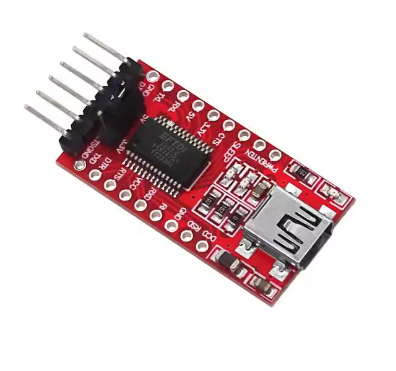
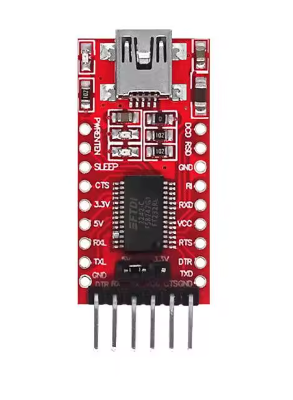
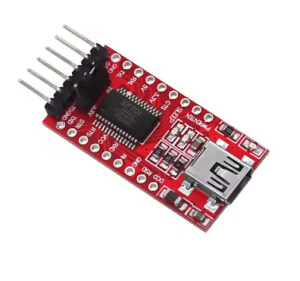
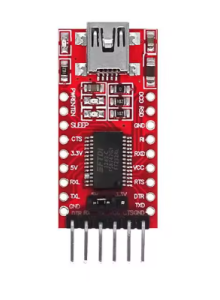
Mini USB to TTL Download Cable to Serial for FT232RL module

SKU: FA2048
Main Chipset

FTDI FT232RL (Original)

USB Interface

Mini USB Type-B

Logic Levels

3.3V or 5V (Selectable via Jumper)

Baud Rate Range

300 bps to 3 Mbps

Output Power

3.3V (50mA max) / 5V (500mA max)

Supported OS

Windows (7/8/10/11), macOS, Linux, Android

Communication Mode

Full-Duplex UART

Dimensions

36mm x 18mm

Product Description
The FT232RL Mini USB to TTL Serial Module is the industry standard for reliable USB-to-Serial communication. Built around the world-renowned FTDI FT232RL chipset, this module provides a rock-solid bridge between your computer’s USB port and any microcontroller or serial device. Unlike budget alternatives, the FTDI chipset is famous for its driver stability across Windows, macOS, and Linux, making it the preferred choice for professional engineers, industrial maintenance, and academic research.
This module is designed for maximum flexibility, featuring an onboard jumper to switch between 3.3V and 5V logic levels instantly. This ensures safe operation with both legacy 5V systems and modern, sensitive 3.3V microcontrollers. Its compact Mini USB interface and integrated status LEDs (TX/RX) provide immediate visual feedback, making it an indispensable tool for firmware development, hardware “unbricking,” and long-term serial data logging.
Key Features
  • Original FTDI FT232RL Chip: Industry-leading stability with official driver support integrated into most modern operating systems.
  • Dual-Voltage Logic Support: Onboard jumper allows seamless switching between 3.3V and 5V TTL levels to protect sensitive hardware.
  • Visual Status Indicators: Integrated high-brightness LEDs for Power (PWR), Transmit (TXD), and Receive (RXD) provide real-time diagnostic feedback.
  • Integrated Over-Current Protection: Features an onboard 500mA self-restoring fuse to protect your computer’s USB port from accidental shorts or surges.
  • Full Signal Breakout: Standard 6-pin header (DTR, RXD, TXD, VCC, CTS, GND) ensures compatibility with most Arduino-style programming interfaces.
  • Internal EEPROM: Includes 1024 bits of memory to store USB VID, PID, serial number, and product description strings for custom identification.
Usage & Applications
  • Microcontroller Programming: The gold standard for uploading code to Arduino Pro Mini, LilyPad, and custom ESP8266/ESP32 boards.
  • Hardware Recovery (Flashing): Accessing the serial console of routers, switches, and hard drive controllers for low-level repair and firmware updates.
  • Industrial Data Logging: Interfacing RS232/TTL sensors (GPS, Flow Meters, LiDAR) with a PC for long-term monitoring.
  • Device Configuration: Programming and fine-tuning 3DR telemetry radios, OSD boards, and specialized industrial controllers.
  • Lab Prototyping: A stable, “plug-and-play” USB-to-UART bridge for testing new serial protocols during the R&D phase.
Q: Why should I choose the FT232RL over a cheaper CH340 or CP2102 module?

The FTDI FT232RL is widely considered the most reliable serial chip in the industry. It has the best driver support (usually automatic on Windows) and handles high-speed, continuous data streams with significantly fewer errors and lower latency than budget alternatives.

Q: Do I need to move the jumper for my project?
Yes. If you are working with 3.3V devices (like ESP8266, STM32, or Raspberry Pi), ensure the jumper is set to 3.3V. For standard 5V Arduino-based projects, use the 5V setting. Sending 5V logic to a 3.3V device can cause permanent damage.
Q: Does this module support "Auto-Reset" for Arduino programming?

Yes. The DTR (Data Terminal Ready) pin is broken out specifically to trigger the reset circuit on microcontrollers, allowing for automatic code uploads without needing to press a manual reset button.

Q: Where can I find the drivers for Windows 10/11?

Most modern operating systems will download and install the drivers automatically when the module is plugged in. If not, the latest official drivers are always available for free on the FTDI Chip website.

Q: Can this module be used as a power supply for my project?

It can provide 5V (up to 500mA) or 3.3V (up to 50mA). While sufficient for basic sensors and small MCUs, high-power components like motors or cellular modems will require a separate external power source.