Description
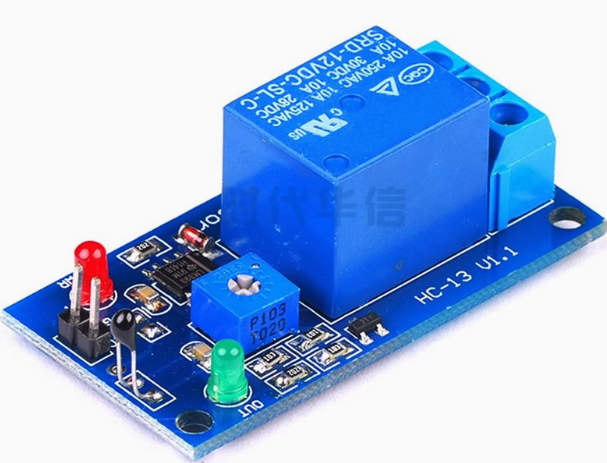
The Smart 5V Thermistor Relay Switch – Automatic Temperature Protection is an intelligent, self-contained temperature monitoring and control module designed for automation enthusiasts, hobbyists, and industrial users. Operating on a standard 5V DC supply—compatible with USB power banks, Arduino, Raspberry Pi, and other microcontroller platforms—this module combines a sensitive NTC thermistor temperature sensor with a built-in relay to automatically switch external devices based on ambient temperature .
When the temperature rises above or falls below your preset threshold, the onboard comparator circuit (LM393) instantly energizes or de-energizes the relay, allowing you to control fans, heaters, pumps, alarms, or other AC/DC devices up to 10A. The module features an adjustable potentiometer for setting the temperature trip point, a green LED indicator showing relay status, and both Normally Open (NO) and Normally Closed (NC) output terminals for flexible application design .
Unlike complex programmable controllers, this module works standalone—simply apply 5V power, adjust the potentiometer to your desired trigger temperature, and connect your load. No coding, no microcontrollers, no software required. The onboard comparator provides reliable, noise-immune performance with a built-in flyback diode to protect the circuit from relay coil spikes .
Whether you need to activate an exhaust fan in a hot server room, turn on a heater in a reptile terrarium, protect a 3D printer enclosure from overheating, or automate greenhouse ventilation, the Smart 5V Thermistor Relay Switch delivers plug-and-play temperature protection in a compact, easy-to-use package.
Key Features
-
Standalone Operation – No microcontroller or programming required; works immediately after power-up .
-
Adjustable Temperature Trip Point – Onboard potentiometer lets you set the exact temperature for relay activation.
-
Dual Mode Operation – Use NO (Normally Open) for “turn on when hot” applications, or NC (Normally Closed) for “turn off when hot” applications .
-
High-Power Relay – 10A/250V AC or 10A/30V DC contact rating can control fans, heaters, pumps, and more .
-
Sensitive NTC Thermistor – Fast response to temperature changes with included external probe.
-
LM393 Comparator IC – Provides stable, noise-immune threshold detection.
-
Status Indicator LED – Green LED illuminates when relay is energized .
-
Flyback Protection Diode – Protects circuitry from voltage spikes when relay de-energizes .
-
Compact Form Factor – Small footprint (approx. 50mm x 26mm) fits easily into enclosures .
-
Wide Compatibility – Works with 5V USB power, Arduino 5V pin, or any regulated 5V DC supply.
Technical Parameters
Usage Guide
How It Works
The module continuously monitors temperature via the NTC thermistor. As temperature increases, the thermistor’s resistance decreases. The LM393 comparator compares the thermistor voltage to a reference voltage set by the onboard potentiometer. When the temperature crosses the threshold, the comparator triggers the relay, which switches the connected load ON or OFF depending on your wiring configuration .
Wiring Instructions
Step 1 – Power Connection
-
Connect a 5V DC power supply to the VCC (+) and GND (-) terminals.
-
Suitable sources: USB charger, 5V power adapter, Arduino 5V pin, or 5V battery pack.
Step 2 – Load (Device) Connection
Wiring Example (Cooling Fan – Turns ON when hot):
-
Connect fan’s live wire → NO terminal
-
Connect power source live → COM terminal
-
Connect fan’s neutral → power source neutral directly
Wiring Example (Heater – Turns OFF when hot):
⚠️ Safety Warning: When working with 110V/220V AC, ensure all connections are properly insulated. Use appropriate gauge wire and consider mounting the module in an enclosure .
Setting the Temperature Threshold
-
Power on the module with the sensor placed in the target environment.
-
Use a small screwdriver to adjust the potentiometer on the board:
-
Turn clockwise (CW) – Increases the temperature trip point (relay triggers at higher temperature)
-
Turn counter-clockwise (CCW) – Decreases the temperature trip point (relay triggers at lower temperature)
-
The green LED illuminates when the relay is activated .
-
Test by applying heat (e.g., warm breath or hairdryer) to the thermistor to verify the relay switches at the desired temperature.
Sensor Placement Tips
-
Place the thermistor probe in the area you wish to monitor (enclosure, room, equipment).
-
Avoid placing the sensor near the relay or power components, as they generate heat.
-
For liquid temperature monitoring, use a waterproof thermistor probe (sold separately)
Q: Does this module require programming or an Arduino?
No. The module is completely standalone. Simply apply 5V power, adjust the potentiometer, and connect your load. No coding or microcontroller is required .
Q: What is the difference between NO and NC outputs?
For safety-critical applications (e.g., heaters), using NC is recommended because a power failure will stop heating .
Q: Can I control a 220V AC fan or heater with this module?
Yes. The relay is rated for 10A at 250V AC, which is sufficient for most fans, small heaters, pumps, and lights. Always ensure your load current does not exceed 10A
Q: What is the temperature accuracy of this module?
The module provides approximately ±2–3°C accuracy. For precise temperature control applications, consider calibrating the trip point using a reference thermometer. The potentiometer allows fine adjustment.
Q: Why does my relay click on and off rapidly near the setpoint?
This is normal if the temperature fluctuates exactly at the threshold. Unlike digital controllers, this analog comparator module does not have built-in hysteresis. To prevent rapid cycling:
Q: Can I extend the thermistor sensor wires?
Yes. The thermistor can be extended using standard 2-conductor wire up to approximately 10 meters (30 feet). Longer runs may affect accuracy due to wire resistance.
Q: What is the difference between this module and a digital temperature controller?
This module is ideal for basic on/off temperature control where precision hysteresis is not critical.
Q: Can I use this module for both home and business applications?
Home users: 3D printer enclosure cooling, reptile terrarium heating, aquarium temperature control, grow tent ventilation, sous vide backup protection.
Business users: Server room fan control, greenhouse ventilation, laboratory equipment protection, food storage monitoring, industrial cabinet cooling, print shop temperature control.
Q: What is the maximum temperature the sensor can measure?
The NTC thermistor can measure up to approximately 100°C (212°F). For higher temperature applications (e.g., ovens, engines), consider a K-type thermocouple-based module instead
Q: Does the module remember settings after power loss?
The potentiometer position is mechanical—it does not change when power is removed. The module will return to the same temperature threshold when power is restored.