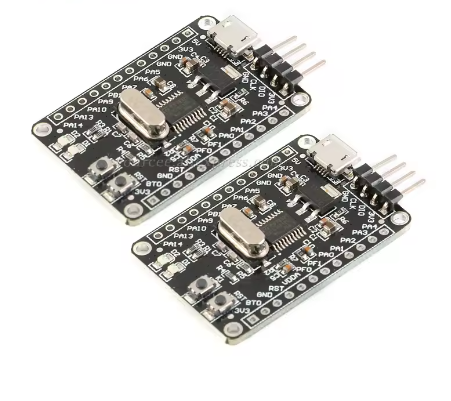
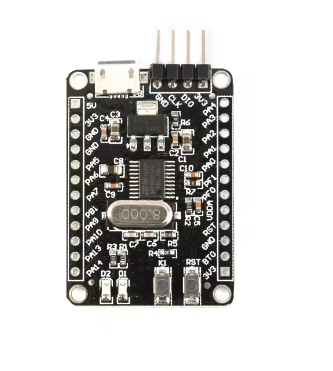
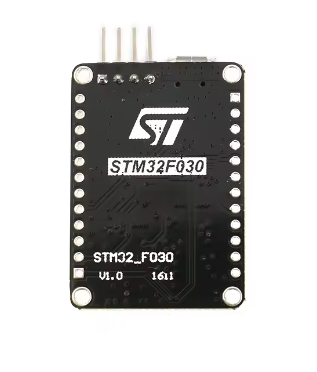
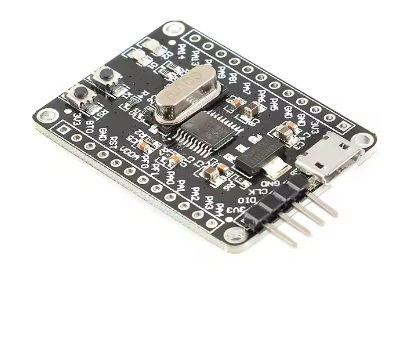
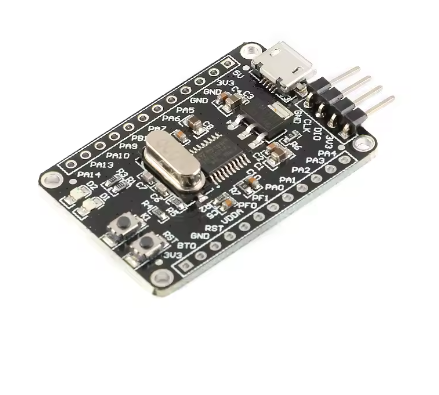
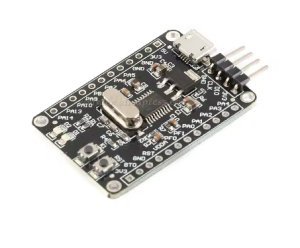
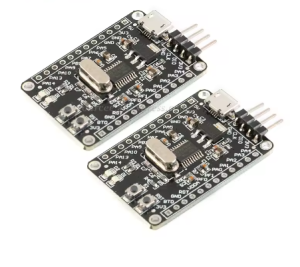
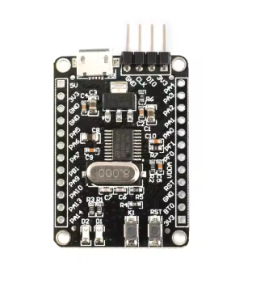
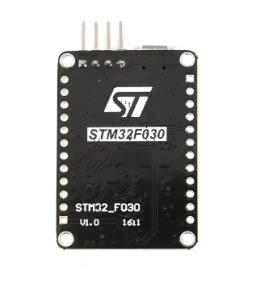
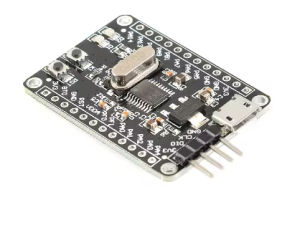
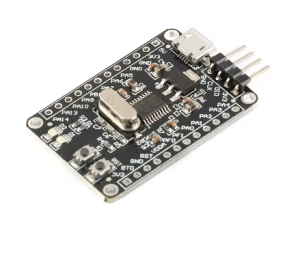
STM32F030F4P6 Core Board – ARM Cortex-M0 Development Board, Microcontroller System Board

SKU: FA1073
Microcontroller

STM32F030F4P6 (ARM Cortex-M0)

Maximum Clock Speed

48 MHz

Flash Memory

16 KB

SRAM

4 KB

GPIO Count

15 pins (5V tolerant)

Operating Voltage

2.4V – 3.6V

ADC Resolution

12-bit, up to 11 channels

Debug Interface

SWD (SWDIO, SWCLK)

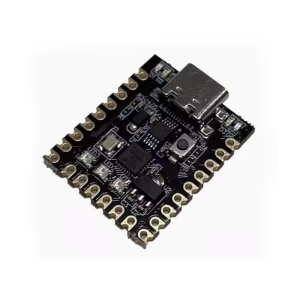
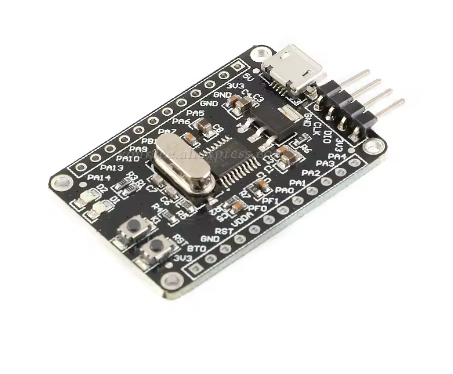
The STM32F030F4P6 Core Board is a compact, low-cost development platform built around STMicroelectronics’ STM32F030F4P6 microcontroller. It is designed for developers, students, and engineers who want a minimal, straightforward entry point into the STM32 ecosystem without unnecessary onboard peripherals or complexity. The board exposes the MCU’s essential pins and debug interface, allowing you to focus on learning and prototyping.

At the heart of the board is an ARM Cortex-M0 32-bit RISC core running at up to 48 MHz, delivering significantly more processing power than traditional 8-bit microcontrollers at a comparable price point. The chip integrates 16 KB of Flash memory and 4 KB of SRAM, sufficient for control logic, sensor drivers, and small protocol stacks. A 12-bit ADC with up to 11 channels handles analog sensor inputs, while USART, SPI, and I2C interfaces provide connectivity to external modules and peripherals.

The board’s minimalist design is intentional. It does not include an onboard programmer, USB interface, or voltage regulator in most configurations. Instead, it gives you direct access to the MCU’s pins through standard headers, making it easy to integrate into custom setups or breadboard prototypes. Programming is done through the SWD (Serial Wire Debug) interface using an external ST-Link, J-Link, or DAP-Link programmer. This keeps the board small and affordable while giving you full control over your development environment.

The STM32F030F4P6 is part of ST’s Value Line series, which targets cost-sensitive applications where 32-bit performance is beneficial but budgets are tight. It is well-suited for simple control tasks, sensor data collection, and educational projects. The board’s 15 GPIO pins are all 5V-tolerant, making it easy to interface with common 5V sensors and modules without level shifting.

Development is supported by STM32CubeIDE, ST’s free integrated development environment, which includes a graphical configuration tool for pin assignment and peripheral setup. This allows beginners to generate initialization code without deep register-level knowledge, while experienced developers can still work at the register level if desired.

Whether you are a student learning ARM embedded development, a maker building cost-sensitive control projects, or an engineer evaluating the STM32F0 Value Line for a product design, this core board provides a practical, affordable foundation.


Features

  • ARM Cortex-M0 @ 48 MHz — 32-bit performance in a compact, low-cost package.

  • 16 KB Flash / 4 KB SRAM — Sufficient memory for control logic and small applications.

  • 5V-tolerant I/O pins — Direct interface with common 5V sensors and modules without level shifting.

  • 12-bit ADC (up to 11 channels) — For analog sensor reading and signal measurement.

  • Multiple communication interfaces — USART, SPI, and I2C for connecting peripherals.

  • Minimalist pin breakout — Exposes essential MCU pins on standard 0.1″ headers for flexible integration.

  • SWD debug interface — Standard programming and debugging via external ST-Link or compatible programmer.

  • STM32CubeIDE support — Free development environment with graphical configuration and code generation.


Technical Specifications 

# Parameter Specification
1 Microcontroller STM32F030F4P6 (ARM Cortex-M0)
2 Maximum Clock Speed 48 MHz
3 Flash Memory 16 KB
4 SRAM 4 KB
5 GPIO Count 15 pins (5V tolerant)
6 Operating Voltage 2.4V – 3.6V
7 ADC Resolution 12-bit, up to 11 channels
8 Debug Interface SWD (SWDIO, SWCLK)

Usage

Getting Started

  1. Power the board — Supply 3.3V to the VDD pin and connect GND. The MCU requires a stable 3.3V rail.

  2. Connect a debugger — Use an ST-Link v2 or compatible programmer. Connect SWDIO, SWCLK, GND, and the 3.3V reference line.

  3. Set up STM32CubeIDE — Download and install ST’s free IDE. Create a new STM32 project and select the STM32F030F4P6 as your target.

  4. Configure peripherals — Use the built-in CubeMX graphical tool to assign pins, enable peripherals, and set clock speeds.

  5. Write your code — Add your application logic inside the designated user code sections.

  6. Flash and debug — Build the project and use the Run or Debug button to program the chip via SWD.

Typical Applications

  • Learning ARM embedded development — A low-cost way to step up from 8-bit MCUs to 32-bit ARM.

  • Simple control systems — Timers, PWM, and ADC for motor control, LED dimming, and sensor reading.

  • Sensor data acquisition — Connect analog and digital sensors for data collection projects.

  • Breadboard prototyping — Compact form factor integrates easily into breadboard setups.

  • Educational kits — Cost-effective platform for classroom and workshop teaching.

  • Evaluation and comparison — Assess the STM32F0 Value Line for suitability in a target application.

  • OEM and product development — Compact form factor and low cost support integration into commercial designs.

Notes for Business Buyers

  • Extremely low unit cost — The STM32F030F4P6 is one of the most affordable ARM Cortex-M0 MCUs available.

  • Standard ARM toolchain support — STM32CubeIDE, Keil MDK, and IAR are all supported, easing integration into existing workflows.

  • Minimalist design reduces BOM cost — No onboard programmer or regulator keeps the board inexpensive for volume deployment.

  • 5V-tolerant I/O simplifies interfacing — Reduces the need for level shifters when connecting to legacy 5V peripherals.

  • Suitable for bulk purchasing — Ideal for educational institutions, training programs, and product development teams.

Q: Does this board come with a built-in programmer?

No. The core board does not include an onboard ST-Link or USB programmer. You need an external ST-Link v2 or compatible programmer connected via the SWD interface.

Q: What software do I need to program this board?

You can use STM32CubeIDE (free from ST), Keil MDK-ARM, or IAR Embedded Workbench. STM32CubeIDE is recommended for beginners due to its integrated graphical configuration tool.

Q: How do I connect the ST-Link programmer to the board?

Connect four wires: SWDIO (data), SWCLK (clock), GND, and the 3.3V reference. The 3.3V line allows the programmer to detect the target voltage

Q: Is the STM32F030F4P6 compatible with the Arduino IDE?

Not natively. It is an ARM Cortex-M0 MCU that requires a standard embedded toolchain (STM32CubeIDE, Keil, or IAR). Some community projects have explored Arduino compatibility, but official support is not available.

Q: What is the difference between this board and a standard Arduino?

The STM32F030F4P6 is a 32-bit ARM Cortex-M0 running at 48 MHz, compared to the Arduino Uno’s 8-bit ATmega328P at 16 MHz. It offers more processing power but requires a different development workflow.

Q: Can I use 5V sensors with this board?

Yes. The GPIO pins are 5V-tolerant, meaning they can accept 5V logic signals without damage. However, the board itself operates at 3.3V for power.

Q: How much memory does the board have?

It has 16 KB of Flash for program storage and 4 KB of SRAM for runtime data.

Q: What is the maximum ADC sampling rate?

The 12-bit ADC has a conversion time of 1.0 µs, corresponding to a sampling rate of approximately 1 MSPS.

Q: Does the board have a built-in voltage regulator?

Most minimalist versions of this core board do not include an onboard regulator. You must supply a regulated 3.3V to the VDD pin.

Q: Can I purchase in bulk for a school or company?

Yes. This board is suitable for both individual users and business purchasing, including classroom kits, evaluation labs, and volume production. Its low unit cost makes it particularly attractive for educational and cost-sensitive applications.