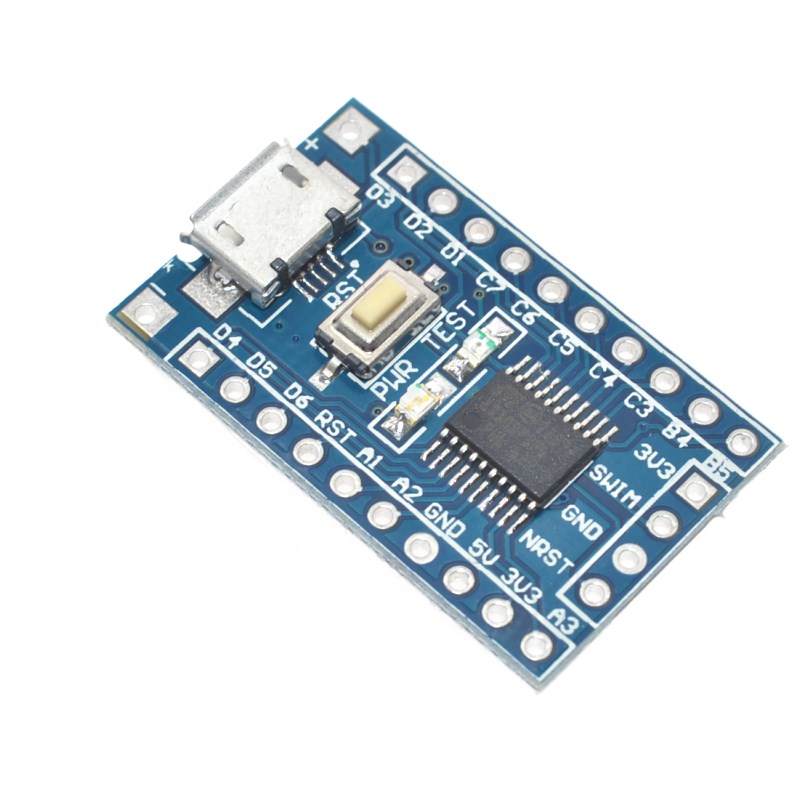
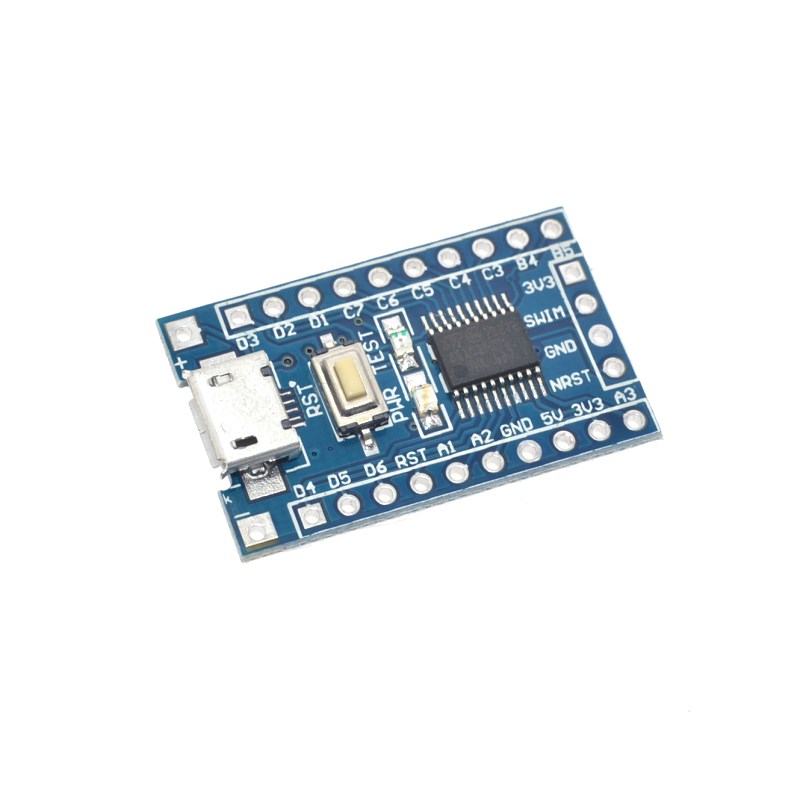
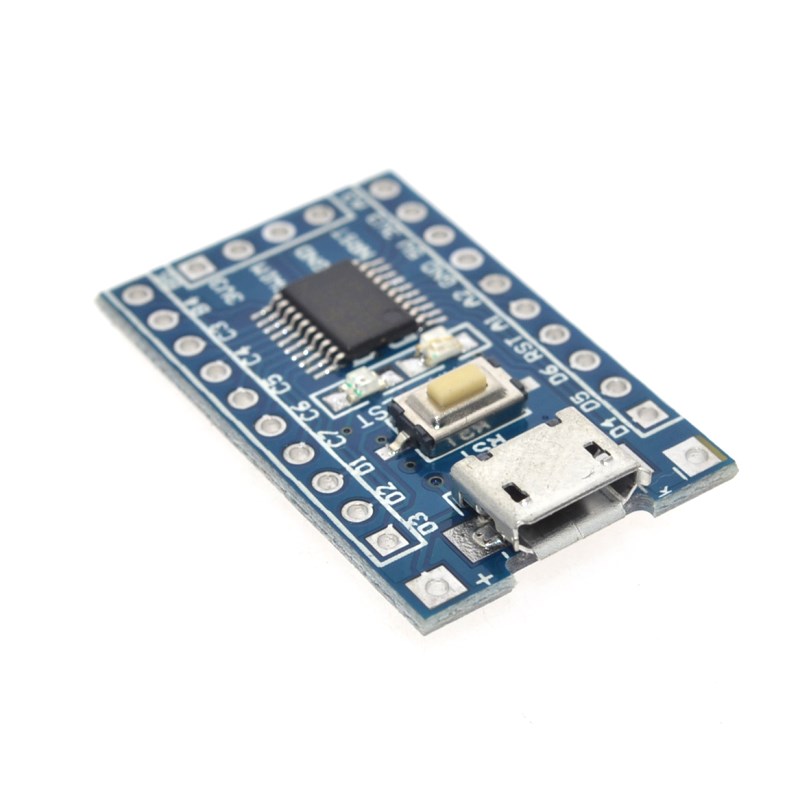
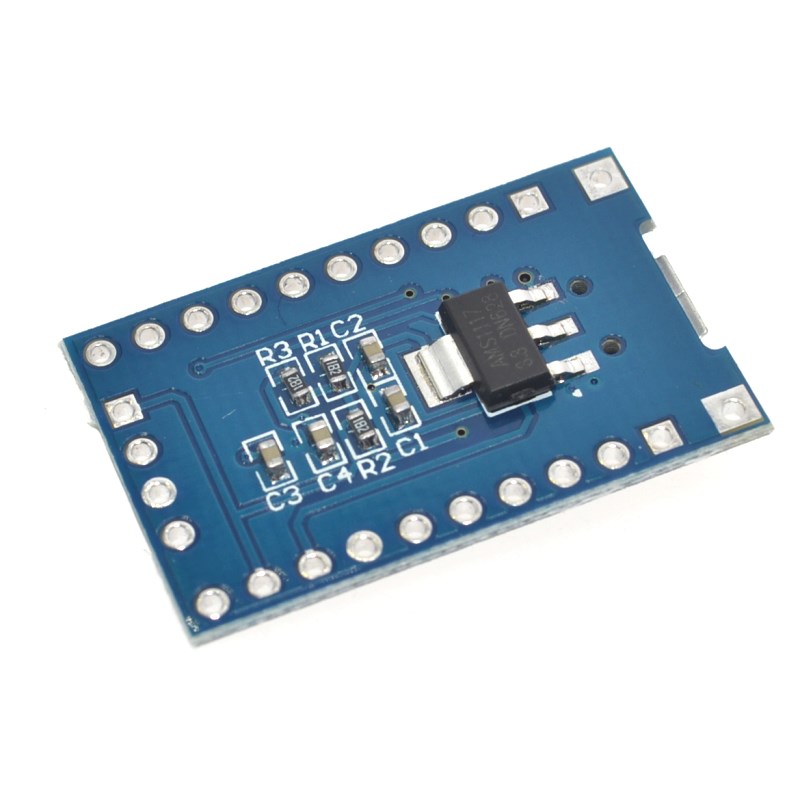
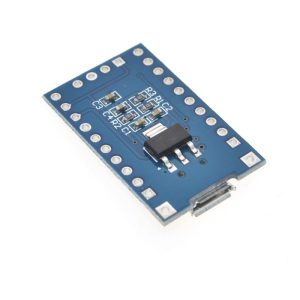
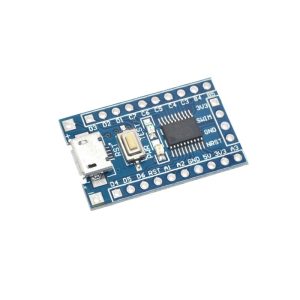
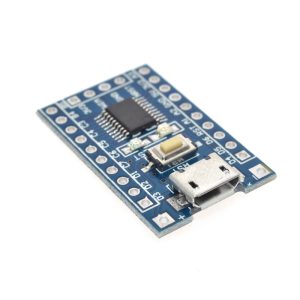
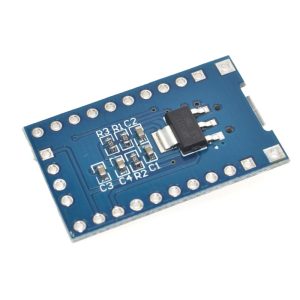
STM8S103F3P6 system board STM8S STM8 development board minimum core board Micro usb interface

SKU: FA2174
Microcontroller

STM8S103F3P6 (8-bit, STM8 core)

Clock Speed

Up to 16 MHz

Flash Memory

8 Kbytes

RAM

1 Kbyte

EEPROM

640 bytes (true data EEPROM)

Operating Voltage (MCU)

2.95V – 5.5V DC

Input Voltage (Board)

4.5V – 15V DC (via power pads)

Digital I/O Pins

16 (all broken out to headers)

ADC Channels

5 × 10-bit

Communication Interfaces

UART, SPI, I²CTimers

Timers

Advanced 16-bit timer, 16-bit general purpose, 8-bit basic timer, watchdog timers

Programming Interface

SWIM (Single Wire Interface Module)

Board Dimensions

30mm × 20mm (approx.)

Operating Temperature

-40°C to +85°C

Description

The STM8S103F3P6 Minimum System Development Board is a compact, cost-effective, and powerful entry point into the world of STM8S microcontroller development. Built around the robust STM8S103F3P6 8-bit MCU from STMicroelectronics, this core board provides everything you need to start prototyping embedded applications immediately.

This development board breaks out all microcontroller pins to standard 2.54mm headers, making it easy to integrate into breadboards or custom PCBs. The Micro USB interface serves as a convenient power input, compatible with common smartphone charging cables. Unlike older boards using the outdated Mini-USB standard, this modern interface ensures you can power your projects with cables you already own.

The heart of the board is the STM8S103F3P6 microcontroller, featuring an advanced STM8 core with Harvard architecture and a 3-stage pipeline capable of running at up to 16 MHz. With 8 Kbytes of Flash program memory1 Kbyte of RAM, and 640 bytes of true data EEPROM, this MCU offers a balanced feature set for a wide range of applications. The true EEPROM allows for data retention of up to 20 years at 55°C after 10k cycles, making it suitable for storing calibration constants or user settings without external memory chips.

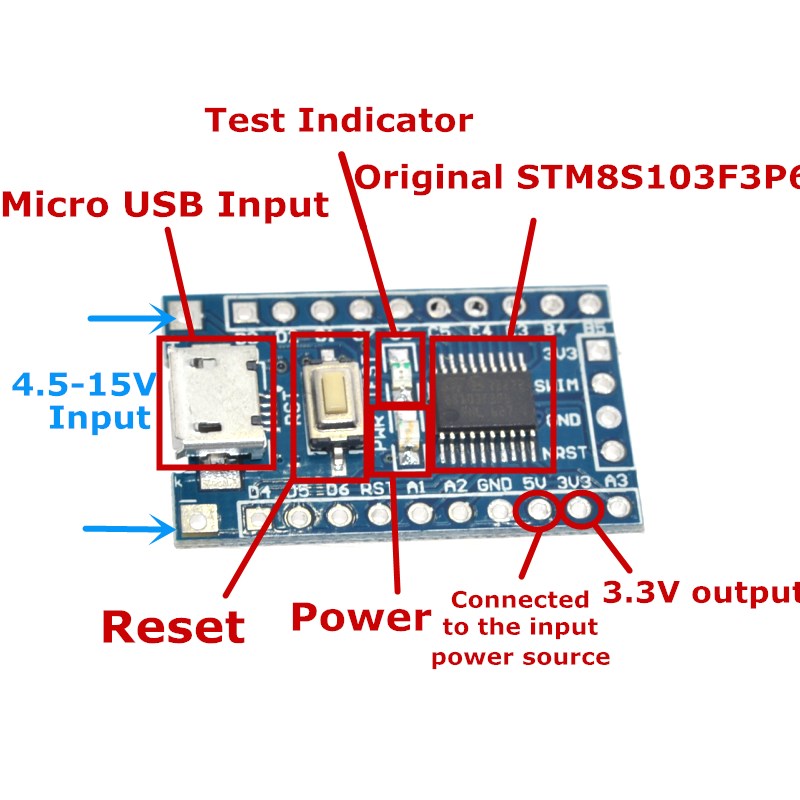
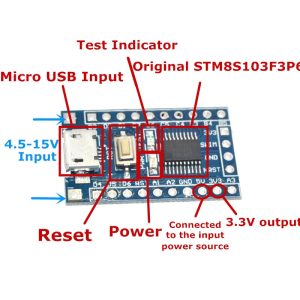
The board includes a SWIM (Single Wire Interface Module) connector for programming and debugging, a reset button for easy system restart, and a user LED connected to PORTB_5 for basic output testing. An onboard 3.3V voltage regulator allows the board to accept input voltages from 4.5V to 15V via the power pads or the Micro USB port.

Whether you are a student learning embedded systems, a hobbyist building a DIY project, or a professional developing cost-sensitive industrial controls, this STM8S103F3P6 minimum system board delivers exceptional value in a tiny 30mm × 20mm footprint.

Key Features

  • STM8S103F3P6 Microcontroller – 16MHz advanced STM8 core with Harvard architecture and 3-stage pipeline

  • Memory Resources – 8 Kbytes Flash, 1 Kbyte RAM, 640 bytes true data EEPROM

  • Micro USB Power Interface – Convenient power input using common smartphone cables; compatible with Micro USB chargers and power banks

  • All Pins Broken Out – All 16 GPIO pins accessible via 2.54mm headers for easy breadboard and PCB integration

  • SWIM Programming Interface – Single-wire debug and programming port for use with ST-Link programmers

  • Onboard Reset Button – Physical reset button for easy system restart during development

  • User LED – Built-in LED connected to PORTB_5 for basic output testing and debugging

  • Wide Power Input Range – 4.5V to 15V input via power pads; onboard 3.3V regulator

  • Rich Peripherals – 10-bit ADC (5 channels), UART, SPI, I²C, multiple timers

  • Compact Form Factor – Extremely small board (approx. 30mm × 20mm) for space-constrained projects

Technical Specifications 

Specification Value
Microcontroller STM8S103F3P6 (8-bit, STM8 core)
Clock Speed Up to 16 MHz
Flash Memory 8 Kbytes
RAM 1 Kbyte
EEPROM 640 bytes (true data EEPROM)
Operating Voltage (MCU) 2.95V – 5.5V DC
Input Voltage (Board) 4.5V – 15V DC (via power pads)
Digital I/O Pins 16 (all broken out to headers)
ADC Channels 5 × 10-bit
Communication Interfaces UART, SPI, I²C
Timers Advanced 16-bit timer, 16-bit general purpose, 8-bit basic timer, watchdog timers
Programming Interface SWIM (Single Wire Interface Module)
Board Dimensions 30mm × 20mm (approx.)
Operating Temperature -40°C to +85°C

Typical Usage

  • Embedded Systems Learning – Ideal for students and beginners learning 8-bit microcontroller programming, C coding for embedded systems, and register-level programming

  • Industrial Control – Motor control applications using the advanced 16-bit timer with complementary outputs and dead-time insertion

  • Home Automation – Smart home devices, sensor interfaces, and actuator control with I²C and SPI communication

  • Consumer Electronics – Small appliances, remote controls, and user interface controllers

  • IoT Edge Devices – Low-power sensor nodes with periodic wake-up using the auto-wake-up timer

  • LED Lighting Control – PWM generation for RGB LED control and dimming applications

  • Automotive Accessories – 12V automotive applications (note: 4.5V-15V input range)

  • Prototype Development – Rapid proof-of-concept for products before custom PCB design

  • Data Logging – Store calibration data or user settings in the integrated EEPROM (640 bytes)

  • Communication Bridges – Interface conversion between UART, SPI, and I²C protocols

Q: What is the difference between this board and a standard STM8S103F3P6 chip?

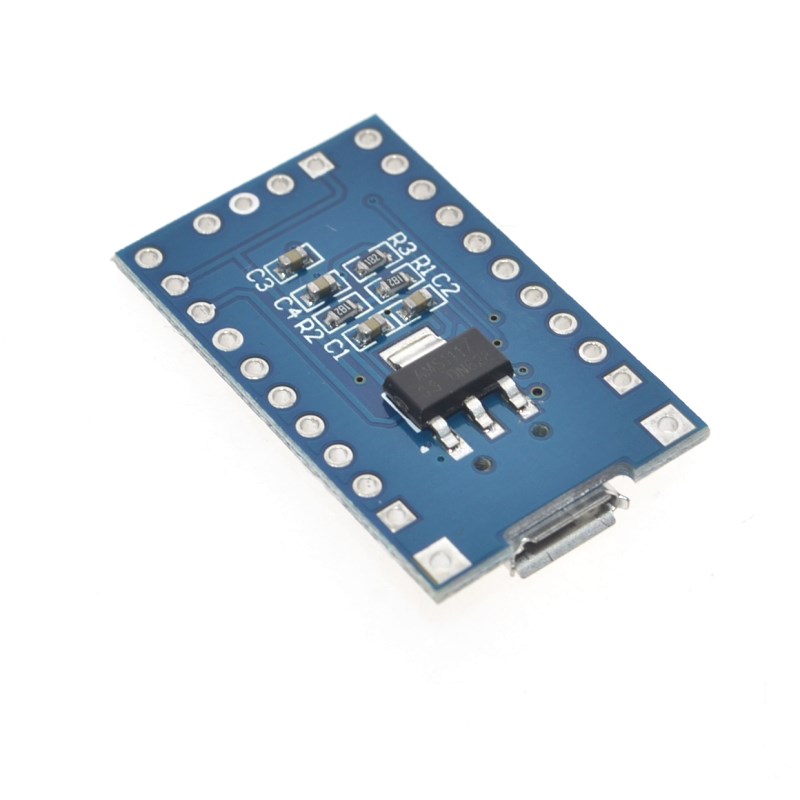
This is a minimum system board that includes the STM8S103F3P6 microcontroller plus all necessary supporting components: voltage regulator, reset circuit, decoupling capacitors, Micro USB connector, and breakout headers. The bare chip requires external circuitry for operation; this board is ready to use out of the box.

Q: How do I program this board?

You need an ST-Link programmer (ST-Link V2 or compatible). Connect the programmer to the board’s SWIM interface (typically 4 pins: VCC, GND, SWIM, RESET). Use STMicroelectronics’ STVP (ST Visual Programmer) or open-source tools like SDCC with stm8flash. The SWIM interface uses a single wire for programming and debugging, making it simple to use.

Q: Does this board have a bootloader? Can I program via USB?

No. Unlike many ARM-based development boards (e.g., Arduino), this STM8S board does not have a USB bootloader. The Micro USB port is for power only, not for programming. You must use an external ST-Link programmer connected to the SWIM header.

Q: What is the input voltage range and how should I power the board?

The board accepts 4.5V to 15V DC input via the power pads, or 5V via the Micro USB port. An onboard 3.3V regulator provides stable power to the microcontroller. Do not exceed 15V, as this may damage the voltage regulator. The 5V pins on the header reflect the input voltage, not a regulated output.

Q: What is the EEPROM endurance and data retention?

The integrated 640-byte true data EEPROM has an endurance of 300 kcycles (write/erase cycles) and data retention of 20 years at 55°C. This makes it suitable for storing calibration data, configuration settings, or user preferences that may be updated frequently.

Q: What development tools are available for this microcontroller?

Several options exist:

  • STVD (ST Visual Develop) – Free IDE from STMicroelectronics

  • COSMIC C compiler – Free for STM8 up to 32KB (limited edition)

  • SDCC (Small Device C Compiler) – Complete open-source option

  • IAR Embedded Workbench for STM8 – Commercial option with free size-limited version

  • STVP – Programming utility for flashing hex files

Q: What communication interfaces are available on this board?

The STM8S103F3P6 supports:

  • UART – Full-duplex serial communication (TX/RX)

  • SPI – Synchronous serial up to 8 Mbit/s

  • I²C – Two-wire interface up to 400 kbit/s
    All pins are broken out to the headers for easy connection to sensors, displays, and other peripherals.

Q: What is the difference between the STM8S103F3P6 and STM8S003F3P6?

These two microcontrollers are pin-compatible and have nearly identical features. The key difference is that the STM8S103F3P6 is the standard industrial-grade version, while the STM8S003F3P6 is a value-line version with slightly lower specifications in some areas. The STM8S103F3P6 is generally recommended for new designs due to better availability and documentation.

Q: Can I use this board with Arduino IDE?

Not directly. The Arduino IDE does not natively support STM8 microcontrollers. However, community projects like Sduino (STM8duino) provide Arduino-style wrappers and libraries for the STM8 family, allowing you to use a simplified coding approach with SDCC compiler. This is an option for developers familiar with Arduino but requires additional setup.

Q: Is this board suitable for commercial or industrial products?

Yes. The STM8S103F3P6 is rated for industrial temperature range (-40°C to +85°C) and is qualified for use in automotive and industrial applications. The minimum system board can be used for prototyping, and the design can be transferred to a custom PCB for mass production. Many businesses use this board for low-volume production runs (1-1000 units) due to its low cost and reliability.