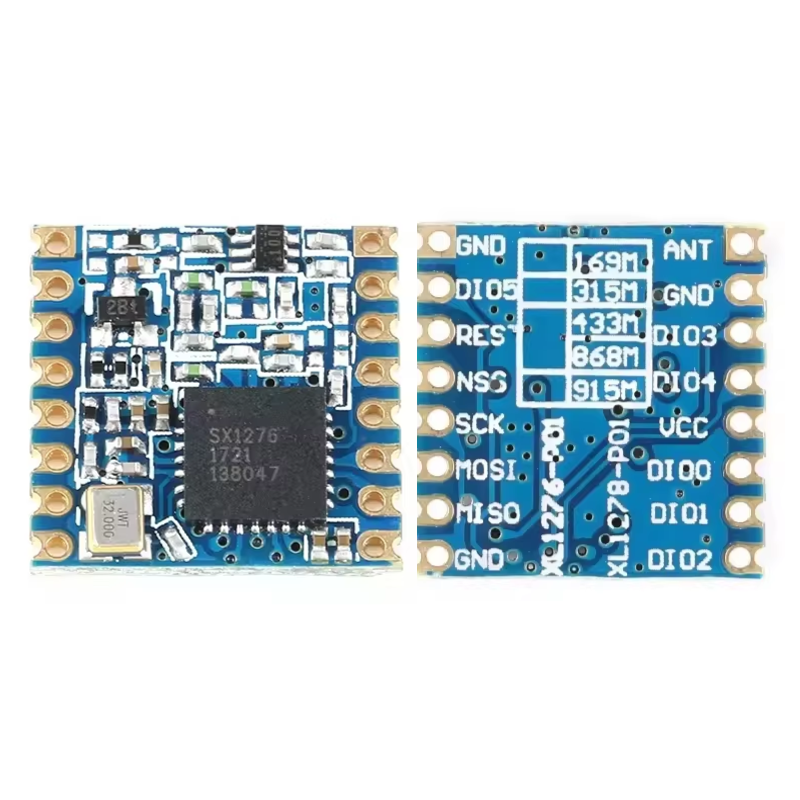
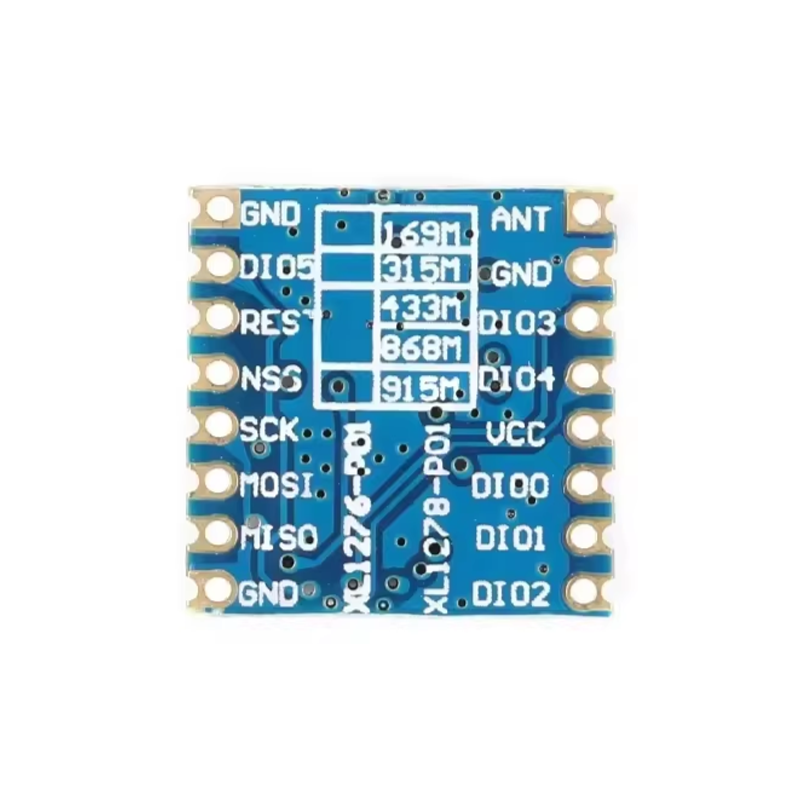
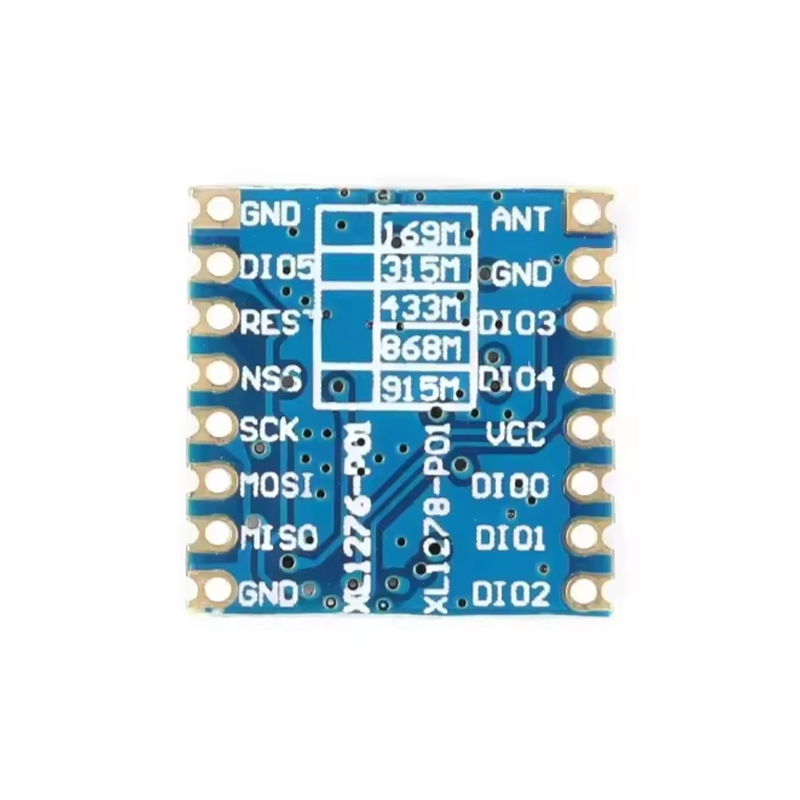
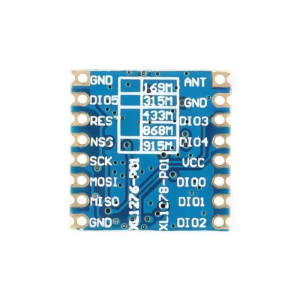
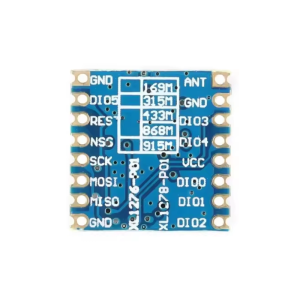
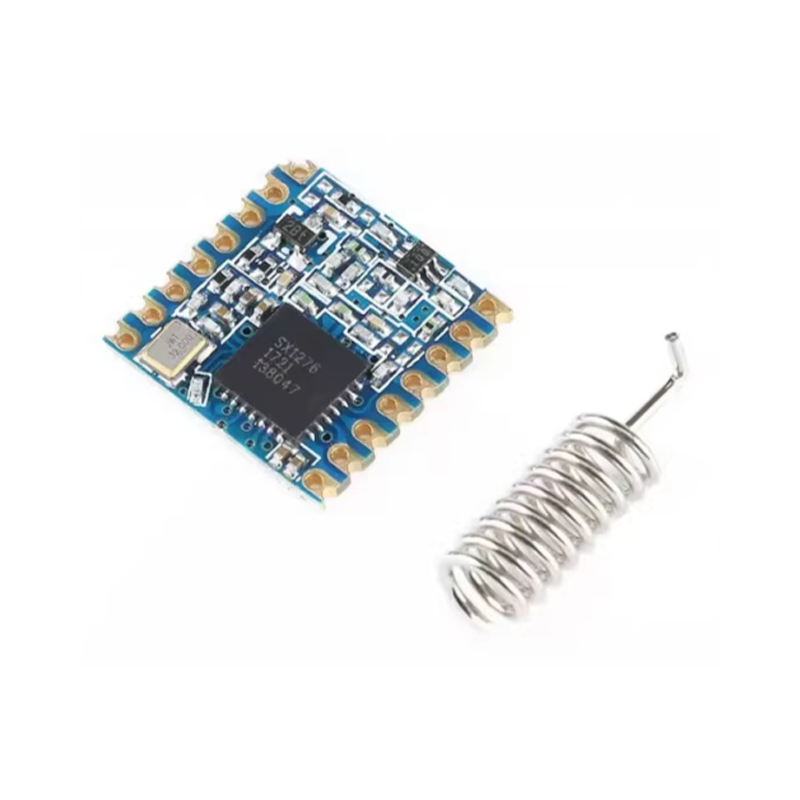
The SX1276 LoRa Long-Range RF Module is a high-performance wireless transceiver built around Semtech‘s SX1276 chip, designed for ultra-long-range spread spectrum communication with exceptional interference immunity and minimal power consumption. It is an ideal solution for power metering, industrial IoT, and remote sensing applications where reliable data transmission over long distances is essential.
At the heart of the module is the SX1276 LoRa modem, which utilizes Semtech’s patented LoRa modulation technique to achieve a receiver sensitivity of over -148dBm using a low-cost crystal and bill of materials. Combined with an integrated +20dBm power amplifier, this yields an industry-leading link budget of 168dB, making it optimal for any application requiring range or robustness. In ideal conditions, the module can achieve transmission distances of up to 15km in suburban areas with clear line-of-sight, and 2–5km in urban environments.
The module supports a wide range of modulation schemes including LoRa, FSK, GFSK, MSK, GMSK, and OOK, giving developers flexibility to balance data rate, range, and power consumption for their specific application. It features a programmable bit rate up to 300 kbps and a 127 dB dynamic range RSSI.
Power efficiency is a key strength. The module has a low receive current of 9.9mA and a register retention current of just 200nA, making it well-suited for battery-powered devices. For IoT and metering applications where devices must operate reliably for years on a single battery, this low-power design is critical.
The module operates across the 137MHz to 1020MHz frequency range, supporting both 868MHz (Europe) and 915MHz (North America) ISM bands (variant dependent). The 868MHz band is standard in Europe, while 915MHz is used in North America and other regions. Choose the variant that complies with your region‘s regulatory requirements. The module also supports FSK modulation for legacy systems, making it a versatile choice for mixed-technology deployments.
The SX1276 is pin-compatible with the SX1278, but optimized for the higher frequency bands. It features a 256-byte FIFO for packet handling, built-in CRC, and automatic RF sense and CAD (Channel Activity Detection) for reliable data transfer. The module is available in both SPI interface and UART interface variants for flexible integration.
Whether you are building an automated meter reading system, a wireless sensor network, or an industrial monitoring solution, the SX1276 LoRa module provides a proven, reliable foundation for long-range wireless communication.
Features
-
LoRa Long-Range Modem — Semtech’s patented spread spectrum technology for ultra-long-range communication
-
High Sensitivity — Down to -148dBm for reliable reception in challenging RF environments
-
+20dBm Output Power — 100mW constant RF output with integrated power amplifier
-
168dB Link Budget — Industry-leading link budget for maximum range and robustness
-
Multiple Modulation Modes — LoRa, FSK, GFSK, MSK, GMSK, and OOK supported
-
Ultra-Low Power Consumption — 9.9mA RX current, 200nA register retention
-
Wide Frequency Range — 137MHz to 1020MHz, supporting 868MHz and 915MHz ISM bands
-
Programmable Bit Rate — Up to 300 kbps for flexible data throughput
-
256-Byte FIFO — Built-in CRC and packet handling for reliable data transfer
-
Industrial Temperature Range — -40°C to +85°C operation for harsh environments
Technical Specifications
Usage
Getting Started
-
Power the module — Connect 3.3V to the VCC pin and GND to ground. Important: Do not use 5V, as it will damage the module.
-
Connect the SPI interface — Wire the module‘s SPI pins (SCK, MOSI, MISO, NSS) to your microcontroller’s SPI bus. For Arduino, typical connections are: NSS→D10, SCK→D13, MOSI→D11, MISO→D12.
-
Connect control pins — Connect DIO0 to a microcontroller interrupt pin (e.g., D2) for receive interrupt handling. Connect RST to a digital pin (e.g., D9) for module reset.
-
Install the LoRa library — In Arduino IDE, install the LoRa library by Sandeep Mistry through the Library Manager.
-
Configure the module — Set the frequency, spreading factor, bandwidth, and coding rate. Example: LoRa.begin(868E6) or LoRa.begin(915E6), LoRa.setSpreadingFactor(7), LoRa.setSignalBandwidth(125E3).
-
Test communication — Upload a basic transmit/receive sketch to verify operation. Ensure both modules use identical frequency, spreading factor, bandwidth, and coding rate settings.
Antenna Considerations
The module requires a 50Ω impedance antenna matched to the operating frequency. For 868MHz, a quarter-wave antenna is approximately 8.6cm long. For 915MHz, it is approximately 8.2cm. Antenna placement significantly affects performance — keep it away from metal objects and orient it vertically for best results.
Typical Applications
-
Automated Meter Reading (AMR) — Water, gas, and electricity meter data collection
-
Power Metering & Smart Grid — Remote monitoring of power distribution equipment
-
Industrial Monitoring & Control — Factory automation and equipment data transmission
-
Wireless Alarm & Security Systems — Long-range sensor networks for perimeter security
-
Long-Range Irrigation Systems — Agricultural sensor networks for remote field monitoring
-
Home & Building Automation — Smart home devices requiring extended range
Notes for Business Buyers
-
Proven Technology — SX1276 is a widely adopted LoRa transceiver with extensive documentation and community support.
-
Regulatory Compliance — Module variants are available for 868MHz (Europe) and 915MHz (North America) ISM bands to meet regional requirements.
-
Low Power Design — Suitable for battery-powered metering and sensor applications requiring multi-year operation.
-
Suitable for Bulk Purchasing — Ideal for IoT product development, metering infrastructure, and industrial deployments.
Q: What is the SX1276 LoRa module used for?
It is a long-range wireless transceiver for IoT applications including power metering, automated meter reading, industrial monitoring, and remote sensor networks.
Q: What is the maximum transmission distance?
In ideal conditions, the module can achieve up to 15km in suburban areas with clear line-of-sight, and 2–5km in urban environments. Actual range depends on antenna quality, obstacles, and environmental conditions.
Q: What frequency bands does this module support?
The module supports 868MHz (Europe) and 915MHz (North America) ISM bands (variant dependent). The SX1276 chip operates across 137MHz to 1020MHz.
Q: What is the difference between the 868MHz and 915MHz versions?
The 868MHz band is standard in Europe, while 915MHz is used in North America and other regions. Choose the variant that complies with your region‘s regulatory requirements.
Q: What is the difference between SX1276 and SX1278?
The SX1276 is optimized for higher frequency bands (868MHz/915MHz), while the SX1278 is optimized for lower frequency bands (433MHz). Both share similar architecture and are pin-compatible.
Q: What is the power supply requirement?
The module operates from 1.8V to 3.7V, with 3.3V being the typical supply. Do not use 5V, as it will permanently damage the module.
Q: What antenna should I use?
Use a 50Ω impedance antenna matched to your operating frequency. For 868MHz, a quarter-wave antenna is approximately 8.6cm long. For 915MHz, it is approximately 8.2cm.
Q: What development environments are supported?
The module is compatible with Arduino (using the LoRa library by Sandeep Mistry), STM32 (using Semtech’s SX12xx driver library), and other platforms with SPI support.
Q: What is the receiver sensitivity?
The receiver sensitivity is -148dBm in LoRa mode, enabling reliable reception of weak signals at long range.
Q: Can I purchase in bulk for product development?
Yes. The SX1276 module is suitable for both individual users and business purchasing, including IoT product development, metering infrastructure, and industrial deployments.