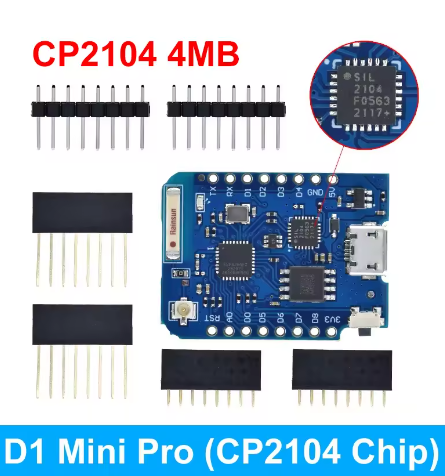
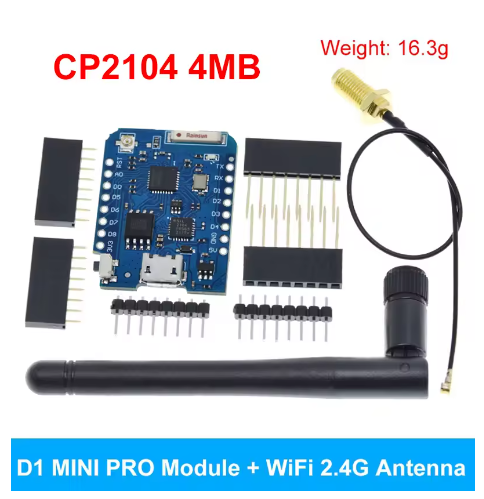
The Wemos D1 mini Pro V3.0.0 is a compact Wi-Fi development board based on the ESP8266EX microcontroller, designed for Internet of Things (IoT) projects. It features a 4MB flash memory, a micro USB interface, and uses a CP2104 or 2104 USB-to-UART converter chip for programming.
Key Features and Specifications
- Microcontroller: ESP8266EX
- Operating Voltage: 3.3V (5V power via micro USB is converted internally)
- Flash Memory: 4MB (some variants offer 16MB)
- Digital I/O Pins: 11 (support interrupt, PWM, I²C, one-wire, except D0)
- Analog Input Pins: 1 (max 3.2V input)
- Clock Speed: 80MHz/160MHz
- Connectivity: 802.11 b/g/n Wi-Fi (2.4 GHz)
- Antenna Options: Built-in ceramic antenna and an external U.FL antenna connector
- USB Interface Chip: CP2104 or 2104 (different versions may use CH340G or CH9102X)
- Compatibility: Arduino IDE, NodeMCU, and MicroPython
- Dimensions: Approximately 34.2mm x 25.6mm
- Additional Features: Onboard 500mA resettable fuse, and the ability to connect the deep sleep pin directly with the reset pin
The WeMos D1 Mini Pro V3.0.0 is a versatile, compact development board primarily used for Internet of Things (IoT) projects. Its small form factor, integrated Wi-Fi, and extensive GPIO pins make it ideal for:
- Smart Home Automation: Building custom smart plugs, light switches, or sensor hubs that connect to platforms like Home Assistant, openHAB, or a custom MQTT broker.
- Remote Sensor Monitoring: Deploying battery-powered temperature, humidity (e.g., using the DHT or BME series sensors), or motion sensors in hard-to-reach areas.
- Wi-Fi Mesh Networks: Creating decentralized communication systems using libraries like PainlessMesh due to its U.FL connector for an external antenna.
- Web Servers/AP Creation: Hosting simple web interfaces or creating a local Access Point (AP) for configuration screens for custom devices.
- Wearable/Portable Projects: Its small size and low power consumption (in deep sleep mode) make it suitable for compact, portable electronic projects.
Q: What is the main difference between the D1 mini V3.0.0 and the D1 mini Pro V1?
The D1 Mini Pro V3.0.0 typically has an upgraded internal design, sometimes featuring a newer USB chip like the CH9102X or CP2104 instead of the original CH340G, and better antenna configuration options. Both use the ESP8266 chip and 4MB of flash memory.
Q: Which USB driver do I need for the V3.0.0 board?
The specific version you have likely uses the CP2104 or 2104 chip as noted in the product description. You should download the drivers from the Silicon Labs website. If that driver doesn’t work, try the drivers for the CH340G or CH9102X, as component sourcing can vary slightly between manufacturers.
Q: Can I power this board with a battery?
Yes. The board is rated for 3.3V operation. You can power it via the micro USB port (5V input) or apply 5V directly to the 5V pin. The board does not have a built-in LiPo charging circuit, so you would need an external charger/protection circuit if using a single-cell LiPo battery.
Q: How do I switch between the ceramic antenna and an external antenna?
The D1 mini Pro usually requires a physical modification to switch antennas. There is typically a small surface-mount resistor (0 Ohm jumper) near the U.FL connector and the ceramic antenna. You must carefully move or desolder this resistor from its default position connecting the ceramic antenna and solder it to the position that enables the external U.FL connector.
Q: Is this board compatible with MicroPython?
Yes, the ESP8266 platform is well supported by MicroPython. You will need to flash the appropriate MicroPython firmware onto the board using a tool